Wednesday, November 30, 2016

Cats and Humans, Eating Birds

Margaret Atwood is perhaps the highest profile figure in what has become a widespread North American campaign to restrict cats to the indoors. In "The Case Against Cats" in the December issue of The Atlantic, Britt Peterson reviews Peter Marra and Chris Santella's Cat Wars: The Devastating Consequences of a Cuddly Killer, and asserts that cats are "bad for us, and for our planet." Reviewing the same book in a piece this fall in The New York Review of Books ("The Killer Cats Are Winning," September 29), Natalie Angier insists that it's a no-brainer that all cats should be forced to stay indoors, so that they will not be able to kill birds:
This is a ridiculous point to waffle on: pet cats should no more be allowed to roam around at will than should pet dogs, horses, pythons, or pot bellied pigs.
The reason is that domestic cats are alleged to be responsible for the deaths of "up to 4 billion birds" annually in the US.

That figure comes from a 2013 Smithsonian Biology Institute study, conducted under the direction of Marra. Previous estimates had been in the range of 500 million birds; Marra's study put the range at "between 1.3 billion and 4.0 billion." Marra is clearly not impartial on this issue, and so far as I'm aware, neither the 1.3 billion nor the 4.0 billion figure has subsequently been given credence by other scientific studies. But let's say that his numbers are accurate--and then let's ask where our efforts to save birds and other animals should be concentrated.

On the one hand we have a species--the domestic cat--that is by nature carnivorous. The digestive systems of cats, biologists tell us, are such that these animals cannot choose not to eat the flesh of dead animals. If a domestic cat does not catch and kill its own meat, then it must be fed meat from animals that we humans have caused to have killed. One way or another, it must be a carnivore.

On the other hand we have a species that can choose to abstain from eating other animals (and that will be perfectly healthy if it does so--indeed, much more healthy than if it consumes animal products). Yet most members of this species choose a diet that involves the wholesale killing of members of other species. Moreover, in order to minimize their own expenditure, they confine the animals whose flesh and milk they will consume, keeping them in horrific conditions throughout their lives.

The species that must eat meat is said to be responsible for killing between 1.3 and 4 billion birds in the United States annually.

The species that can choose not to eat meat or other animal products is quite certainly responsible for killing more than 18 billion birds annually in the United States--plus hundreds of millions of cows, and pigs, and other animals. And virtually all of those 20 billion or so animals are subjected to horribly cruel treatment through their lives before the humans have them killed.

Is there a priority here? Of these two species, which should we focus on if we are trying to reduce suffering for other species?

The issue of cats killing and eating birds is not trivial. But it pales beside the much, much larger issue of humans killing and eating birds and other animals. Before we blame humans who choose to keep cats who will sometimes kill and eat birds, let's put the larger share of blame where it belongs--on humans who choose to kill and eat birds themselves, and to kill and eat other animals, all of it cruelly, and all of it utterly, utterly unnecessary.

Thursday, November 24, 2016

New Canada Food Guide - Input Needed

For the first time in many years the Canadian government is revising the advice it offers to Canadians on what we should eat. In the current food guide, two of the four food group categories are consumed by animal products. Mercy for Animals and other organizations working to improve the lives of animals (human and otherwise), and to improve the life of the planet, are asking us all to go the the Health Canada website and provide our input. They have provided one template for answering some of the key questions. I'll provide another below in the hope that it may be useful. But please act now; the website questionnaire is open only until December 8.

To find the questionnaire, google Canada Health Guide Questionnaire.

You'll find the following among the questions:

Would healthy eating recommendations based on the level of processing of foods be helpful to you?

Yes

Why do you say that?


There is now a huge amount of evidence that a whole foods, plant-based diet is the best way to go. The "plant-based" part is vitally important; as the scientific evidence which nutritionfacts.org and pother sites are continually presenting and analyzing clearly indicates, eating animal products is bad for our health in myriad ways (increased risk of cancer, diabetes, heart disease, stroke, and on and on). But the "whole foods" part is important too; processed foods tend to be less nutritious in many ways.

To what extent are the current food groupings (vegetables and fruits, grain products, milk and alternatives, meat and alternatives) useful to you?

Not at all

Why do you say that?


The current categories are absurdly weighted in favor of foods that are bad for our health, bad for the environment, and horrendously bad for our fellow creatures. Two of the four categories foreground eating the flesh or the milk of non-human animals--the consumption of which has been conclusively shown to be associated with increased risk of myriad health problems, from cancer and diabetes to heart disease. (Plus, the factory farming methods that produce today's meat and dairy products are horrible for the environment and endlessly cruel to cows, pigs, birds, and so on.)

If animal products are to be included at all, they should be included in a single category of foods that may provide some nutritional benefits but that have huge health risks and other negatives associated with them.

The recommended categories should be as follows:

vegetables (possibly sub-divided into leafy and root vegetables); legumes (or pulses); fruits; nuts and seeds; grains

Rather than including things such as soy milk as "alternatives to milk" or such things as tofu as "alternatives to meat," they should be presented in a category of healthy foods that is separate from any category of animal product.

What else can Health Canada do to help improve the uptake and use of its healthy eating recommendations?

Don't presume that it would be "too extreme" to tell Canadians the truth about the damage we are doing to ourselves by eating animal products, when we'd be so much healthier if we didn't.

Help to make being vegan a mainstream concept, so that (to pick just one example) restaurants would start to be embarrassed if they didn't offer vegan options.

Vitamin information should be included: Anyone over 50 should take a B12 supplement; anyone in Canada should take a Vitamin D supplement; anyone over 50 should either eat plenty of goji berries or take a multi vitamin that includes lutein and xeaxanthan to help prevent macular degeneration; those who eat little or no citrus fruit know should know that vitamin C supplements are not a sufficient substitute; vegans should take Vitamin B12 supplements, etc., etc.

[Much as I was tempted, I did not suggest including beer as a separate, recommended food group. It's under the grains, I guess.]

Saturday, July 16, 2016

Reading Animals and Eating Animals:A Micro-Study of the Capacity of Literature to Spark Change

Many thanks to those who responded to the questionnaire posted on this blog a few months ago. The results are reported in the paper below (the full version of which, including footnotes and appendices, has been posted on SSRN as well).


Reading Animals and Eating Animals:A Micro-Study of the Capacity of Literature to Spark Change (Paper presented at the Annual Conference of the Northeast Modern Language Association Conference, Hartford, March 18, 2016)
Don LePan, with Maureen Okun, (Vancouver Island University)
To what degree is the experience of reading literature capable of affecting humans in ways that have ethical implications? A very substantial body of research in this area (by both literary scholars and psychologists) has focused on empathy; does reading a work of fiction tend to enhance our ability to relate emotionally to the lives of others? Some studies suggest it may well do so in certain circumstances—but some studies have also suggested that any such effect may be transient.

But what of literature’s capacity to bring about social change? To what extent can fiction change hearts and minds about real world issues? And can the effects be long-lasting? It has often been said that novels such as Uncle Tom’s Cabin and The Jungle caused significant changes in many readers’ attitudes—and in many readers’ behavior. But there is surprisingly little hard evidence that this is so. There can be no doubt that such works helped to bring change, but studies of their impact sometimes suggest that they did so not so much by directly changing attitudes as by providing encouragement to the already committed, and by heightening the level of controversy.

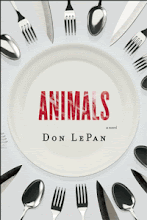
One recent novel written with the explicit purpose of helping to bring about social change is my own Animals: A Novel (Véhicule Press edition 2009, Soft Skull/Counterpoint edition 2010); that book aims to engage readers imaginatively over the issue of cruelty in factory farming. In the seven years since the book was published, dozens of people have reported in conversation that they found the experience of reading the book quite powerful; several have reported in writing that the experience helped to change their attitudes, their behavior, or both.

The present study seeks to broaden the range of respondents, and also to go beyond the anecdotal. I contacted as many readers of Animals as possible, and asked them to complete a survey concerning the effect the experience of reading the book has had on their behavior, and on their attitudes. All responses were provided anonymously. The hope was that the survey results would quantify in a somewhat more scientific fashion than the anecdotal responses had done the degree to which the experience of reading this literary work has contributed to specific changes in attitudes (and/or behavior) on the part of readers—and also the extent to which any changes have been lasting.

Let me turn first to what the respondents say on the question of attitudes—the eighth and last question on the survey. Here the results seem unequivocal: 65% of those answering this question (and 59% of all respondents) indicated that the experience of reading the book had contributed either “to a considerable degree” (35%) or “at least to some slight degree” (30%) to an increase in their level of concern for the welfare of non-human animals.

Attitudes are one thing; behavior is quite another. One may come more and more strongly in one’s belief system to be in favor, for example, of ending slavery while still—until the day that happens—remaining a slave-owner oneself. And one may be in favor of ending the cruelties of factory farming while continuing to consume the products of that cruelty every day. But it would seem from the answers to questions 5 and 6 that the experience of reading Animals had just as much of an effect on behavior as on attitudes: 70% of those answering Question 5 (and 64% of all respondents) indicated that the experience of reading the book had contributed either “to a considerable degree” (15%) or “to at least some degree” (55%) to this change. Moreover, 65% of those answering Question 6 (and 59 % of all respondents) indicated that the experience of reading the book had contributed to a lasting effect on their behavior.

“Lasting for how long?” one may fairly ask. Here too the survey results provide a fairly clear answer. The vast majority of respondents were people who had read the novel at least three years before responding; fully 90% of respondents read the book either when it first appeared in 2009-2010 (73%) or in the years 2011-2012 (18%). The survey is thus able to provide useful information as to how lasting the effect may have been—as would not have been the case if, for example, 90% of respondents had read the novel less than six months before responding.

Questions 2, 3, 4, 5, and 7 are designed to explore with more precision first, the question of how long lasting any effect on behavior may be; and second, the question of the degree to which respondents’ behavior has actually changed. Questions 2, 3, and 4 ask the same set of questions for different times: before reading the novel, six months to a year after reading the novel, and today (which, for 90% of respondents, is at least three years after reading the novel).

What is perhaps most striking in the answers to these questions, given the high percentages of respondents who reported changed behavior, is how little actual change in behavior is reported. Particularly given that the sample responding to the survey is almost certainly skewed towards readers who were strongly influenced by the book, one might have expected there to be a more dramatic shift. The shifts indicated here are relatively modest. In percentage terms, the reduction in those describing themselves as in one of the two categories least concerned about animal welfare may be striking—the number drops in half—but when the absolute numbers are from 6 respondents to 3 respondents, it’s hard to portray the change as earth-shattering. Nor is the change at the other end particularly dramatic—the number reporting themselves to be either vegetarian or vegan increasing from 7 to 9, or from 31.82 to 40.91 per cent of the total. Those in the middle—omnivores who “to a considerable degree” limit their consumption of animal products “for reasons relating to the treatment of non-human animals” continue to constitute the largest block. The composition of that block has presumably shifted over time, with some of those who have moved out of the lowest two groups entering this larger middle group, as those who become vegetarians or vegans leave it. But there is also, of course, a good deal of space for movement within the large, middle group. One may move from eating free-range meat frequently to eating meat only if it is free range (and from a farmer one trusts to treat the animals well before they are killed), and still stay within that broad, middle category. One may move from very occasionally choosing dairy products that one knows are from organic farms where the cows are treated well to consuming dairy products only if those conditions are met—and again, stay entirely in that broad middle category. One respondent emailed me after she had completed the survey to comment on this sort of nuanced point:
The survey is lacking some possibilities, as you probably know. For instance, I experimented with vegan products, but I couldn't develop a taste for some of them. Nevertheless, I try to make more vegan choices in my diet, and buy only organic products (particularly milk) approved by Natural Grocers. … [I]t was not solely reading your book that caused these changes, though it is very powerful.
The answers to Questions 2, 3, and 4, then, are consistent with the responses given to Question 7. The reported changes in behavior are not always large, and the degree to which the experience of reading Animals contributed to those changes is not always great. But for most respondents there was a change, and for most respondents the experience of reading the novel did contribute to that change.

That is to put everything in the past tense. We should look too at the responses to Question 7: might the experience of reading Animals contribute to some future change in behavior for readers? Very interestingly, 6 people—some 30% of the total number of respondents—thought it quite possible that the experience of reading Animals would contribute to some future change in their behavior—and a further 7 did not rule out the possibility entirely. In total, then, some 65% of respondents did not rule out the possibility that the experience of reading a book could influence their behavior in the future. If we recall here the results of Question 1, we realize that of those 13 respondents, at least 11must have read the book in 2012 or earlier—at least three years before completing this survey. And a number of those people had clearly been altering their behavior already, in part at least as a result of the experience of reading this text. Even three, four, or five years after reading a book, in other words, many think it still possible for the experience of reading a novel to exert a further effect on their behavior.

This may seem implausible—I would have thought it implausible myself many years ago. But in fact it accords entirely with my own experience—with both fiction and non-fiction. It was I think in 1991 that I read Peter Singer’s Animal Liberation. This was my introduction to the atrocities of factory farming; I was shocked, and I am sure deeply influenced. But to what extent did I change my behavior? At first, not at all. And when changes in my behavior did come, they were very gradual; beginning in the late 1990s, I began to eat free-range meat and free-range eggs when I could, and dairy milk from cows who I believed to have been relatively well treated. In the early years of this century I became more and more passionate about the evils of factory farming. In 2005 the outline of a story that could dramatize those evils came to me, and I began working on Animals. When the novel was published in 2009 I still believed that the novel’s essential argument was against factory farming—not against eating animal products. A number of readers suggested that in fact the afterword I had written went against the grain of the story—that Animals constituted an argument not just against the evils of factory farming, but against the human practice of consuming other animals. Over the years since then, I have come to agree with them. (When the next edition of Animals is published, it will carry a very different afterword—or no afterword at all.) Both with my experience of reading Animal Liberation, then, and with my experience of writing Animals, I found that experiencing a book could continue to affect my behavior many years afterwards. * * * For most of the past two centuries the tide in literary criticism and theory—indeed, in literary circles of all sorts—has run heavily against didacticism. Interestingly, even those who have endorsed the notion that all literature is political have been carried with the tide; if a book is described as a powerful political statement, that may safely be taken to mean simply that the book embraces a world view broadly critical of establishment values—not that the book aims to prompt us quite specifically to change our behavior (to devote more time and money than we have been to helping the homeless, for example, or the poor in the developing world, or young women who are being denied an education, or gays and lesbians who in so much of the world are still denied any rights whatsoever).

Elizabeth Gaskell’s Mary Barton, on the other hand, or Anna Sewell’s Black Beauty, or Upton Sinclair’s The Jungle, are political in a very different sense; like Animals, they were written with the intention of changing readers’ attitudes–and behavior—in quite specific ways. They are examples of literature that is not just political, but didactic. There are some signs that the tide in literary circles is beginning to turn. Black Beauty and The Jungle now appear frequently on university courses—as works of aesthetic as well as historical interest. And some of the leading lights of literary criticism and theory have begun to openly acknowledge the possibility that didactic literature can also be good literature. Here, for example, is Terry Eagleton, writing in 2012:
That even a touch of didacticism is distasteful is as received a judgement for the literary establishment as is the suggestion that Shakespeare wrote some pretty impressive stuff. But it is surely not the case [that didacticism should be regarded as inherently distasteful]. “Didactic” simply means a matter of teaching and there is no reason why all teaching should be hectoring or doctrinaire. Brecht’s Lehrstücke, Lancelot Andrewe’s sermons, and William Blake’s Proverbs of Hell are didactic works which are also potent pieces of art. Uncle Tom’s Cabin is not an embarrassingly second-rate novel because it has a specific moral purpose—so does Swift’s “A Modest Proposal,” Tolstoy’s Resurrection, and Orwell’s Animal Farm—but because of the way it executes it. (The Event of Literature, 68-69)
Yet Uncle Tom’s Cabin is widely assumed to have succeeded in its didactic purpose at least as well as did any of these other works. Is Eagleton wrong about Uncle Tom’s Cabin? Is it, as some others have suggested in recent years, a far better novel aesthetically than the twentieth century took it to be? Or, if Eagleton is right, does bad literature work best when it comes to doing good? Those are some of the larger questions that seem to me to be worthy of discussion. But to do so in an informed way, it seems to me that we should try to find out more about what literature can actually do by way of changing human attitudes—and human behavior. This paper represents a very small step in that direction.

Tuesday, June 7, 2016

Student Protests and the Media: Why Have Trigger Warnings Trumped Tuition Fees?

The latest New Yorker carries a long article by Nathan Heller entitled “What’s Roiling the Liberal-Arts Campus.” Unlike the widely-read Atlantic article by Greg Lukanioff and Jonathan Haidt published last September (“The Coddling of the American Mind”), this one takes a largely positive view of campus unrest over a wide variety of issues, ranging from trigger warnings to college administrations’ treatment of people of color, people with disabilities, and people with sexual orientations that may not fit traditional categories. Whereas Lukanioff and Haidt, focusing largely on the trigger warnings controversy, fret in the Atlantic over whether students are too “coddled” and ask if calls for trigger warnings might spark a threat to academic freedom, Heller suggests that the “Firebrands,” as he calls today’s crop of protesters, are re-setting norms and may be “shifting the default settings of political culture.” But both articles seem to agree that what’s happening represents something fundamentally new—and something that’s becoming very widespread.

There are indeed some new and interesting things happening in many of these student protest movements (and perhaps some worrisome ones too, not least of all insofar as a seeming rise in anti-Semitism at many campuses is concerned). But how widespread are these sorts of radical protests over new sets of issues? Read these articles closely and you’ll see a very few campuses mentioned again and again. Repeatedly, it’s suggested that “America’s colleges and universities” generally (Lukanioff & Haidt) are being greatly affected by a new movement—or at the very least “the liberal-arts campus” (Heller) is undergoing something of a revolution. But the evidence provided is almost entirely anecdotal, and the same fifteen or twenty colleges—Oberlin, Amherst, Northwestern, and so on—crop up again and again in the examples. Fifteen or twenty out of well over 2,000. Maybe they are indeed representative—but where are the numbers? How widespread is all this?

Heller tells us that “when Wesleyan’s [student] newspaper published a controversial opinion piece questioning the integrity of the Black Lives Matter movement, some hundred and seventy people signed a petition that would have defunded the paper.” So there’s a number—170 students. Quite a few, perhaps, but to put it in another way, a little over 5% of Wesleyan’s student population of about 3,000.

In the previous paragraph Heller gives another number: after mentioning various controversies “in mid-November” of 2015 over racial and cultural issues at Yale, Claremont McKenna, and Ithaca College, Heller asserts that “more than a hundred other schools held rallies that week.” That number seemed surprisingly large to me. Granted, it would still be far, far smaller than the 500 or more campuses at which there were sometimes simultaneous demonstrations in the Vietnam War era. But my sense (as someone who spends a fair bit of time on a number of American campuses each term) was that, rightly or wrongly, the protests over these racial and cultural issues had been nothing like so widespread.

I googled, of course. There had indeed been that at least that many “mid-November” student protests—but the great majority of them had nothing to do with racial or cultural issues. So far as the number of protests are concerned, here’s the key November 12 news item (as phrased by the Reuters report): “Students hold demonstrations on university campuses across the United States to protest against ballooning loan debt for higher education and rally for tuition-free public colleges.” A worthy cause, I’d say, but not one that most people would automatically connect with protests about insensitive treatment of racial issues or inadequate trigger warnings—and not one that Heller focuses on in his article (though he does touch on the effects of economic hardship for some students).

One can argue, of course, that everything is connected—that every issue of class and education and race and sexual orientation and culture and the economy can be linked with every other issue, including high tuition fees and inadequate student loans. (Interestingly—and to their credit, I would say—the Million Student March of November 12 also called for an increase in wages for campus workers.) Arguably, though, explorations of the issues start to lose focus if they are trying to deal simultaneously with movements as disparate as the push for trigger warnings and Black Lives Matter. And certainly such explorations will leave a misleading impression if they reference the total number of student protests at a given time but neglect to mention that the majority of these protests were over an issue that the writer has not listed.

Heller is not alone in giving short-shrift to the issue of economic hardship for students. The New York Times carried several articles on culture-related and race-related student protests that week (including a November 15 1,600-word feature article on how a dean at Yale had been “Racked By Racial Protests” at that university), but—so far as I could see—no coverage at all of the large countrywide protests Thursday, November 12 over student loans and tuition fees. The Wall Street Journal seems not to have covered those November 12 protests either—though they too carried articles on culture and race-related student protests that week, and an op-ed feature with a predictable slant: “The Rise of the College Cry-bullies: The status of victim has been weaponized at campuses across the nation.” Elsewhere too, those November 12 protests seem to have received relatively little coverage in the media—though at least brief reports did appear in the Washington Post, USA Today, and Newsweek.com, among others. Overall, though, it would seem that the largest cause of student unrest in America is also the one that the media is giving the least attention.

I certainly wouldn't want to argue that protests over Black Lives Matter or gender issues or sexual orientation issues deserve any less coverage than they've been getting; all are important. But I would argue that the protests over the issue of the cost of higher education deserve more coverage. And if Hillary Clinton wants to improve her chances of getting young people out to vote and defeat Donald Trump, one would think she'd be well advised to pay a good deal of attention to this issue herself in the coming months.

Saturday, May 21, 2016

Reading and Writing and Work

Last year I was fortunate enough to have the opportunity to edit John Bart’s novel Middenrammers, which has now just been published. I should say at once that it required very little by way of editing—and that it was and is a very great pleasure to read.

It’s easy to forget the virtues of simplicity in the world of today’s literary fiction—a world that tends to place a premium on certain forms of literary stylishness. At a sentence-by-sentence level, striking metaphors are often disproportionately valued, as are sentences designed to impart vividness through every verb, every adverb, every adjective. We are assured that such work will repay slow and careful reading, that it is worth taking the time to reflect on the poetic qualities of what we read.

At the level of narrative structure, complexity is often disproportionately valued—flashbacks, flash-forwards, and various other devices that often force the reader to spend a good deal of time figuring out what happened when, and to whom (or perhaps I should say what happens when, for the historical present has largely taken over between the covers of literary novels). Again, we are assured that the effort invested will be repaid; at some level, we are often told, the novel we are reading is not just about the characters, or about the things novels used to be about—love and money—but “about language itself,” or “about memory itself,” and it’s worth taking the time to work all that out.

At some level, certainly, all this is work; “literary fiction” might well be defined as “fiction the reader is expected to work at appreciating.” That’s not to say that such work can’t also be a pleasure, of course; indeed, there can be few greater pleasures than reading a great literary novel. But when a literary novel is less than great—and such is the case most of the time—the reader can surely be forgiven for wondering if the work is worth it. When the sentences start to creak with the strain of all that vividness imparting, and the tangles in the narrative start to seem as pointless as they are dense, we can be forgiven for wishing we had opted instead for a book that aimed to please without making us work.

Stylistically, Middenrammers does precisely that. It tells its story straightforwardly, from beginning to middle to end—and a gripping story it is, too; a doctor and a midwife take sides against the medical establishment in a 1970 Yorkshire community where women still struggle for reproductive rights. At a sentence-by-sentence level the narrative never calls attention to its style. Descriptions—including several memorable descriptions of crises being dealt with as women give birth—are entirely matter-of-fact; metaphors are rarely employed, and even adjectives and adverbs are used sparingly. About as close as the book comes to a “poetic” passage is this nicely understated end-of-chapter description of the book’s protagonist leaving the hospital after a difficult delivery:
I was surprised to find it was evening outside. The rough grass at the edge of the path to the prefabs was wet. Perhaps it had rained. Perhaps it was just sea spray. The standard lamps along the way had a stippled halo around their bulbs. Everything looked washed and worn, and I felt the same.
If Middenrammers is straightforward so far as its style is concerned—an easy read, from that angle—its subject matter certainly does not always make for easy reading. The story is emotionally wrenching at more than one point, and it certainly carries with it an important message about medical practice. Though the style doesn’t make readers work, in other words, we may have to work a bit to come to grips with the novel’s content.

I want to make one more point about Middenrammers and work—which is simply to say that the novel concerns what happens at work far more than do most novels. (Television programs deal with the workplace a good deal—literary novels, not so much.) Most novels in any era—and certainly most novels of the past few decades—foreground personal relationships outside the workplace. Love and money are the traditional topics of the novel, not love and work. To be sure, personal relationships are part of the story of Middenrammers too—but the heart of the novel is what happens at work—in this case, at a small Yorkshire hospital.

The closest literary analogy to Middenrammers I can think of is the fiction of Nevil Shute—novels such as Landfall (about the struggle to develop better planes during WW II) and The Ruined City (about the struggle to revive a shipbuilding town that has fallen on hard times). Like Bart, Shute wrote in an utterly matter-of-fact style; like Middenrammers, these novels of his deal with personal and romantic relationships as well as business and professional ones. But in all these cases, the work developments are at least as important to the progress of the story as are the personal ones.

Like Shute’s novels too, Bart’s Middenrammers is entirely engaging—and no less well-written for being written with clarity and simplicity.

Let me end with a thought about writing and work more generally: writing and work can go together far better than many aspiring writers assume. By “work” in this context, I mean of course work other than writing—but, more than that, work that you find truly engaging (not “day jobs” that you don't care about and work at only in order to give you time and money to write). Working at something you care about can of course provide raw material for your writing—and for most of us, it beats sitting at a desk staring at blank paper when you’re finding creative writing difficult. But arguably it can also help develop habits of caring about life in a broader variety of ways than can a more purely writer’s life. It’s surely not coincidence that both Bart and Shute, who write so well about work, did not make writing their life’s work. (Though he became a best-selling novelist later on in life, Shute worked in aviation and as an engineer for several decades; Bart has worked as a doctor for over forty years.) Young writers sometimes assume that the key to success as a writer is to find time to write—the ideal being a position in a Creative Writing Department that does not impose too heavy a teaching load. It’s certainly true that some fine writers have followed that route—and remained fine writers even after having done so. And of course many great writers—Jane Austen perhaps chief among them —never took paid employment of any sort at any time. But the body of work done by writers who worked at work other than writing is pretty impressive; among them are Geoffrey Chaucer the comptroller and diplomat, Anton Chekhov the doctor, Joseph Conrad the sea captain, George Eliot the periodical editor, T.S. Eliot the banker, Henry Green the industrialist, Thomas Hardy the architect, Philip Larkin the librarian, Wallace Stevens the insurance executive, Virginia Woolf the publisher, and Anthony Trollope the Post Office inspector. Whatever works for you, I say.

PS One related idea is simply that having some experience in the world helps when writing fiction. On that theme there was an interesting piece in the Globe recently--Want to write a novel? First Novel Awards finalists say it's better with age (April 16).

Tuesday, April 26, 2016

Ownership and the Long Term: The Case for Bombardier and the C Series

If there is one thing on which every mainstream commentator on the Canadian economy and Canadian politics has agreed over the past year, it's that Bombardier’s dual share structure, which allows the Beaudoin family to control the fortunes of the company even though they hold a minority of its equity, is bad for the other shareholders, and bad for Canada. The near-universal consensus* has been that the federal government should make any investment in Bombardier’s fortunes contingent on the company abandoning its dual share structure, and treating all shares equally.

Intuitively it all makes sense. Equal has to be good, right? And Bombardier’s other shareholders probably would have benefited in the short term if the company had, for example, sold off its train division last year, or sold the C series to Airbus. (Both sorts of deals were said to be on the table.)

But what about the long term? Where would the shareholders be? Where would Canada be? Without its biggest contributor to R&D, for one thing. Bombardier’s investment in research and development totals about $2 billion a year—one sixth of all R&D spending in the entire country. Canada would also be without its only big league player in the aerospace industry. And Canada would be without a company that is making a larger contribution to greening the world economy than almost any other corporation in the country; the appeal of the C series is very largely that it uses far, far less jet fuel than the average plane today—and less than its new competitors from Airbus and Boeing and Embraer too.

For the fact is that, without the dual share structure which has enabled Bombardier to remain in family hands, Bombardier in all likelihood wouldn’t be in Canadian hands at all. When its share price kept falling and falling in 2015 until the company’s shares were selling for bargain basement prices, a Chinese company would surely have snapped up not just the rail division, but the entire company. Or Airbus or Boeing would have done so, simply to kill the competition. Or a takeover specialist such as Carl Icahn would have orchestrated a buyout.

For Bombardier shareholders like me, who are in it for the long term, it’s a very, very good thing that the company has remained in family hands, and that they have taken the long view. Have there been mistakes? Sure? Is the C series late and over-budget? Sure. Those things are true of virtually every major project that any ambitious company takes on. But the company seems to have a great management team in place now, and—most importantly—they have succeeded in developing an absolutely superb plane. Before long they will again come to be acknowledged as a company responsible for some of Canada’s greatest technology and manufacturing successes.

If Canadians really do want the country’s economy to be about more than resources, this is a company we do not want to die. And if people everywhere want air travel to be more environmentally friendly, we should be grateful that Boeing or Airbus hasn’t been able to drive Bombardier and its C series out of business.
*The only places I've seen any other views expressed have been posted a few comments on sites such as stockhouse.com, and of course in Bombardier's own statements

Tuesday, February 2, 2016

The Wrong Kind of Animals

The lead-in for the CBC Radio news this morning gave advance notice of a featured story: "Snare traps in British Columbia are catching the wrong kind of animals." As the story reported, snares set on Crown land near residential areas have been catching dogs rather than the wild animals for whom they were intended. Randy McNolty's dog Almoe is pictured on the CBC site, having evidently died a cruel and painful death in the trap:

Dog snared in wildlife trap prompts call for tighter laws http://www.cbc.ca/news/canada/british-columbia/dog-snared-in-wildlife-trap-prompts-call-for-tighter-laws-1.3429418

As a society, do we really think there is a right kind of animal to die in this sort of way? The law allows--some would say encourages--this sort of killing of a fox or a lynx or an otter or a muskrat or a marten or a bobcat or a coyote--or any one of ten other species of animal.

Are human beings the right sort of animal to be doing this--or to be allowing this?

Sunday, December 6, 2015

Reading Animals and Eating Animals

Can literature change hearts and minds about real world issues? And can such effects be long-lasting? It is often assumed that novels such as Uncle Tom’s Cabin changed readers’ attitudes. But there is surprisingly little hard evidence that this was so—and some have suggested that such novels may have facilitated change less by changing attitudes as by providing encouragement to the committed.

As part of a session at the NEMLA (Northeast MLA) conference in March 2016 (organized by Laura Struve and Ursula McTaggart and entitled "Literature that Sparks Social Change"), I'll be giving a paper that focuses on the degree to which the experience of reading Animals may have contributed to changes in attitudes and behavior for some readers. I'm hoping you may be willing to help.

I've now posted a short questionnaire on this topic that my partner, Maureen Okun, helped me put together. Responding should take no more than a couple of minutes; I'd be very grateful indeed if you may be willing to answer the 8 multiple choice questions. The questionnaire has been posted through Survey Monkey, and they will tabulate the responses. All answers are anonymous; neither nor anyone else will be able to see how you responded.

Here's the survey; I do hope you'll check it out!

Create your own user feedback survey

Sunday, November 29, 2015

Flattening the Past: The Recent Controversy over Woodrow Wilson as a Case in Point

Recent protests at Princeton concerning the ways in which that university honors Woodrow Wilson have elicited an extraordinarily vituperative response. The essentials of the case seem to be as follows: historical research has drawn attention to the prominent role Wilson played in purging the American civil service of African Americans (except from the most menial positions); in keeping any African American out of Princeton while he was president of that university; and in preventing the League of Nations from adopting a proposed racial equality principle. In response, some students at Princeton have demanded that the Woodrow Wilson School of Public and International Affairs be renamed, and that a Princeton residence named in Wilson’s honor also be renamed.

Predictably, many have rushed to attack the students—and in doing so have missed some of the most basic points about such debates about historical figures. Some declare vehemently that we must not try to “stamp out history”—as if the protesters were demanding that Wilson’s legacy not be discussed, rather than demanding he cease to be singled out for special honors at the institution. As Karen Attiah rightly put it in her November 25 Washington Post column on this topic,
Of course [such figures as Wilson and Cecil Rhodes] will never be erased from history; nor do they need to be. But in forcing their sins into the international limelight, universities, and society by extension, must reevaluate the lionizing of such men.
Others who attack the students’ demands emphasize the “nobody’s perfect” argument—pointing to the public and private flaws in everyone from George Washington to Martin Luther King, and suggesting that, by the protester’s logic, there is absolutely no one truly worthy of honoring.

While it is of course true that no one is without flaw, it is also true that, when we are judging public figures, large matters of public policy are more important than personal peccadilloes; that some have fewer flaws than others; that the achievements of some are greater than those of others; and, in the other direction, that the damage done by some is far greater than the damage done by others.

But how are we to judge fairly who should be honored and who is perhaps not so deserving of being honored? Another refrain of those attacking the Princeton students is that (to quote one comment in response to Attiah’s column), people such as the Princeton students must “stop demanding that historical figures be judged by the standards of today rather than by those of their own time.” One hears this said, of course, on almost every occasion when a historical figure is criticized for having been intolerant towards women, or towards those of other races, or towards gays and lesbians. The inference is often an extraordinarily simple one: that the past presents us with a flat picture, in which everyone in a given era (or at least every white male) was equally sexist, racist, and homophobic.

Let’s look at that assumption in the context of Woodrow Wilson’s attitudes about race. Did other American presidents of the time take a similar approach in dealing with African Americans in the civil service? Did other Ivy League universities in the early twentieth century act in much the same way as Princeton did under Wilson when it came to admitting African Americans as students?

The answer is in both cases a resounding no. Grover Cleveland and Teddy Roosevelt don't have a great record when it comes to African Americans and the civil service, but Wilson's is considerably worse. It’s worse as well than some of the oft-vilified Republican presidents of the 1920s; Calvin Coolidge, for example, apparently had a relatively good record in this area. Wilson’ racist policies as a university president during the years 1902-1910 also stand in contrast to others of his own era. African American students had by the first decade of the twentieth century been attending Harvard and Yale for more than twenty years; they were well established at Columbia as well. At Harvard African American women students were attending in sufficient numbers that they founded their own sorority in the first decade of the twentieth century.

It is with reference to facts such as those rather than purely “by the standards of today” that we should read Wilson’s refusal to allow even a single black student to enter Princeton. "The whole temper and tradition of the place,” he firmly declared of Princeton, “are such that no Negro has ever applied for admission, and it seems unlikely that the question will ever assume practical form." Wilson made very sure that the question indeed did not “assume practical form” during his tenure as university president—and it was not until the late 1940s, some seventy years after African Americans had begun to graduate from Harvard and Yale, that the same began to happen at Princeton.

Historical figures in any given era are not, in fact, all equally sexist and racist and homophobic; the past is not flat, and we should not try to make it so.

Nor should we feel obliged in perpetuity to pay special tribute to those who have been far more intolerant than others of their own era. The School of Public and International Affairs at Princeton will always have good reason to study Woodrow Wilson; surely they need not feel obliged to pay tribute to him.

Sunday, November 22, 2015

Rising Stories in Winnipeg

The final story in the appendices to Rising Stories: A Novel concerns the Sears Tower—and also the broad topic of the correlation that exists between great ages of the skyscraper and periods of tremendous inequality in various societies. Was that the case in Winnipeg? That was a question I found myself asking before I visited the city for a launch event at McNally Robinson’s bookstore last week. So far as I can tell, the historic early twentieth century period of extraordinary growth in Winnipeg (during which the fine towers of the Exchange District went up) was indeed a period of unusually high inequality. Levels of urban poverty and appalling factory conditions in the city are described by Pierre Berton in his history of the settling of the Canadian west (The Promised Land) as being worse than anywhere else in western Canada; people in much of the north of the city lived in hovels and, if they had employment, worked for 20-25 cents an hour, while on the south side the mansions of the rich became grander and grander. (A 2004 article by Dan Nerbas, “Wealth and Privilege: An Analysis of Winnipeg’s Early Business Elite,” details this.) And certainly the skyscrapers in Winnipeg dwarfed those in other cities of the Canadian prairie. The 1908 Grain Exchange Building in Winnipeg? 11 stories. The 1909-10 Grain Exchange in Calgary? Only 6 stories. At that time, Winnipeg had taller skyscrapers than Calgary, and also higher levels of inequality.

* * *

Rising Stories touches on the notion that Winnipeg during the early decades of the twentieth century was “the Chicago of the North.” I confess I had thought of this historical moniker as being uncontroversial, but as I was doing a bit more research before last week’s Winnipeg event I came across a Brent Bellamy column in the August 25, 2014 Winnipeg Free Press that took issue with the whole concept. As Bellamy points out, Winnipeg skyscrapers in the early twentieth century arose though a good many connections to architects from New York and elsewhere, as well as from connections to Chicago architects. The Exchange District as a whole is often today characterized as “Chicago Style” or “Chicago School,” and Bellamy is I think right that such a description is problematic. (I think it’s also worth noting the degree to which Chicago and New York architects from the period are not discreet categories; before Frederick Dinkelberg designed the Jewelers’ Building in Chicago he had designed the Flatiron (aka the “Fuller Building”)in New York. After Raymond Hood designed the faux Gothic Chicago Tribune Tower in Chicago he went on to design Art Deco and modernist towers in New York. And so on.)

I would argue, though, that the best of the towers in Winnipeg’s Exchange District are in fact strongly influenced by the Chicago style. If the terms "Chicago School" or "Chicago Style" architecture from the early twentieth century are to mean anything, it is surely that, in addition to a steel frame and a cornice, a skyscraper will have large windows to let in the light (this made possible by the walls not needing to support the building’s weight); and the windows will be in groups, with vertical elements between the window groupings that emphasize the building’s height. A skyscraper such as the Union Bank Tower on Winnipeg's Main Street, by this definition, is not Chicago Style; there is no vertical element, and the windows are small and evenly spaced. Nor does the Grain Exchange fit the description of a Chicago Style tower.


Union Bank Building


The Lindsay Building, on the other hand, or the Confederation Life Building, or the Union Trust Building—all, to my eye, more attractive skyscrapers than the Union Bank Building—do indeed fit the “Chicago Style” description.


Lindsay Building


Confederation Life Building

More than the buildings themselves, of course, was the spirit of the city. People called Winnipeg the Chicago of the North not just because some of its skyscrapers resembled some of the skyscrapers in Chicago, but because they felt the bustling spirit of the railway town that was the Canadian gateway to the west resembled that of the railway town that filled the same role in America. The comparison certainly would not be apt today—and I guess that was a large part of Bellamy’s point in his Free Press piece. But in the 1910s or 1920s or 1930s? My guess is that the expression “Chicago of the North” captured something real; both were growing up in similar ways, and growing up fast.

Sunday, October 25, 2015

P.K. Page and Rising Stories

The initial idea for Rising Stories came to me in December of 2009 as Maureen and I were reading a letter to the Globe and Mail about the sorts of imaginary worlds that children discover when they go through doors in magical closets or down magical rabbit holes. What sort of world would we imagine for ourselves if we were writing such a story? The thought came to me of a child pressing the buttons of one of the elevators in a skyscraper; rows of additional numbers suddenly appear—and magically, those additional stories turn out to be real.

But what or who would be up there?

I’m not entirely sure how or why I came to think within a few months of someone like P.K. Page inhabiting this magical world—but if I put my mind into analytic rather than imaginative mode I can think of a few possibilities. The rising stories of the skyscraper are from one angle a metaphor for growing up, and that growing up in which physical growth mirrors mental growth is followed (if we’re lucky) by growth of a different and purely invisible sort—the growth of mind, of feeling, of wisdom. From this angle it makes a certain sort of sense for the child to travel up to find a very old person in a space that you can't at first see.

In the case of K.P. in Rising Stories, there is a further wrinkle, quite aside from the question of whether or not the story on which she lives is real: it is not at all clear that she is real. Robin remembers at one point that she has died: is the person Robin meets in her apartment on the 86th story a ghost? Or some other sort of magical figure? Or simply a figment of Robin’s imagination, and Robin’s memory?

(As an aside here, I might mention that, at about Robin's age, I had a similar experience involving the death of an aunt. I think I had felt guilty for not having sent her a thank-you note or some such thing; when I was told that she had died I pushed the information from my mind, preferring to think of her as still alive; I did not "remember" that she was in fact dead for many months.)

P.K. Page died on January 14, 2010. You would not think that the death of someone in her 94th year would inspire shock and a tremendous sense of loss. If you make it to your 93rd birthday still able to get around a little and with your wits more or less about you, (as P.K. certainly had most of hers), and you die a death that does not entail prolonged and horrendous physical pain, we generally think it has to be counted good news—a good end to a good life. The fact that I (and I’m sure many others) nevertheless did feel a very powerful pull in the heart on the news of her death, a feeling of pained shock as well as deep sadness, attests to the extraordinary warmth of feeling P.K. inspired—and also, I suppose, to her having come to seem almost ageless. Of course she looked old in her last few years, but far less old than she was. And she retained an extraordinary vitality, as well as real elegance—an elegance not at all the product of fancy clothes or jewelry or makeup. “In the strangest of ways, she was beautiful” is what Robin thinks when the door opens.

P.K. was a well-known painter as well as an acclaimed poet, and I wanted the story of a painter to be part of Rising Stories.

As well, I may have thought of P.K. in part because she represented to me bookends of my own experience. She had known my family in the 1950s in Ottawa, when both her husband and my father worked in the Department of External Affairs, and I was a very small child—too young to remember her. Roughly fifty years later, as a book publisher, I contacted P.K. about her inclusion in an anthology and she encouraged me to be in touch if I ever came to Victoria. I did exactly that, and between 2005 and 2009 paid her visits on several occasions when I was in the city. She would always welcome me with a strong gin and tonic, but take vodka herself; she explained that she would prefer gin but that, for some medical reason, vodka had come to agree with her more in her old age. (Those who have read Rising Stories may at this point be reminded that, although Robin never sees K.P. eating anything, the child does comment on the “colorless liquid” that she drinks.) And she would always provide wonderful conversation—about aging and about love, about the oddities of the human spirit, and of course about writing books—mostly the many books she was still writing, for children as well as for adults, but also my own Animals, which she was kind enough to read in manuscript, and which (as she later wrote) led her to give up eating meat.

The character of K.P. in Rising Stories is inspired by P.K., not based on her. The story of collapsing skyscrapers in Brazil is lifted from P.K.'s Brazilian Journal, and P.K. did say (as K.P. does) that she felt she had aged more in her 91st year than all the other 90 put together. But I don’t believe P.K. was particularly interested in skyscrapers—and she had no more lived in one than I ever have. She was a painter of a very different sort than is K.P. And K.P.’s voice is not that of P.K., either, though I do think there are echoes of the one in the other. I hope to always hear those echoes.

Sunday, October 18, 2015

Against Our Way of Celebrating Thanksgiving

[Canadian Thanksgiving is over for another year; American Thanksgiving approaches. The piece below--a short work of speculative dystopian fiction rather than a conventional essay--is not specific to either one of these. The year is 2215, and the gniebs now control earth; the gnieb who is the author of the essay below is addressing the issue of what moral status should be accorded the creatures who were once themselves the dominant species on the planet---the humas, as they are now referred to.

The story was published recently in The Navigator. ]
Oct 20, 2215

I know this will be an unpopular argument: I want to speak out against something we have come to accept as part of our community values, as part of our traditions of sharing.

Some may say the matter I bring before you is a trivial one, one that pales beside the great issues of our day. Scientists warn that our “progress” has put at risk our great forests, our waterways, our atmosphere—indeed, almost every part of our environment. Increasingly, we are told that a war involving the entire planet is a real possibility. In the big picture, you may say, can it seriously be suggested that the condition of our food animals is an issue meriting our attention?

This is where I beg to differ. Rest assured, I am no extremist: I make no call for the food animals to be “freed” or for we gniebs to eat nothing but plants. There is simply no case to be made for radical views of that sort. That’s an obvious point, perhaps, but let us not forget the evidence on which it is based. Following the conquest, test after test after test established beyond a doubt that the intelligence level of gniebs is far above that of humas—so much so that it would be ludicrous to suggest that humas be accorded the same moral status as gniebs. And of course no responsible person does suggest they be accorded such status: I mention all this merely in order to make it abundantly clear that, in what I am about to say, I am no extremist. Though I will in a moment be defending the “interests” of humas—I would not for a moment suggest they be accorded “rights.”

These preliminaries dispensed with, let me go directly to the main point. If there is one thing in this culture on which all parties may relied on to agree, it is the value of community—and of sharing. For neighbors to show respect and consideration for each other—to give each other the benefit of the doubt, to work together to keep neighborhoods clean and safe for our children, to support local initiatives as much as national and international ones, to extend a welcome to families new to the neighborhood. And, of course, for gniebs of all backgrounds to gather together to celebrate Thanksgiving with their families. That is for us a central ritual—a ritual that honors our shared history and all that we share in our national community, that honors as well the community that goes beyond national borders, and that honors the sanctity of life itself.

There are of course those who believe that the values of individual striving are more important than those of community—but no one is against community, no one is against sharing. The left will always put a different twist on the idea than does the right, of course. To those on the right the values of community and of sharing are more a matter of tradition; those on the left put more emphasis on sharing as a form of egalitarianism. But no one is against sharing per se.

I declare myself here and now to be against one form of sharing. I am opposed to the very foundation on which our tradition of Thanksgiving dinner has come to rest. More specifically—and I do want to be specific—I am opposed to the cruelty that underlies our treatment of the humas, whose consumption has become such a central part of our ritual of sharing at Thanksgiving.

When we conquered this planet all those centuries ago—and in the process, it seems safe to say, saved the humas from extinction—we gniebs were faced with a set of very difficult questions. Perhaps the most difficult was how to deal with the humas, who had themselves been so dominant for so long. Should we simply consign them wholesale to oblivion, as they themselves, whether through negligence of through willful slaughter, had often consigned their own inferiors—from Beothuk to Bo to Bororo, from auk to passenger pigeon to rhinoceros. Or should we make a place for them in what would now become a better world—a world of gnieban values, of gnieban striving, of gnieban sharing?

We chose the second, of course. Humas were not subjected to wholesale slaughter. They were raised to be productive throughout their useful lives; huma life was put into the service of higher values.

But at what cost? Here it is essential to distinguish between the practices of our ancestors and those that have become prevalent in our own day. When gniebs first domesticated the humas we treated them well—virtually every authority is agreed on that point. (Too well, many might say.) Their lives might be taken and their blood spilled, but as a rule that occurred at the end of their productive lives—and/or in harmony with the natural cycles of harvest and of thanksgiving. Throughout their productive lives they were treated with dignity, even with kindness, in some sense as fellow creatures. They tilled our soil, they tended our crops—and, at the end of their productive lives, their meat graced our tables, and we gave thanks together for the sacrifice of their lives.

Is there anything that can equal the sense of true sharing that comes at Thanksgiving time? Family and friends gathered around the table to celebrate the season, and to give thanks for that sacrifice. Its value is deeply moral, but deeply spiritual as well—even those of us such as myself who belong to no organized religion can sense the spiritual significance of that sacrifice, that sharing. I may even suggest that such traditions extend to the animals themselves, the animals who share themselves with us. We cannot understand their gibberish, of course, but perhaps we may imagine their own gratitude—imagine their own sense of sharing themselves, in gratitude for having been given fruitful lives, lives without suffering. It is to honor that tradition, not to sully it that I ask you to remember how those humas in bygone days were treated throughout their productive lives—with dignity, even with kindness, as our fellow creatures.

And their milk? That is arguably a more complex question, but once the nutritionists weighed in and informed us of how healthful humas’ milk was compared to our own, we could hardly be blamed for arranging a system such as that which survives to the present day. (Humas themselves, of course, are known to have put into place a very similar system with a four-legged species that is believed to have become extinct not long before our arrival on the planet.) By removing the young from the mother, she may be induced to produce more milk, which the superior species may then consume. The young are of course the unfortunate victims of the process, but so long as their end is brought about quickly and without cruelty, there can be no ethical objection—any more than there can be any reasonable objection to ending any huma life quickly and without cruelty.

The problem with all this—at long last I come to the main point—is that we have not held to these values. Not by any stretch of the imagination. Under the name of “tradition” we bring to the table humas that are nothing like the humas of old. I leave to one side the matter of taste—though I confess I can find nothing in the taste of today’s factory farmed huma to compare with the sweet and slightly gamy taste that I can still remember from when I was young. But it is not taste that should concern us—it is morality. Readers may not wish to know the truth, but know it they should. Today’s humas live lives that are hideous to contemplate. They are no longer to be seen in the open fields, of course, where robotic devices now perform almost every task once assigned to humas. We no longer see them. They live behind closed doors in vast sheds, cramped, confined, and generally in chains; it is only for their milk and flesh that we value them now. The udders of those bred for the dairy industry—their breasts, as once we called them—are painfully distended as a result of the way we have bred them, bred them to produce more and more milk that can be sold at lower at lower prices. So too the bellies of those bred to gain weight quickly and reach the table as soon as possible; the weight we have bred into them is intensely painful to carry.

There is more, much more—I believe that most of you who are reading this may have some dim awareness of everything I'm speaking of, a dim awareness you would perhaps rather push from your conscious mind. I sympathize with your desire not to know the details; I do not want to paint for you an endless series of pictures of suffering animals wallowing in their own excrement—animals that are bound in due course for our dinner tables. It is enough to be aware of the general picture.

Once we know that, it is surely unconscionable not to take some action. To be blunt, it is unconscionable to continue to eat these products of cruelty. If we are to continue, on this and on every Thanksgiving, to glorify the harvest and to accept with grace the humas sacrificed at this special time, we must honor the traditions some of us remember from the time when we were young, when meat and milk were not the products of cruelty, when the traditions of sharing and of sacrifice did not entail needless suffering on the part of humas or of other animals, imposed through our own cruelty, throughout the full duration of their lives. We must return to the practices of the past—to a time when we could eat Thanksgiving dinner with a clear conscience, knowing we were consuming the products of kindness rather than of cruelty. We owe it to the animals; even more importantly, we owe it to ourselves.

“But what of the poor?” I hear some of you say. I own this to be a serious problem. If it is the case (as I believe it to be) that the mistreatment of humas has led to great reductions in the prices of animal foodstuffs, what are we do about prices if conditions for humas are ameliorated—if the efficiencies of breeding and of mechanization are rolled back, if the animals are allowed to lead more or less natural lives up until slaughter? If no other measures are taken, that could surely place an intolerable burden on the poor.

Of those who accept my case that we must address the cruelties that have become part and parcel of modern farming, there are no doubt a few who will say forget about the poor. They have only themselves to blame for their poverty, and they deserve no better. There are surely a few at the other end of the political spectrum who will say we should eat lentils and leaves, all of us, nothing but lentils and leaves; we should leave the humas and all the other animals alone. We need not adopt either of these ludicrous extremes: let me propose a sensible middle ground. Just as it would be unreasonable to insist we all get our protein from legumes rather than from meat and milk, it would be unreasonable to insist that the poor do so. But let us recognize that eradicating cruelty to humas cannot be done for free; the meat and the dairy products will all have to carry higher prices—and that, unless we provide subsidies, the poor will indeed bear that burden disproportionately. That, then, is exactly what we should do—provide income assistance to those who require it. Such subsidies will prevent the poor from slipping into worse poverty, while allowing the animals—the huma animals—to live lives that are no longer filled with endless suffering.

So there it is—a modest proposal for our families, for our communities, and for our world to depart from today’s traditions of sharing and of thanksgiving by returning to an older set of traditions, a set of traditions that did not rest, as ours does today, on an unacknowledged foundation of cruelty.

No, this is not so important an issue as that of how to avoid war, or how to save our environment from destruction. But if we are to judge ourselves as superior to the other creatures—morally superior, not simply more intelligent—then we must listen to our better selves. We must refrain from unnecessary cruelty. We must reject the false tradition of sharing that is reliant on that cruelty. We must return to the great traditions of sharing and of sacrifice that were once the foundation of our society. We can—and we must—re-establish gnieban society on that great tradition of true sharing.

Wednesday, October 14, 2015

Copyright, the TPP, and the Canadian Election

The message below was composed with the Broadview Press e-list in mind (and sent earlier today). I'll post it here as well, in the hope that it may be of interest to others.
Late last week it became known that the TPP trade agreement would significantly increase copyright restrictions in Canada.

Let me begin by filling in a bit of the background for those who may not be aware of it. The 1990s were a time of triumph for the many large corporations who continually seek to extend copyright restrictions. In 1995 the UK (along with the rest of the European Union) increased the duration of copyright from 50 to 70 years following the death of the author. In 1998, pressed by the Disney Corporation and others, the US followed suit, increasing the duration of copyright in America to 95 years after publication (for works published in 1978 or earlier) and to 70 years following the death of the author (for works published thereafter). Later, Australia and other nations also moved from 50 to 70 years.

But a few holdouts in the developed world remained—Canada and New Zealand among them—and as we have moved further into the twenty-first century it has sometimes seemed that the tide might be turning. More and more people have argued that it is both unwise and unfair to keep works from entering the public domain for more than three generations following an author’s death. Copyright restrictions have an undeniable value when they allow authors to control the rights to their works and to be compensated for the time that has gone into the creative process. Copyright also ensures that publishers are able to justify their investments in the publication and promotion of new books; without the temporary grant of an exclusive copyright license there would be little incentive to create new works. But copyright has always been intended as a temporary license that must be balanced against the public good of a public domain. Unlimited, or excessively long, copyright terms have often kept scholars from publishing (or even obtaining access to) material of real historical or cultural significance. They have severely restricted certain options for university teaching as well. Broadview’s editions of Mrs. Dalloway and of The Great Gatsby (edited by Jo-Ann Wallace and by Michael Nowlin, respectively), for example, are to my mind unrivalled. Each includes far more than just the text itself: explanatory notes, extended introductions, and an extraordinary range of helpful and fascinating background material in a series of appendices. They offer a truly distinctive pedagogical option. But instructors and students in the USA are still not allowed access to those editions.

Currently, we at Broadview are looking at publishing similar editions of works by other authors who have been dead for more than 50 but fewer than 70 years—works such as Orwell’s Animal Farm and 1984, for example; a Broadview edition of such works, with the appendices of contextual materials that are a feature of almost every Broadview edition, would provide highly valuable context for students at all levels. We are also looking forward to January 1, 2016, when we will finally be able to make the superb Broadview edition of The Waste Land and other Poems—with its excellent explanatory notes and extensive range of background material on modernism—available in Canada. (Eliot died in 1965.)

Until now Canada’s government has insisted that it would retain a “made-in Canada” copyright policy. This past week, though, it signed the Trans Pacific Partnership trade agreement.

Nowhere in the information made public by the Canadian government about the TPP are we informed of any change in the 50-year rule. Last Friday, however, the text of the intellectual property provisions was leaked; it has now been revealed that the TPP agreement will force Canada and other countries that had resisted the push toward longer copyright restrictions to fall into line with the American and European Union standards. (The news was revealed on the blog of law professor Michael Geist, with whom I’ve often disagreed over other copyright issues—notably, the appropriate interpretation of the education-related provisions of the Canadian Copyright Act—but to whom we are I think indebted in this instance. See http://www.michaelgeist.ca/2015/10/canada-caves-on-copyright-in-tpp-commits-to-longer-term-urge-isps-to-block-content/ . Here is a link to the full text of the intellectual property provisions in the TPP agreement: https://wikileaks.org/tpp-ip3/WikiLeaks-TPP-IP-Chapter/WikiLeaks-TPP-IP-Chapter-051015.pdf )

If the legislatures of the governments involved ratify the agreement, the public domain will be cut back by a full 20 years in Canada, New Zealand, and Malaysia; those countries will be forced to extend copyright restrictions from 50 to 70 years following the death of the author.

If the TPP is approved in Canada, then, say goodbye to those Orwell and Eliot editions. Indeed, given that the application would appear to be retroactive in Canada, say goodbye to a number of books that we’ve been making available in Canada for some time already; we at Broadview will have to take them off the market until the authors have been dead for the full 70 years. The newly-published Broadview editions of Dorothy Richardson’s Pointed Roofs and The Tunnel? It seems likely that we would be forced to take them out of circulation in Canada until 2027; though the works were published in 1915 and 1919 respectively, Richardson died in 1957.

Looking forward, how significant would the effect be? Let’s look at just one year—at some of the authors who died in 1970, and some of the classic works they published. Among them are Erich Maria Remarque (author of All Quiet on the Western Front, first published in 1929); E.M. Forster, author of A Passage to India, first published in 1924; and Bertrand Russell (author of The Problems of Philosophy, first published in 1912). Under the current law, we could publish Broadview editions of these works on January 1, 2021; even the current law, in other words, creates an effective monopoly in these cases for roughly a century after initial publication. If the TPP is approved, the situation becomes far more extreme. Each of these early twentieth-century works would not enter the public domain in Canada until at least 2040.

And for scholars seeking to publish historically important hitherto-unpublished material that might be controversial and that, for whatever reason, a copyright holder might prefer to keep under wraps? The new rule would be 70 years from date of creation. The Group of Seven artist Lawren Harris died in 1970; under current Canadian law it will become possible to make any of his unpublished papers available to the public at the end of 2020. Under the TPP, a Lawren Harris letter from 1969 that his estate did not wish to see enter the public domain could remain under wraps until the end of 2040.

Everyone has heard a great deal of the TPP provisions regarding auto parts and dairy products. Yet we have been told nothing of a change so important as this on copyright; no doubt the Canadian government is aware that it would not improve its already-low standing in the polls by announcing more restrictive copyright laws.

How many other hidden provisions are there in the TPP? The Canadian election is in less than a week, and we have no idea.

I should perhaps own that I was a supporter (in some respects a reluctant supporter, but a supporter nonetheless) of both the 1988 Free Trade Agreement and the subsequent NAFTA treaty involving Mexico, the US, and Canada. I cannot support the TPP. Justin Trudeau says that he and the Liberals are neither for nor against this deal. Stephen Harper’s Conservatives will continue to defend it vigorously without telling Canadians all the specifics of what is in it. For Canadians opposed to the TPP there are two options available; both the Greens and the New Democrats have come out against the deal. Of these, of course, only the New Democrats have a realistic chance of forming (or being part of) a government.

I now know how I will be voting on October 19.

Sunday, October 4, 2015

Let's Refuse to Give Mass Murderers the Publicity They Crave

John Hanlin is the sheriff of Douglas County, Oregon, where last Thursday's mass murder of at least nine people took place. He took an extraordinary stance after the killings:
Let me be very clear: I will not name the shooter. I will not give him credit for this horrific act.... [I encourage the media to] "avoid using [the shooter's name], repeating it, or engaging in any glorification and sensationalizing of him. ... He in no way deserves it. Focus your attention on the victims and their families and helping them to recover.
Hanlin is surely right--and not only as a matter of what the shooter and his victims deserve. It's also a matter of deterring future such acts. As Doug Saunders ("Lone Wolf" - The Globe and Mail, Oct. 25, 2014) and various others have pointed out, sensational acts of violence are often in large part motivated by a hope on the part of a mentally deranged person that the violent act will make him (it is almost always a him) famous. The Oregon shooter was quite explicit about this. In the message he left for the world before committing his heinous act he commented on the perpetrator of the recent TV station murders in Virginia:
I have noticed that people like him are all alone and unknown,, yet when they spill a little blood, , the whole world knows who they are. ... Seems the more people you kill, the more you're in the limelight.
And we play right along. After reporting on Friday morning the sheriff's plea not to name the shooter, NPR named the shooter. In the front page article quoting the shooter's comments about killing people to get "in the limelight," The New York Times published his name and picture.

From the assassinations of a long line of politicians, to the 1989 École Polytechnique massacre, to the Columbine High School killings, to the Utøya island mass murder in Norway in 2011, and through to the events in Oregon last week, we keep splashing the names and photos of the killers across our front pages and our television screens. Why can we not simply say, “The killer, whose name cannot be revealed, was a 26-year old Caucasian with a history of instability and an avowed dislike of organized religion." No name, no photo, and no chance of becoming famous through committing deranged acts of violence. If news organizations feel they have a responsibility to dig deeper, fine. But do so without revealing the name, without publishing the picture. Surely that's not too much to ask.

Our laws already recognize one important circumstance (youthful offenders) that we regard as providing sufficient justification to trump freedom-of-speech principles when it comes to revealing names; it’s time to add another.

But even if legislators can't manage to change the laws governing media coverage, the media themselves can start to behave responsibly--act in the way that Sheriff John Hanlin recommends, not in the way that the mass murderers are counting on.


[NB Part of the above also appeared in "Remaining Nameless," which was posted in this blog following last October's attack on the Canadian parliament.]

Friday, September 4, 2015

Population Growth and the Economy

Amid all the talk of how serious Canada's recession during the first two quarters of 2015 actually was, one point seems never to be mentioned--population growth. Given that Canada's population is growing at an average of 1.1% per year, the economy needs to grow at at least 1.1% a year just to stay in the same place on a per capita basis.

We are now told that Canada's economy shrank on an annualized basis by 0.8 % in the first quarter and 0.5% in the second quarter--by 1.3% on an annualized basis overall, in other words. But factor in population growth: on a per-capita basis that's a decline in GDP of 2.4%.

Sure, this recession seems to have been not particularly deep compared to some in the past. But to suggest that a per capita 2.4% economic decline is a mere technicality is to significantly distort the facts.

The point is one that deserves to be made whenever GDP figures are released--though the effect it draws attention to will not always move the numbers in the same direction. In a country such as Japan, for example, population is now falling by about 0.2% annually; calculating the per-capita rate of GDP growth in such circumstances requires an upward rather than a downward adjustment to the raw figure.

Regardless of the direction, it would be a healthy development if, whenever GDP figures are released by a country, statisticians routinely provided the equivalent as a per capita figure.

Sunday, August 30, 2015

The Long Sentence and the Freight Train

As the co-author of a guide to writing and as someone who has spent close to forty years in academic publishing, I’ve seen a lot of misinformation doled out about writing in the English language—and no doubt I’ve doled out a fair bit of it myself. But I ran into a piece of misinformation this week of a sort I've never encountered before. It’s a discussion of long sentences that may be found in a new offering from Oxford University Press Canada (where—full disclosure—I began by career in publishing in the 1970s and early 1980s). The book is a writing textbook entitled Clear, Precise, Direct: Strategies for Writing. Written by Duncan Koerber and Guy Allen (respectively of the Writing Department at York University and the Institute of Communication, Culture, Information and Technology at the University of Toronto, Mississauga), the book is praised in advance reviews by other composition instructors as a text applicable both to expository and to creative writing. Here’s what Koerber and Allen have to say about long sentences:
Long sentences have their own unique effect. They’re loosely structured so they’re inherently ambient and atmospheric. They’re impressionistic. They’re useful for depicting dreams, experiences of drug and alcohol abuse, intense emotion, and observational scene setting. They’re often called freight train sentences.
I know just what Koerber and Allen are talking about here; as a fiction writer given to the free indirect style, I use many such sentences. Here’s one from the first chapter of Rising Stories: A Novel:
Carol could see that Robin was close enough to grab hold of Hope, that Hope would not fall, that Hope would not die, that life could be as it had been and that never again would she leave them alone and that never again would she and Carl…, it would be all right, Robin’s hand was there, Robin was in time, Robin’s hand was at Hope’s and Hope was taking the hand.
Sentences such as this in fiction can be an effective means of conveying a character’s train of thought—and sometimes that train is indeed a very long freight train.

But Koerber and Allen don’t specify that their generalizations are meant to apply to a certain sort of long sentence only. Quite the opposite. Their claim is that long sentences are “inherently” like this; later in the same section of the book they make it very plain that what they are saying as to the “rambling, flowing feeling” of long sentences applies to long sentences in expository writing too—including academic writing.

Anyone who has read anything of seventeenth- or eighteenth- or nineteenth-century expository prose in English knows that this is rubbish, of course. For a writer such as Samuel Johnson, the long sentence is a means not so much of expressing rambling and dream-like impressions as of organizing ideas. Much as his sentences are often long, they are anything but “loosely structured” or “inherently ambient and impressionistic”:
The desires of man increase with his acquisitions; every step which he advances brings something within his view, which he did not see before, and which, as soon as he sees it, he begins to want. Where necessity ends, curiosity begins; and no sooner are we supplied with everything that nature can demand, than we sit down to contrive artificial appetites. By this restlessness of mind, every populous and wealthy city is filled with innumerable employments, for which the greater part of mankind is without a name; with artificers, whose labour is exerted in producing such petty conveniences, that many shops are furnished with instruments of which the use can hardly be found without inquiry, but which he that once knows them quickly learns to number among necessary things.
But perhaps complex structures and complex ideas in a long sentence are a thing of yesteryear; perhaps in the twentieth and the twenty-first centuries we have moved beyond that stuffy old balance and parallelism. If so, someone forgot to tell acclaimed scholarly writers such as Martha Nussbaum:
I now return to Whitman, for I have come round to several themes that lie at the heart of his poetry: the pain of social exclusion; the relationship between the exclusion of the homosexual and other exclusions based on gender and religion and race; the interest all citizens have in liberty, erotic and otherwise; and the importance of fostering a rationality that can “see into“ that interest, with what Whitman called the poet’s “soul of love and tongue of fire.”
And someone forgot to tell Barack Obama:
We believe in a generous America, in a compassionate America, in a tolerant America open to the dreams of an immigrant’s daughter who studies in our schools and pledges to our flag; to the young boy on the south side of Chicago who sees a life beyond the nearest street corner; to the furniture worker’s child in North Carolina who wants to become a doctor or a scientist, an engineer or an entrepreneur, a diplomat or even a president.
Granted, much expository prose today reads as if the writers take for granted what Koerber and Allen say about the long sentence being inherently rambling and loosely structured. In some cases, even tenured academics in English departments have shown themselves to be capable of such writing. “Loosely structured” would be a kind description of the following passage, which betrays virtually no awareness of the generally accepted conventions governing punctuation and grammar in English.
Like a status update on Facebook, the book that we carry signals who we are – or, rather, to be Lacanian, it functions in the imaginary realm as our image. And – why not? – we can indeed carry out a full tripartite Lacanian analysis of the role of the middlebrow text: in the imaginary, the book signals who we would like others to think we are: literary but not too literary, not a pointy-headed academic; in terms of the symbolic, the text can only have that meaning in a system of literary difference, of signifiers, of being neither lowbrow trash nor highbrow obscurity; then, in terms of the real, the inaccessible raw stuff of life, the book is still a commodity, a manufactured object of paper and ink and glue which, if we can’t make out the title or, from far off, even what the object is, has no meaning whatsoever. (Clint Burnham, “Middlebrow Lit and the End of Postmodernism,” in Paul Budra and Clint Burnham, eds., From Text to Txting: New Media in the Classroom [2012])
Writing in the same volume, Philip A. Klobucar has his own problems with long sentences. Here he is discussing the fact that film-based media have become much more varied in the digital world:
These new signifying forms continue to elude common genre-based approaches in arts criticism, upending the very concept of the film arts as exclusive practices to include creative work in broadcasting, software production, and cellular data networks, not to mention critical studies in information economics, globalization, and science and technology theory.
And here he is again, discussing scholarly work that has called for investigations of literary modernism to take into account material changes—new uses of type, and so on:
Specific to the first decade of the twenty-first century, writers Steve McCaffery (Prior to Meaning: The Protosemantic and Poetics), Barrett Watten (The Constructivist Moment, 2003), and Darren Wershler-Henry (The Iron Whim, 2005) all contend to varying degrees that research into experimental literary formalisms of the modernist period must consider changes in media technology – especially as they pertain to new typographic environments – to appreciate fully the aesthetic challenges posed by poets like Ezra Pound, Gertrude Stein, and Laura Riding Jackson, among others, to more traditional verse forms. Such studies tend to be categorized within the literary arts as material histories, acknowledging how different modes of representation in terms of media technology and design help determine a work’s cultural meaning. (Philip A Klobucar, "The ABCs Of Viewing: Material Poetics and the Literary Screen," in Paul Budra and Clint Burnham, eds., From Text to Txting: New Media in the Classroom [2012])
Where to begin in critiquing prose such as this? If these are "freight train sentences," the trains in question are all either off the rails or in imminent danger of derailing. These are indeed "loosely structured" long sentences--and they are also unclearly structured. Let’s look at some of the verbal forms here. What does the participle “upending” connect to in the first quotation? It must be the “new signifying forms.” But in that case the forms are eluding one thing at the same time as they are upending another. What about the infinitive “to include”? What is doing the including? Those forms are at it again—eluding one thing as they upend another thing and include many other things, all in the same sentence. What about the participle “acknowledging” in the second quotation? Who is doing the acknowledging? Grammatically it must be the studies doing the acknowledging—yet the substance of the sentence suggests that it is those who categorize the studies as “material histories” who are doing the acknowledging. The participle “acknowledging,” in other words, is dangling, with no grammatical connection to its actual subject.

If Koerber and Allen have read a great many long sentences of this variety in their academic careers, they may perhaps be forgiven for reaching the conclusion that a long sentence is by its very nature loosely structured. Certainly their textbook—brand-new as it is—cannot have contributed to the evident lack of understanding among certain of today’s academics as to how to create highly structured, finely balanced, and readily comprehensible long sentences in expository writing. And I would argue in any case that, in any first edition of a textbook, the authors should be forgiven if they take a wrong turn or two. (Certainly there was a good deal to be forgiven in the first edition of The Broadview Guide to Writing—which, I should make clear, was written before co-authors Doug Babington and Maureen Okun came on board.) But what of textbooks that are now in their seventh or eighth editions, and that have been ubiquitous on college and university campuses over the past generation? To be more specific, what of “the Hacker”—A Writer’s Reference, by Diana Hacker (together with Nancy Sommers for recent editions)? There is surely a case to be made that the most influential writing handbook of the past twenty-five years should shoulder some of the blame for today’s defects in academic writing in general—and, in particular, for the ways in which many academics have become accustomed to structuring long sentences. But that’s a subject for another day.

Tuesday, August 25, 2015

African American Leaders

This is the full text of a letter I sent to the Globe and Mail just over a week ago; a slightly trimmed version was published in the Tuesday August 18 edition of the Globe.
Margaret Wente laments the lack of a Martin Luther King-like figure among African Americans today—someone who would “preach a narrative of hope and forgiveness” and believe that “the arc of the moral universe is long, but it bends towards justice.”(White America Dons the shroud of Guilt—August 15). If he did exist, Wente insists, “no one would listen to him.”

Interestingly, the greatest moderate African American leader today has that very quotation woven into a rug in his office. Perhaps Wente missed the widely-reported eulogy he delivered at the recent Charleston memorial service, a speech praised as one of the most moving and important ever made on the subject of race in America. But has she heard nothing of the eloquence over the past many years of the greatest moderate African American leader since King? Does she not know that he not only exists but has for seven years been President of the United States of America? How could someone have missed this?

Saturday, August 22, 2015

Rising Stories and Second Hand Memories

When I was young, the worlds my parents had inhabited before I was born seemed strange and impossibly distant. The 1930s and 1940s were a world that had to be imagined, not a real one. And imagining it was no easy business.

It’s hard to be sure exactly when that changed—and how and why it changed. As the years went by I listened to my parents’ stories (especially, my mother’s stories) more and more, and found I enjoyed hearing more and more about the 1930s and 1940s, and was almost beginning to “feel” something of those decades myself. By the time I was into my forties and early fifties (in the 1980s and 1990s), there was no question about it anymore; the world had not begun in 1954.

Is one’s capacity for this sort of strongly connected historical imagination simply a matter of getting older oneself? Might it in some small part also have to do with having reached the age your parents were when you were young—and/or having children yourself, or interacting with children a good deal?

I don’t know the answers to those questions, but I do know that I am curious to find out if my strongly connected historical imagination will start to extend further backwards in time as I become older (and, perhaps, have grandchildren). Will the stories my grandfather told to his grandchildren in the 1960s and 1970s start to become much more palpably real? Will the 1890s become as real for me as the 1930s and 1940s have now become?

The relevance of all this to Rising Stories is of course the part of the book in which K.P’s life in Winnipeg and Chicago in the late 1930s is recounted. I was interested to find that writing about that era now comes entirely naturally to me; it feels real in a way I can directly connect to (as the Edwardian era or the Victorian era does not).

I wonder if it might be fruitful to look at historical fiction as falling into one of three categories. In one category—historical fiction that the author bases at least in part on first-hand memories—we may put works such as Hardy’s The Mayor of Casterbridge (set in the 1840s, when Hardy was a young child), and Wharton’s The Age of Innocence (published in 1921 but set in the 1890s, when Wharton was in her thirties). In a second category we may put works that may be based at least in part on the sort of second-hand memories we build from what our parents or others of their generation have told us. In that category we would put, for example, Tolstoy’s War and Peace (written in the 1860s, when Tolstoy was in his thirties, but set roughly fifteen years before his birth in 1928). Ishiguro’s The Remains of the Day would be another novel in that category. (Should there also be a 2(b) category of books comprising works partly based on the sort of second-hand memories we may build from what our grandparents have told us?) Then of course there is a large third category: what one might call pure historical fiction (Waverley, Wolf Hall, and so on).

Insofar as I’ll ever be a writer of historical fiction, it’s in the first and second of these categories—I can’t fathom trying to fully imagine a historical world that I haven’t at least heard people tell me about. Which may seem odd in the case of Rising Stories, because neither my mother nor my father ever told me about Chicago in the 1930s—or any other era. Indeed, I’m not sure if either of them ever went there. I do remember that my mother (very much a New Yorker, though she lived much of her life in Toronto and Ottawa) would say the world “Chicaaaago” with a loud, long stress on the middle syllable, and with the same sort of dismissive tone that she would adopt when speaking of other places that were impossibly far away and that one would never go to by choice. (“Way the hell and gone, in Brooklyn” was the paradigm.) What makes the world of the pre-war American city half real to me is the stories she would tell not of Chicago, but of New York.

No. Of Manhattan, I should rather say.