Showing posts with label Rising Stories: A Novel. Show all posts

Sunday, November 22, 2015

Rising Stories in Winnipeg

The final story in the appendices to Rising Stories: A Novel concerns the Sears Tower—and also the broad topic of the correlation that exists between great ages of the skyscraper and periods of tremendous inequality in various societies. Was that the case in Winnipeg? That was a question I found myself asking before I visited the city for a launch event at McNally Robinson’s bookstore last week. So far as I can tell, the historic early twentieth century period of extraordinary growth in Winnipeg (during which the fine towers of the Exchange District went up) was indeed a period of unusually high inequality. Levels of urban poverty and appalling factory conditions in the city are described by Pierre Berton in his history of the settling of the Canadian west (The Promised Land) as being worse than anywhere else in western Canada; people in much of the north of the city lived in hovels and, if they had employment, worked for 20-25 cents an hour, while on the south side the mansions of the rich became grander and grander. (A 2004 article by Dan Nerbas, “Wealth and Privilege: An Analysis of Winnipeg’s Early Business Elite,” details this.) And certainly the skyscrapers in Winnipeg dwarfed those in other cities of the Canadian prairie. The 1908 Grain Exchange Building in Winnipeg? 11 stories. The 1909-10 Grain Exchange in Calgary? Only 6 stories. At that time, Winnipeg had taller skyscrapers than Calgary, and also higher levels of inequality.

* * *

Rising Stories touches on the notion that Winnipeg during the early decades of the twentieth century was “the Chicago of the North.” I confess I had thought of this historical moniker as being uncontroversial, but as I was doing a bit more research before last week’s Winnipeg event I came across a Brent Bellamy column in the August 25, 2014 Winnipeg Free Press that took issue with the whole concept. As Bellamy points out, Winnipeg skyscrapers in the early twentieth century arose though a good many connections to architects from New York and elsewhere, as well as from connections to Chicago architects. The Exchange District as a whole is often today characterized as “Chicago Style” or “Chicago School,” and Bellamy is I think right that such a description is problematic. (I think it’s also worth noting the degree to which Chicago and New York architects from the period are not discreet categories; before Frederick Dinkelberg designed the Jewelers’ Building in Chicago he had designed the Flatiron (aka the “Fuller Building”)in New York. After Raymond Hood designed the faux Gothic Chicago Tribune Tower in Chicago he went on to design Art Deco and modernist towers in New York. And so on.)

I would argue, though, that the best of the towers in Winnipeg’s Exchange District are in fact strongly influenced by the Chicago style. If the terms "Chicago School" or "Chicago Style" architecture from the early twentieth century are to mean anything, it is surely that, in addition to a steel frame and a cornice, a skyscraper will have large windows to let in the light (this made possible by the walls not needing to support the building’s weight); and the windows will be in groups, with vertical elements between the window groupings that emphasize the building’s height. A skyscraper such as the Union Bank Tower on Winnipeg's Main Street, by this definition, is not Chicago Style; there is no vertical element, and the windows are small and evenly spaced. Nor does the Grain Exchange fit the description of a Chicago Style tower.


Union Bank Building


The Lindsay Building, on the other hand, or the Confederation Life Building, or the Union Trust Building—all, to my eye, more attractive skyscrapers than the Union Bank Building—do indeed fit the “Chicago Style” description.


Lindsay Building


Confederation Life Building

More than the buildings themselves, of course, was the spirit of the city. People called Winnipeg the Chicago of the North not just because some of its skyscrapers resembled some of the skyscrapers in Chicago, but because they felt the bustling spirit of the railway town that was the Canadian gateway to the west resembled that of the railway town that filled the same role in America. The comparison certainly would not be apt today—and I guess that was a large part of Bellamy’s point in his Free Press piece. But in the 1910s or 1920s or 1930s? My guess is that the expression “Chicago of the North” captured something real; both were growing up in similar ways, and growing up fast.

Sunday, October 25, 2015

P.K. Page and Rising Stories

The initial idea for Rising Stories came to me in December of 2009 as Maureen and I were reading a letter to the Globe and Mail about the sorts of imaginary worlds that children discover when they go through doors in magical closets or down magical rabbit holes. What sort of world would we imagine for ourselves if we were writing such a story? The thought came to me of a child pressing the buttons of one of the elevators in a skyscraper; rows of additional numbers suddenly appear—and magically, those additional stories turn out to be real.

But what or who would be up there?

I’m not entirely sure how or why I came to think within a few months of someone like P.K. Page inhabiting this magical world—but if I put my mind into analytic rather than imaginative mode I can think of a few possibilities. The rising stories of the skyscraper are from one angle a metaphor for growing up, and that growing up in which physical growth mirrors mental growth is followed (if we’re lucky) by growth of a different and purely invisible sort—the growth of mind, of feeling, of wisdom. From this angle it makes a certain sort of sense for the child to travel up to find a very old person in a space that you can't at first see.

In the case of K.P. in Rising Stories, there is a further wrinkle, quite aside from the question of whether or not the story on which she lives is real: it is not at all clear that she is real. Robin remembers at one point that she has died: is the person Robin meets in her apartment on the 86th story a ghost? Or some other sort of magical figure? Or simply a figment of Robin’s imagination, and Robin’s memory?

(As an aside here, I might mention that, at about Robin's age, I had a similar experience involving the death of an aunt. I think I had felt guilty for not having sent her a thank-you note or some such thing; when I was told that she had died I pushed the information from my mind, preferring to think of her as still alive; I did not "remember" that she was in fact dead for many months.)

P.K. Page died on January 14, 2010. You would not think that the death of someone in her 94th year would inspire shock and a tremendous sense of loss. If you make it to your 93rd birthday still able to get around a little and with your wits more or less about you, (as P.K. certainly had most of hers), and you die a death that does not entail prolonged and horrendous physical pain, we generally think it has to be counted good news—a good end to a good life. The fact that I (and I’m sure many others) nevertheless did feel a very powerful pull in the heart on the news of her death, a feeling of pained shock as well as deep sadness, attests to the extraordinary warmth of feeling P.K. inspired—and also, I suppose, to her having come to seem almost ageless. Of course she looked old in her last few years, but far less old than she was. And she retained an extraordinary vitality, as well as real elegance—an elegance not at all the product of fancy clothes or jewelry or makeup. “In the strangest of ways, she was beautiful” is what Robin thinks when the door opens.

P.K. was a well-known painter as well as an acclaimed poet, and I wanted the story of a painter to be part of Rising Stories.

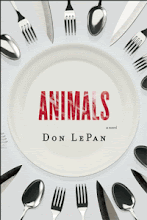
As well, I may have thought of P.K. in part because she represented to me bookends of my own experience. She had known my family in the 1950s in Ottawa, when both her husband and my father worked in the Department of External Affairs, and I was a very small child—too young to remember her. Roughly fifty years later, as a book publisher, I contacted P.K. about her inclusion in an anthology and she encouraged me to be in touch if I ever came to Victoria. I did exactly that, and between 2005 and 2009 paid her visits on several occasions when I was in the city. She would always welcome me with a strong gin and tonic, but take vodka herself; she explained that she would prefer gin but that, for some medical reason, vodka had come to agree with her more in her old age. (Those who have read Rising Stories may at this point be reminded that, although Robin never sees K.P. eating anything, the child does comment on the “colorless liquid” that she drinks.) And she would always provide wonderful conversation—about aging and about love, about the oddities of the human spirit, and of course about writing books—mostly the many books she was still writing, for children as well as for adults, but also my own Animals, which she was kind enough to read in manuscript, and which (as she later wrote) led her to give up eating meat.

The character of K.P. in Rising Stories is inspired by P.K., not based on her. The story of collapsing skyscrapers in Brazil is lifted from P.K.'s Brazilian Journal, and P.K. did say (as K.P. does) that she felt she had aged more in her 91st year than all the other 90 put together. But I don’t believe P.K. was particularly interested in skyscrapers—and she had no more lived in one than I ever have. She was a painter of a very different sort than is K.P. And K.P.’s voice is not that of P.K., either, though I do think there are echoes of the one in the other. I hope to always hear those echoes.