Monday, June 21, 2010

Fiction and Purpose

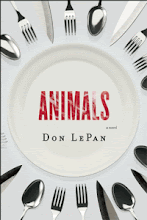
The first review of Animals in a major American newspaper appeared over the past weekend in The Boston Globe. On the whole it's quite positive, and I think the reviewer (Thrity Umrigar) is in a number of respects very perceptive. But I would quibble with her suggestion that to the extent the novel succeeds it does so "almost despite itself." The central problem with the novel is, in her view, that it is not really a novel at all: "this is a political tract disguised as a novel."

To what extent can a novel be written to further a specific political agenda and still be a novel? More generally, what purpose does or should literature fulfill? For most of the millennia over which such questions have been posed, the answers have included ethical or political goals. As often as not, indeed, those goals have been accorded explicit priority over any aesthetic or epistemological ones. In the Western world, from Plato through the eighteenth century, a widely held view was that all literature should play an active part in helping to make us better people, in helping to make a better world—including in ways that were explicitly political. In the nineteenth century fewer and fewer believed that it was the responsibility of all literature to play such a role, but a very great many—from George Eliot to Bernard Shaw to George Orwell—believed that literature could play such a role, believed at a minimum that such a role was one of its legitimate functions. In recent generations in the Western world, though, it has been all the other way. Literature is expected to eschew explicit ethical or political goals; according to the prevailing wisdom, there is almost nothing more damning than for a work to be (or be perceived to be) didactic or polemical.

Yet, while it is almost universally agreed that literature is not the place to express an explicit ethical or political agenda, it is agreed just as widely that literature somehow fulfills a set of broader but less clearly defined ethical and socio-political aims. It is a truism (almost a bromide) that, in general, reading literature enriches and broadens our understanding of other humans, and of the world.

One of the interesting things about these assumptions is that we have very little evidence to support the one that is universally accepted as true, whereas we have ample evidence to support the one that is universally assumed to be false. That reading increases one’s understanding in ways that make one better as a person is intuitively an attractive position. But only recently have people begun to test it empirically, and the evidence is thus far inconclusive (to my mind at least--see my posting "A Good Read," November 24, 2009). There is a great deal of evidence, however, that reading Upton Sinclair’s The Jungle led hundreds of thousands of people in the early twentieth century to press for changes in working conditions in slaughterhouses, and that real change ensued. There is a great deal of evidence that in the 1840s and 1850s hundreds of thousands were influenced by openly didactic novels such as Oliver Twist and Mary Barton to sympathize with those in wretched poverty, and to support legislation to ameliorate conditions imposed by ruthless factory owners. (In her preface to the first edition of Mary Barton Elizabeth Gaskell writes directly of her intent in writing the novel—to “give some utterance to the agony which, from time to time, convulses this dumb people”; she goes on to urge that “whatever public effort can do in the way of legislation, or private effort in the way of merciful deeds…should be done, and that speedily.”) And real change ensued. So too with other novels, and with other issues. Black Beauty was written to change attitudes about the treatment of horses—and did so. Ramona was written to change attitudes about the treatment of native peoples in America—and did so. Uncle Tom’s Cabin—perhaps the most widely read book of the nineteenth century—is universally acknowledged to have helped to turn the tide of public opinion in the United States against slavery.

Are we so very sure that we should be dismissing moral purpose of this sort as inappropriate to serious literature?

To be fair, dismissing the didactic or polemical is generally done not on the grounds that the didactic or polemical can’t make a difference to readers’ attitudes, but on the grounds that a work which aspires first and foremost to an ethical or political purpose cannot be “good” literature. We assume that an overt moral purpose will necessarily be accompanied by a lack of psychological shading, by an absence of intellectual subtlety, by a crudeness of style—in short, that a didactic or polemical work of literature will be “merely” didactic or polemical. And doubtless there have been many works over the centuries that have been just that. But as soon as one begins to cite examples at the other end of the spectrum, the argument that there is any necessary connection between didacticism and aesthetic failure falls apart. Jonathan Swift, Charles Dickens, Elizabeth Gaskell, George Eliot, George Orwell—some of the greatest writers of the past few centuries have written work that can fairly be described as didactic or polemical, but that is also almost universally accepted as having met extraordinarily high standards of aesthetic accomplishment. Tellingly, the critical consensus regarding Mary Barton is that the first half of the novel—comprising an imaginative polemic against the oppression of the poor—is far better realized aesthetically than is the more romantic and individualistic material that comes to the fore towards the book’s conclusion. Even Uncle Tom’s Cabin—long derided as a sentimental page turner—is now starting to be much more favorably assessed from an aesthetic point of view.

Animals is unashamedly a work in this tradition; as the afterword makes clear, it is a novel written with an explicit ethical and political purpose: to influence readers against the evils of factory farming. Along the way, it tries to explore a number of other questions—the ways in which humans are able to rationalize unconscionable behavior, for example, and the ways in which the “dividing line” separating the human from the non-human may be formed. It also aims to interest and stimulate readers in the way that conventional novels do—I certainly hope that readers will be engaged by the psychology of the characters, and by what the interactions between them reveal about their natures. And I hope too that the novel will go beyond what I intended it to be—will “take on a life of its own,” as the phrase goes. Already it has done so for me. I could feel it taking on an emotional life of its own as the tears streamed down my cheeks while I was writing the first draft of the end of Part One. I could feel it taking on a formal and stylistic life of its own as I tried to work out the intricacies of narrative viewpoint and the novel became a much more layered work than I had intended—in some ways almost a postmodern one. I could feel it taking on an intellectual life of its own as I came to realize that the interplay between the viewpoints of the various characters might end up pointing towards more thoroughgoing changes in behavior than I have adopted in my own life, or than I would feel comfortable in promoting with complete confidence. But I hope that under it all a purposeful core still glows with a white heat—a core that is entirely simple and straightforward. I will judge the novel to have failed in the way that I care about most if it does not influence many readers to think again—and feel again, or perhaps for the first time—the horror of what humans are doing to other creatures in order to obtain cheap food for themselves.

It would be foolish to expect that Animals and other works of the imagination today* can make anything like as much of a difference in bringing such cruelty to an end as Uncle Tom’s Cabin and other works of fiction of its era did in ending slavery. But it is never foolish to hope.

* Other such works I am aware of include James Agee’s “A Mother’s Tale” (available online), Angus Taylor’s tale and accompanying philosophical discussion “Hunting for Consistency” (published in Philosophy Now, 2008), and Claude Lalumière’s story “The Ethical Treatment of Meat” (published in a collection entitled Objects of Worship.

[Most of the material in this posting originally appeared in advance of the publication of the Canadian edition of Animals in 2009.]


Monday, May 24, 2010

Akrasia, Animals, Orwell

A few days ago I was struck by a reference from philosopher Matthew C. Altman to “akrasia-- the phenomenon of not doing what we know to be right.” I would take it that the term has been quite widely used by philosophers (from the ancient Greeks through to the present day), but that it has been used for the most part with regard to matters of the individual will—such as controlling our urge to gluttony, or to smoke, or to commit vengeful acts. But Altman’s suggestion that the concept is also applicable in an area such as ethical vegetarianism strikes me as entirely sound. Indeed, I suspect it can apply to a wide range of social and political issues.

By coincidence, the same theme comes up in a book I was re-reading last week: George Orwell’s The Road to Wigan Pier. It’s a book that has at its heart a factual investigation of what it was like in 1930s England to live as part of a working-class family in which no one had work. The facts are still shocking, and the book is still moving. Orwell accompanies the specifics of his investigation with several chapters of rambling ruminations on class, socialism, imperialism, and related topics; these ruminations are on the whole far less satisfying than the reporting, but in the midst of them comes this very interesting observation about imperialism, which of course Orwell came to know at first hand as a member of the police force in British-controlled Burma:
It is not possible to be part of such a system without recognizing it as an unjustifiable tyranny. Even the thickest-skinned Anglo-Indian is aware of this. Every ‘native’ face he sees in the street brings home to him his monstrous intrusion. And the majority of Anglo-Indians, intermittently at least, are not so complacent about their position as people in England believe. From the most unexpected people, from gin-pickled old scoundrels high up in the Government service, I have heard some such remark as ‘Of course we’ve no right in this blasted country at all….’

In short, even those who knew that the system they worked to support was wrong kept working to support it: akrasia. There are surely strong parallels too between this sort of sentiment and one common pattern of thought during the long struggle in the Western world to end the slave trade, and then to end slavery itself; there are many documented cases of people who found it difficult either to take a strong stand against the evils of slavery or to give up their own slaves, even after they had come to the conclusion that slavery was wrong. Akrasia on the broad canvas of political issues may have at least as interesting a history as akrasia of the more familiar variety.

How is "social-political akrasia" (if we may call it that) resolved? Some seem able to make accommodations all their lives with their awareness that the way they live their lives supports what they believe to be wrong. Change for the better can eventually occur, of course. But for whatever reason, we humans seem to have a limited capacity for rapid changes in habitual behavior. There are a great many psychological (and often economic) factors that can lead behavior to lag belief. It would be good to do x, but it would cost me financially is perhaps the most common (and largely subconscious) template for extended inaction, but it is one of many.

When change does come it can take many forms. Orwell famously remade his life once he returned from imperial service, dedicating himself to the struggle against imperialism and, more broadly, class prejudice. He did this through his writing but also through the experiences that became the basis for the writing: living as a tramp, living among unemployed coal miners, fighting in the Spanish Civil War. He managed in the most dramatic of ways to cure his akrasia.

It would be foolish to hope that most would have the courage to follow Orwell’s example, remaking a life on ethical grounds in ways that made it much less comfortable. But what of middle-class people today whose akrasia is primarily a matter of buying goods from companies that they know behave highly unethically, or of eating factory-farmed meat and dairy products when they are more or less aware of what goes on in factory farms, and know that it is deeply wrong? In cases such as these the self sacrifice involved is on a different scale from that of Orwell’s—some additional expenditure, but no real hardship, and no danger. How may such humans be persuaded by those who have overcome each particular form of akrasia to change our ways?

Surely in large part through the persuaders being open, impersonal, and accepting. Open in stating the case and in striving for what they believe to be right. But impersonal when it comes to the beliefs and habits of other individuals. In arguing against cruelty to non-human animals, or imperialism, or slavery it surely helps to personalize the victims whose lives you hope to improve. But it is rarely helpful to make things personal in the other direction; indeed, it is quite likely to be counterproductive if one tries to argue directly to a meat eater not only that vegetarianism is a general good but also that he should become vegetarian right now.

And accepting. Not in the public sphere (where it is surely right to argue as loudly as possible that the cruel, the oppressive, and the heartless are absolutely unacceptable), but rather in our approach to individual hearts and minds. Most important of all, perhaps, the approach we each take to our own heart and mind.
How does the rest of our psyche respond when this sort of disconnect occurs within ourselves—when we are not doing what we know to be right? Understandably enough, we are uncomfortable with it; none of us likes to be confronted on an ongoing basis with an image of ourselves that falls well short of our ideals. And rather than accept the reality of that image, we may prefer to somehow distort the picture. We may start to find excuses to belittle either the ideals themselves, or the people who hold them and who have managed to change their behavior. (Was it for this reason that “do-gooder” became primarily a term of abuse in the 1980s and 90s?) Without looking into the matter too closely, we may start to label the ideals naïve and impractical. We may fall back on ad hominems; the ways in which animals rights activists and vegans and feminists are caricatured today are not unlike nineteenth and early twentieth-century caricatures of anti-slavery activists and suffragettes and advocates of better factory conditions.

And we may go further. We may transfer the irritation or outright anger we feel at ourselves for not living up to certain ideals onto the ideals themselves, or onto the people who are striving to bring them closer to reality. The mind is thereby working to destroy any disconnect between the person we are and the person we would like to be—but doing so in the nastiest of ways.

I would suggest that a better way to deal with this sort of disconnect within ourselves is to accept it as something we can live with for the moment. I should stress that phrase “for the moment”; the worst course of action is surely one that would lead us to become perpetually comfortable with all our failings. Just as important as accepting that immediate change may not always be possible is filing away in a not-too-out-of-the-way place an intent to change our behavior, at least to some significant degree.

I will own that I may be too influenced here by an awareness of my own psyche; one’s own case always seems the most salient somehow. I have written in the Afterword to Animals about the long lag that occurred for me between the realization that factory farming was horrifically wrong and the moment when I began to actually change my behavior. And I have written too about how, when I did begin to change, “slow stages” made change much more easily do-able. For me that is not an isolated case; for some years when I was living in Calgary I had the vague notion that I should in some way volunteer to help the homeless, but I did nothing. Only when a friend and her son mentioned that they were volunteering did I finally act myself. And the same pattern continues: I am persuaded now that it would be right for me to start giving at least 10% of my income in the cause of reducing global poverty, but my level of charitable giving is for the moment far below that. My guess is that this will be the second time in my life when a book by Peter Singer ends up exerting a considerable influence on my behavior. For the moment, though, I am still in a state of akrasia.

* * *

Let me add a postscript here about Orwell. For someone so extraordinarily alert both to subtle nuances and to clear moral imperatives where class and imperialism were concerned, he was astonishingly lacking in sensitivity on matters relating to gender—and even more so on matters relating to the ethics of vegetarianism. This was emphatically not akrasia: Orwell did not at any level think he should be supporting the betterment of women, or ethical vegetarianism. Indeed, he seems to have registered issues such as these as having little or no ethical content whatsoever—other than that feminists and vegetarians displayed a style that deserved to be mocked. Here he is, for example, writing in The Road to Wigan Pier on some of the obstacles to getting the general population to realize the superiority of socialism over capitalism:
…there is the horrible—the really disquieting—prevalence of cranks wherever Socialists are gathered together. One sometimes gets the impression that the mere words ‘Socialism’ and ‘Communism’ draw towards them with magnetic force every fruit-juice drinker, nudist, sandal wearer, sex-maniac, Quaker, ‘Nature Cure’ quack, pacifist, and feminist in England. … For instance, I have here a prospectus from another summer school which states its terms per week and then asks me to say ‘whether my diet is ordinary or vegetarian.’ This kind of thing is in itself sufficient to alienate plenty of decent people [from Socialism]. And their instinct is pretty sound, for the food-crank is by definition a person willing to cut himself off from human society in hopes of adding five years to the life of his carcase; that is, a person out of touch with common humanity.

The logical sleights of hand here are almost breathtaking—first and foremost among them, the insistence on improving one’s own health as the only possible motive for vegetarianism. Could Orwell really have been entirely ignorant of what was already by the 1930s a long tradition in his own culture of vegetarianism on grounds relating to the treatment of non-human animals? Could he really have been as unsympathetic as he appears to be towards feminists, when the struggle of women to achieve the vote was only a few years past? One thing at least is clear; we are none of us without blind spots.

Sunday, April 25, 2010

Identity and Politics

Over the radio this morning Michael Enright was reflecting on “The Champions,” an old NFB film about the era of Pierre Trudeau and René Lévesque (now, like other NFB films, available free online)—and lamenting that no one today measures up to the level of intelligence and passion they brought to the debating of the great issues of the day. Surely they were both great figures. But how much did the great issue that preoccupied them really matter? It is fifteen years since Quebec’s 1995 referendum, thirty since the 1980 one—and fifty years since the July 1960 election that brought the Lesage Liberals to power and ushered in the Quiet Revolution. The social and economic changes that have occurred in Quebec have been more dramatic than in the rest of Canada, simply because 1950s Quebec was so much more of a closed society. But the paths have been parallel (the degree to which 1950s English Canada was a closed and intolerant society is often forgotten). On those parallel paths Quebec and English Canada have grown modern economies and open societies. Gender equality and racial and religious tolerance (in the context of a secularized public sphere) have become accepted by virtually all; sexual orientation is to the large majority regarded as being in the same category. Providing a social safety net—Medicare, help for the poor, help for the unemployed, and so on—is considered by most to be a core principle. The value of the non-human environment—and the principle that its protection must sometimes trump narrow economic concerns—is accepted near universally. So too is the importance of reaching out to the world—and acting generously to those in need. Compared to the importance of such things as these, how much value inheres in the fact of our having remained one nation state rather than two?

Certainly I would say now that it is a lot less important than I once believed. And far, far less important than following through on the core principles that we* feel define us, but that a very great deal of the time we fail to live up to. In Quebec as in English Canada we like to believe that we are more compassionate towards the rest of the world than are the Americans, that we are more tolerant than Americans are, that we behave more responsibly towards the environment. But America is in fact considerably better in all these areas than Canadians like to believe, and Canada considerably worse. In all these areas our goodwill tends to come to the fore only in response to the visible. When the headlines are filled with images of the devastation in Haiti or in Banda Aceh, we are among the world’s most generous—yet on an ongoing basis we are among the least generous of developed nations in the assistance we give to the world’s poor. When the effects of pollution or global warming are plainly before us, our track record of doing something about such problems is a decent one—but we remain unperturbed if our electricity comes from heavily polluting coal-fired generators that remain out of view. We are rightly outraged if we are shown pictures of ducks suffering the effects of tailings from the tar sands—but we would prefer not to know that millions and millions of non-human animals confined in closed sheds are treated with horrific cruelty in order to provide human animals in Canada with meat and dairy products at rock bottom prices. If we can open our eyes to some of these great issues—and act to bring about change for the better—I for one will care little if we are one nation state or two. Or, indeed, new states in an America led by the likes of Barack Obama.

* I should own to being an unusual and in some ways a reluctant participant in this sort of national "we." I have lived most of my life in Canada, hold a Canadian passport, and very much feel myself to be Canadian. But I do not feel myself in any way to be exclusively Canadian. That is not merely (or mainly) a matter of my having been born in the United States, and being as a result an American as well as a Canadian. Or even, more broadly, of having lived in Britain and Zimbabwe as well as in the United States and in Canada; it's more a matter of having come increasingly to distrust nationalisms of all sorts.

Sunday, March 28, 2010

Where the Money Comes From

Why have environmentalists not made opposition to factory farming a priority? For years now there has been broad agreement among independent researchers as to the horrors of factory farming. It presents huge health risks for humans, and is almost as ruinous to the broader environment as it is cruel to the animals it condemns to lives of suffering. The risk to humans as well as to non-human animals from the systematic overuse of antibiotics, the impossibility of disposing of the vast quantities of excrement produced without damage to land and water—that’s the start of a very long list of negatives. Yet many environmental groups do not even mention factory farming on their websites, and those that do—such as the David Suzuki Foundation—tend to be extraordinarily timid in their recommendations. Not for a moment do they suggest that anyone who cares about environmental quality should consider becoming a vegan. They don’t even suggest that if we choose to eat meat and dairy products we should eat only free-range, organically produced meat and dairy products. Far from it. “Here are some fun suggestions for things you can do,” the Meatrix site recommended by Suzuki brightly suggests, and then proceeds to recommend reading books, seeing movies, and “going meatless even one day a week.” It’s much the same with other environmental groups; cautious endorsements of “Meatless Mondays” represent about the furthest they are willing to go. Why so toothless?

One reason may be philosophical. As Angus Taylor sets out in his fine book Animals and Ethics, some environmentalists have long regarded those who advocate on behalf of non-human animals with suspicion—as “sentimentalists who are unwilling to face up to the realities of life and death.” If we ascribe rights to non-human animals, does logic require that we interfere in nature so as to protect wild animals from their natural predators? To what degree should non-human animals be granted moral standing? These may indeed be vexed issues. But as is increasingly recognized, agreement on those sorts of philosophical issues is not required in order to form a coalition against factory farming; relgious people who believe humans should have dominion over other animals can on this issue be in broad agreement with secular environmentalists, with those who support animal rights, and with those whose primary concern is for human health. From all angles, factory farming causes horrendous damage—and, thankfully, these days most environmental groups acknowledge that fact. Yet confronting factory farming remains at or near the bottom of their list of priorities. Again, why?

Could it be a funding issue? That suggestion is raised in an October 21 2008 canada.com article, “Eating Less Meat is Critical to Our Planet’s Future”; Dennis Cunningham of the International Institute for Sustainable Development notes that “when environmental groups apply to governments or large corporations for money to produce an education program, the funding organization can dictate the priorities such a program should take. And no government wants to risk offending a powerful agriculture lobby by telling people to eat less meat — even if it’s good for them.”

Certainly it’s always interesting to know where the money is coming from. Take for instance this past week’s story about Frank Mitloehner, an academic who presented a paper entitled “Clearing the Air” at a conference of the American Chemical Society in which he questioned the Food and Agriculture Organization’s 2008 estimate that our meat-eating ways are responsible for a higher percentage of the world’s carbon emissions (they estimated 18%) than is the entire transportation category (an estimated 15%). Apparently the statistics deserve to be questioned; the UN has admitted flaws in the FAO's calculations, and arguments over what the true percentages are will doubtless continue for some time.* The interesting thing about Mitloehner’s paper, though, is that he doesn't stop at querying meat-eating’s percentage contribution to global warming. He takes a big leap beyond that to broad prescriptions for world agricultural policy: “Producing less meat and milk will only mean more hunger in poor countries....The developed world’s efforts should focus not on reducing meat and milk consumption,” says Mitloehner, “but rather on increasing efficient meat production in developing countries, where growing populations need more nutritious food.” Far from shutting down the factory farms, in other words, he wants to expand them. Through what mechanism might hunger be more easily reduced by raising cows and pigs rather than by growing grains and legumes for direct human consumption (when common sense as well as the weight of much expert opinion points in the other direction)? Mitloehner does not dwell on that question. And he says nothing about dangers to human health from such things as the overuse of antibiotics, nothing about the damage to the world's water supply from the run-off of excrement from factory farms, and (of course) nothing about the issue of cruelty to animals. Even if we accepted the suggestion that our meat-eating habits in no way contribute to global warming, in other words, there are many, many reasons to oppose factory farming. Instead, Mitloehner endorses a call for “replacing current suboptimal production with advanced production methods — at every step from feed production, through livestock production and processing, to distribution and marketing.”

Here’s one piece of information about his paper that you won’t find in the reports on Fox News or in Time Magazine or in the Toronto Sun: the paper “is a synthesis of research... Writing the synthesis was supported by a $26,000 research grant from the Beef Checkoff Program, which funds research and other activities, including promotion and consumer education, through fees on beef producers in the U.S.” Mitloehner goes on to report that in total he “has received $5 million in research funding, with 5 percent of the total from agricultural commodities groups, such as beef producers.” That 5% may sound small — until one remembers that 5% of $5 million is still a hefty $250,000. Interestingly, his research seems almost all to have been on such subjects as ammonia levels in the factory farming of pigs rather than on global warming. Here's a sample, from a study that received $40,000 in funding from the National Pork Board: “Acute and Chronic effects of Ammonia on...Nursery Pigs”:
Most of the existing guidlines and recommendations for animal houses are set at limits ranging from 20 to 50 parts per million of ammonia. Our studies indicated that pigs respond to ammonia with systemic inflamation and stress responses. However, even 50 ppm does not dramatically seem to affect animal performance.

Freely translated, that means that even though the nursery pigs may be suffering more from higher levels of anmmonia, the higher levels do not result in greater “aggressive behaviors” or — no doubt most important — in any change in feeding behavior. The authors make no recommendation that intensive pig farms cut back on ammonia levels; so much for “Clearing the Air.”

* As Vaughan Black of Dalhousie University has pointed out to me, there is no consensus that the true figure is lower than 18%; indeed, the report Livestock and Climate Change, published a few months ago by the World Watch Institute, puts the figure at about 50%.

Saturday, March 6, 2010

Aging and Changing

Do humans naturally tend to become more conservative as we age? Some part of me—the part which never wants to learn how to work new gadgets—feels that is surely true. But another part very much hopes it isn’t. That’s the part of me that resists the thought that I might be destined to become more politically conservative as I age—and that wants to believe that humans won’t become less likely with age to be able to change their behavior toward non-human animals.

It has long been a truism that as we age we tend to move to the right politically—and more generally to become steadily less receptive to change. Whenever this topic comes up someone to the right of center always trots out the saying, “If a man is not a socialist by the time he is 20, he has no heart; if he is not a conservative by the time he is 40, he has no brain”*—a saying so well balanced rhetorically that people tend to start nodding their heads in agreement before they realize that the list of those it would class as brainless includes the likes of Albert Einstein, Abraham Lincoln, Nelson Mandela, George Orwell, Simone de Beauvoir, Virginia Woolf….

Research now suggests the saying to be wrong in another crucial respect; it’s simply not true that that there’s a natural tendency for humans on average to become steadily more conservative as they age. Studies published in 2007 and 2008 study by Nicholas Danigelis, Melissa Hardy, and Stephen J. Cutler (most notably “Population Aging, Intracohort Aging, and Sociological Attitudes,” American Sociological Review, vol. 72, no. 5, October 2007) conclude that there is no clear trend towards greater political conservatism in middle age—and that over the period 1972-2004 Americans aged 60 and over became considerably more liberal in their attitudes regarding such things as the political and economic roles of women and of African Americans, and the politics of sexual orientation.

Those results seem consistent with surveys from the past ten years of attitudes and habits regarding eating animal products. Since the late 1990s there has been a substantial movement towards vegetarianism among Americans. Interestingly, though, the change seems to have occurred at a faster rate among older people than it has among young. In 2000 4.5 % of Americans reported that they never ate meat; by 2009 the percentage had grown to 8%. The current number for young people is also just under 8%—but it has increased only 2% since 2000 (Harris polls, as reported by the Vegetarian Resource Group). In America at least, this sort of change has been happening faster among adults than it has among young people.

I’ll end with a piece of anecdotal evidence that the old are never too old to change. Among the very first people to be persuaded by reading Animals to change their eating habits was someone who had recently turned 90—the poet P.K. Page. It’s hard to imagine that many of us will be sufficiently open-minded at that age to make truly significant changes—but P.K. was surely extraordinary. With how many people in their nineties does it seem as natural to talk about sexual love, or politics, or religion as it does to talk about the health of relatives, or the weather, or the distant past? And how many people in their nineties talk not only with wisdom but with spark and sharp insight? In 2009 P.K. published four books—and they were good books too. When she died this past January 14 she was 93. I had come to know her only in her late 80s, my early 50s; I so wish I could have known her longer.


*No one seems to be sure where the saying originated; in slightly different versions it has been attributed to Churchill, Bismark, Clemenceau, and others.

Sunday, February 14, 2010

Soylent Green and Animals

I’ve never been knowledgeable about science fiction, and I confess to never having heard of Soylent Green before an old friend mentioned it to me in 2007, after I had outlined to him the storyline of Animals. More than a few others have mentioned Soylent Green to me since, and Soft Skull Press, the New York company that will publish the American edition of Animals this spring, has been pitching it to the book trade as “Soylent Green meets ‘A Modest Proposal.’”

I still have not read the Harry Harrison novel Make Room! Make Room! on which Soylent Green is based, but I did finally get around recently to seeing the Richard Fleischer film starring Charlton Heston. From one angle Soylent Green is indeed similar to Animals—like Animals (and, of course, like Swift’s “A Modest Proposal”) it has at its center the idea of humans eating other humans. But it is a work with a message that points in an entirely different direction. Both Soylent Green and Animals are dystopias depicting worlds in which resources have been depleted and there is widespread poverty. But in the world of Soylent Green the root cause of the trouble is overpopulation. The population of New York alone has ballooned to 40 million, farmland has been paved over, food is scarce. Everyone relies on rations produced by the Soylent Corporation—Soylent Red and Soylent Yellow, produced from vegetable extracts, and the high-protein Soylent Green—said to be produced from plankton. Then comes the revelation: it’s not from plankton at all. “Soon they’ll be breeding us like cattle. You’ve got to warn everyone and tell them. Soylent Green is people! We’ve got to stop them somehow!” is the memorable cry of Robert Thorn (the Charlton Heston character) at the movie’s end. The horror at the heart of Soylent Green, then, is not that animals raised for food are treated with terrible cruelty; it is that we might contemplate treating humans as we do other animals. The crucial scene in the movie is one in which the elderly Sol Roth (played by Edward G. Robinson) has been persuaded to make room for others by allowing his life to come to an end. The horror is that his flesh will be converted into protein rich Soylent Green after his death. Appalling though that is, the horror begins and ends there, with no analogy drawn to the ongoing horrors factory farming imposes on living animals--horrors that were becoming the norm in America just as the film was being made. (Far from being treated cruelly as he prepares for death, indeed, Roth is thoroughly pampered.) Soylent Green, in other words, does not ask us to care how cattle are treated (let alone wonder if we should be killing them); its message is simply watch out, lest we start treating each other as we do cattle.

Is that such a bad message to convey? Or was it in 1973? As it turned out, yes, though it need not have been. Had people reacted to the scare-mongering about overpopulation in part by cutting down drastically on their consumption of meat and dairy products (as Frances Moore Lappé advised in her 1971 Diet for a Small Planet), it would have been a very good thing indeed. But few reacted in that way. The important response came not from any change in individual behavior, but from scientists and from industry. Famously, Norman Borlaug and others led a “green revolution” that greatly increased crop yields. Even that, it is now argued, may have been far from an unmitigated good. But the great evil came in the corresponding increase in yields in meat production. Here is O.E. Kolari of the American Meat Institute:

The doubling of the population in such a short span of time will tax the world's resources. ... The ability of American agriculture to supply adequate food, and in our particular area, meat, to needy peoples of the world, can be seriously questioned. ... The most serious food shortage in the future will be protein of high quality, and here is where the meat industry becomes important. … Meat production is steadily increasing in the United States, and improvements in meat production in the United States and other parts of the world suggest an adequate meat supply in the years ahead, although a doubling of meat production within the next 15-20 years may be required. ... It can be calculated that an increase in the efficiency of production may be expected to reduce production costs and, therefore, also selling price by as much as 20%. ... Changes in the development of new products, new facilities, and other developments in the meat industry may not be as rapid as one would like to see ... but changes are occurring, and change is the hallmark of progress. (O.E. Kolari, "The Use of Animal Protein for Food," in Journal of Animal Science, 1966, 25, pp 567, 569, 571)

That may sound largely benign, but as Kolari and others called for further “improvements” of the sort that had already begun in the American meat industry, the practical effect was again and again to ratchet up the cruelty, all in the name of greater yield, of "efficiency," of “improvement,” in a process that continues to this day. They were ahead of the doomsayers; Kolari’s article was published in 1966, two years before Paul Ehrlich’s The Population Bomb, seven years before Soylent Green. But one practical effect of the population doomsayers of the 1960s and the 1970s was to foster an unquestioning acceptance of “improvements” that were already underway in the meat and dairy industries—and an abiding reluctance among most of us to know how those “improvements” are usually achieved. The implicit assumption may have been unstated, but it is not hard to discern: if greater "efficiency" in the meat industry was necessary to stave off some of the horrors that would otherwise result from human overpopulation, well, that was a price non-human animals would have to pay. Soylent Green today is a film that's hard to take seriously--it's entertaining in all sorts of ways it probably didn't mean to be. But to the extent that it had serious effects in its day, it's hard to imagine that they were for the good.

Wednesday, January 6, 2010

Meat Trade News Daily

I’ve been pleased to see that Eric Vollmer’s Calgary Herald interview piece from early December has now also appeared in several other CanWest places—most recently The Montreal Gazette. Rather more surprising is its appearance in the Dec. 12 issue of Meat Trade News Daily, an international, web-based compendium of published material about the industry. Interestingly, the piece does not appear there as it does in the various CanWest places, under something close to its original heading (“Dystopian Novel Finds Origin in Animal Rights”), but rather under the heading “Canada—Conspiracy Theories over Environment and Farming.” Here’s the link:

http://www.meattradenewsdaily.co.uk/news/121209/canada___conspiracy_theories_over_environment_anfd_farming.aspx

CanWest holds the copyright, and is in bankruptcy protection; they may be less amused than I am by this misuse of their property.

Monday, January 4, 2010

Words After an Afterword

Does Animals argue for animal rights? Or only for treating non-human animals better? Does it argue that humans should all be vegetarians, even vegans—or does it simply ask humans to give up factory farmed meat and dairy products for free-range ones?

I’m not entirely sure. That may seem odd for the author of a novel that has been said by more than one reader to be too direct and too obvious in its message. But it is the truth. The main thrust of Animals is of course against factory farming; that much is (I trust) abundantly clear. But what of the vexed issues beyond that? My own views have to some degree shifted over the years; indeed, I suspect they shifted in the course of writing the novel. I have leanings, but I am indeed not entirely sure-not sure about my own beliefs, and not even sure as to what the book may argue on this point.

And I’m not alone. My old friend Tom Hurka, a philosopher who is one of our best and liveliest thinkers on ethics and aesthetics, mentioned when he joined me in Toronto this past season to speak about the book (and about the ethics of human animals dealing with non-human ones) that his reactions had differed on first and second reading. On one reading he had seen Broderick more as an unreliable narrator, and on another had imagined that the book (I won’t say “the author”) was endorsing a good deal of what Broderick has to say.

Interestingly, two online reviews of the novel that I have come across recently are at entirely opposite poles on this point. I don’t mean simply that they take opposing views; they also disagree completely about what is being argued for in Animals. Kentia Gueletina in The Lyon concludes that the book reads “like a treatise on animal rights and the virtues of becoming a vegetarian.” Calling it “one of the most scarring books” she has ever read, she concedes that “the quality of the writing is actually very good,” but disapproves of what she sees as its message: “it would make a good pamphlet for the more extreme (and I mean extreme) Animal Rights movements.”

In fact the book is (I think) careful to steer clear of the difficult issue of whether or not non-human animals have or should possess those abstract qualities many human animals call “rights.” Too careful, by some reckonings. David Regan has just posted his review of the book on his Animals in Canada site. I won’t quibble here over several small points in his review I might take issue with him over. The important thing is that on one very large point he is absolutely right, and I have been quite wrong:

All this puzzling over Broderick is made moot in the end by LePan’s Afterword. Here it becomes clear that the character’s ethical position, far from being a joke or a warning, and in addition to perhaps being a reaction to childhood trauma, is the same as his author’s. Both Broderick and LePan are arguing – passionately, eloquently, earnestly – for an end to factory farming, for improved welfare for food animals, but neither is arguing for animal rights, neither is arguing for the abolition of animal use. There is nothing wrong with this position per se; it’s common and often convincing in contemporary discussions of our obligations toward non-humans. But within the world of LePan’s novel – where humans with intellectual disabilities are stand-ins for, are equated with, non-human animals – it is absolutely untenable, as it suggests that it might be acceptable to use humans with intellectual disabilities for food so long as we do not factory farm them. Broderick defends the indefensible, and rather than laugh or scoff at him, LePan wants us to take him seriously. This failure to condemn the killing and eating of humans with intellectual disabilities does not, obviously, mean that LePan might actually support such a practice. No reader could possibly come away from his book thinking so. Nevertheless, while Broderick’s three-dimensionality, his humanity, makes for good fiction, it is also despicable philosophy and dangerous politics, and these are realms that LePan clearly wants his novel to exist in.

Aesthetically there is I think much to be said for leaving a good deal of uncertainty over the degree to which the book endorses or undercuts Broderick's various positions. But as it stands the Afterword acts in the most unhelpful of ways to remove much of that uncertainty; I am entirely persuaded that the elements of the Afterword that Regan points to are as damaging aesthetically as they are philosophically. Another perceptive recent reader—Deborah Robbins—pointed out to me last month that the afterword anachronistically referenced humans killing and eating pigs and chickens and so on. I made a note to have those lines changed on the first reprint of the Canadian edition, and in the forthcoming US edition—but somehow I still didn’t get the larger underlying point Robbins was making, until Regan made it for me even more forcefully. How I missed the larger problem I don't know; the only explanation I can offer is that with the Afterword I really had left the world of the novel behind, and was focusing on the world of today, and on factory farming. In any case, I now see clearly that the Afterword as it now stands does not connect coherently with the novel. my apologies for having gotten that one large thing so very wrong. I am posting now on my website a revised Afterword that (I hope!) takes account of this problem. My thanks to David and to Deborah for pointing me towards better things!

Saturday, January 2, 2010

Humans and Other Animals

What’s wrong with these sentences?

1. Sturgeon are larger than freshwater fish.

2. The eagle was flying higher than the birds.

It’s not a difficult question to answer; the error is immediately obvious to anyone possessing even a passing acquaintance with biology and with the English language. Sturgeon are freshwater fish, and eagles are birds. To be correct, the sentences should read

Sturgeon are larger than other freshwater fish.

The eagle was flying higher than the other birds.

Yet we very frequently see no error when we read sentences such as the following:

3. Throughout our history, our understanding of animals and of our relationship to them has been debated.

4. The way we view animals determines how we treat them.

To be correct, such sentences as these should also include the word other:

Throughout our history, our understanding of other animals and of our relationship to them has been debated.

The way we view other animals determines how we treat them.

Is this just to carp over a trivial distinction? No more so than it is to suggest there is a problem with sentences such as “Slaves should never sleep in the same quarters as people,” or “The gestation period of man is nine months.” As researchers long ago discovered, the way we use language both reflects and helps to shape our thinking. Though there are still some who resist, most of us accept that it makes a difference whether or not we use language that implies that certain classes of people are not people at all. In the same way, it must make a difference (in shaping as well as in reflecting our attitudes) if we use language implying that humans are not animals. If we treated all non-human animals well, it would arguably be a trivial distinction indeed. But the fact is that we don’t; throughout the world non-human animals are horrifically mistreated; here in North America, over 99% of the meat and dairy products we consume come from animals who spend their lives in conditions of extreme hardship in factory farms. The more we are in the habit of speaking of (and thinking of) those fellow animals as creatures entirely different from ourselves, the better able we are to rationalize the cruelty that we condone—and that our behavior as consumers actively supports.

Ironically enough, examples 3 and 4 above are taken (slightly modified) from an excellent book called The Inner World of Farm Animals, which presents a wealth of research demonstrating that farm animals are far closer to humans in their intellectual and emotional capabilities than has commonly been assumed. Even those who are working to challenge the old stereotypes, in other words, sometimes use language that helps to reinforce them. It took us a long time to learn the importance of being careful about how we use man; no doubt the same will be true of animals. But it is surely time to start learning.

Sunday, December 27, 2009

Real People

I had an interesting conversation with my daughter Naomi over the Christmas break as to whether or not she resembled Naomi in Animals—or, to be more precise, over the degree to which her much younger self resembled the fictional character. Certainly I had not intended to make the two resemble each other. I chose that name for the character because of a different sort of real world connection. Naomi as a student had been influenced by a pamphlet she had been given at Simon Fraser University one rainy day, with pictures showing how factory farmed animals are treated. That in turn had been one thing that had influenced me to try to act against factory farming, so there seemed an obvious appropriateness to giving Naomi’s name to that character in the book. I hadn’t expected the connection to go beyond that—but (the real) Naomi is not alone in thinking that in fact I ended up portraying someone quite like the person she was when she was growing up.

Zayne and Tammy are two other “real” names in the novel. I knew slightly for a time a few years ago someone called Zayne. He is in many ways a good and gentle man, as is Zayne in Animals, but I don’t think overall the two have very similar personalities; certainly I did not intend them to. I wanted a relatively unusual name for Naomi’s father, and that was simply the first one that came to mind.

For several years early this past decade Tammy Roberts worked at the book publishing company where I work. She’s a very lively (and very entertaining) person with a strong conscience—and she has been vegan throughout her adult life. I used to admire how well she accommodated herself to the ways of the world when it came to food—never complaining if it was difficult to get something she could eat at a restaurant we were going to for some company lunch, never thinking less of others who didn’t think twice about eating animals, whether factory farmed or any other sort. I thought it would be appropriate to give someone in the book the name “Tammy”—but here again I didn’t see any close resemblance between the character of Tammy in Animals and the real person Tammy Roberts.

One other note about names and Animals; for many years I had a cat named Sam. Unlike the character in the novel, he wasn't much of a learner. But he was certainly immensely lovable.

Tuesday, November 24, 2009

A Good Read?

In one of my first postings on this blog I suggested that while it is a truism that reading literature tends naturally to do good by extending our sympathy for other humans, that assumption is “untested—and perhaps untestable.”* I recently discovered that some scholars now claim to have tested this very assumption, and to have evidence that it does indeed hold up. As Keith Oatley reports ("The Science of Fiction," New Scientist 25, June 2008), scientifically conducted studies have now concluded not only that regular readers of fiction tend to be more empathetic than other people (which could of course be merely a matter of correlation), but also that when tested immediately after reading a work of fiction—in this case, Chekhov’s “Lady with a Lapdog”—readers exhibit reactions that are more empathetic than those of a control group who are given a version of the same narrative written “in documentary form.” Evidently we are led as we read fiction to empathize with the characters in ways that we do not in reading non-fiction; the suggestion is that this leaves as a residue a slightly increased tendency to empathize with real human beings once we finish reading. “Readers found it easier to identify with the characters in the literary story than in the documentary version. By empathizing with these characters, readers became a bit more like them.”

The researchers caution that the effect has not yet been proven to be long-lived. Nevertheless, these are very interesting findings. The full scientific evidence is, I gather, to be found in Creativity Research Journal, vol. 21—which I have not seen, and I should perhaps therefore reserve judgment. But if it seems plausible that reading fiction could affect readers in this sort of way, it also seems to me highly doubtful that such a study could possibly prove the existence of an inherent improving tendency in the act of reading literature. I can quite believe that reading Chekhov might tend to make the average reader more empathetic; Chekhov is surely among the kindest and most understanding of authors, and his characters, generally of a mixed rather than than a saintly or heroic nature, are drawn in ways that lead us to feel for them in sometimes unexpected ways--ways that can surely expand our emotional capacities. But does that constitute, as Oatley claims, “scientific evidence that reading fiction does have psychological benefits”? That is can have, yes. But that it does have, by its very nature? What happens when we read James M. Cain’s The Postman Always Rings Twice, as I did recently? It’s written from the point of view of Frank Chambers—a drifter who murders a harmless garage owner in order to further the progress of a sexually charged but otherwise empty adulterous love. It’s a powerful first-person narrative, and certainly as I read it I was led to some extent to empathize with Chambers—simply through the mechanism of being made privy to his murderous intentions before he acts on them. As readers most of us find it hard to resist that sort of forward narrative pull. (Much the same thing happens when we read Macbeth, I would argue.) It may lead us to empathize with the character who is driving the narrative—but what are we empathizing with? I found that I felt strangely almost emptied of feeling after having read The Postman Always Rings Twice—which I guess may count as evidence that I became a bit more like Frank Chambers through the experience of reading. But being led to empathize with evil, to feel temporarily emptied of emotions such as kindness and pity, is not, I suspect, what Oatley has in mind when he writes of fiction having psychological benefits.

Whether you agree with all the conclusions or not, all this is highly interesting stuff; I look forward to reading more about the efforts of Oatley and others to conduct empirical investigations into literature’s effects.

* In contrast, I suggested that there is a great deal of empirical evidence that books such as The Jungle, Mary Barton, Oliver Twist, Uncle Tom’s Cabin, and Black Beauty can help to bring about change in very focused ways—helping to persuade readers of the evils of slavery, of the need to change the way horses are treated, of the need to provide better for the poor, and so on.

Sunday, November 1, 2009

Rage against the factory farm

In his thoughful review of Animals in last weekend’s Globe and Mail (http://www.theglobeandmail.com/books/review-animals-by-don-lepan/article1335702/), Jim Bartley writes that the novel is “spot on: psychologically incisive, admirably disquieting.” He also writes that it is “an angry book.” Until I read that I wouldn’t have characterized it in quite that way, but on reflection I don’t think Bartley is wrong.

I have tried to think a little further on this. Everyone is comfortable with works of art being characterized as passionate; we are a little less comfortable with angry. Yet I suspect a fair bit of anger is often at the root of “impassioned” works. Certainly rage against cruelty or injustice is part of what motivates some such works. According to Harriet Beecher Stowe’s biographer Joan Hedrick, for example, Stowe began Uncle Tom’s Cabin after she had become “consumed with a rage unlike anything she had ever experienced” following the passage of the Fugitive Slave Law in 1850. And certainly I did, and do, feel something similar about the way factory farming is practiced today (and at the way in which society condones its cruelty).

But I think, in my own case at least, that another sort of rage may also be at play here—anger of a sort more deeply rooted psychologically. Though most of the time I gather I’m a reasonably pleasant human being to be around, I’ve sometimes had to struggle to control my temper—and I have at least occasionally failed completely to do so. In a few cases where I’ve been drinking too much, an anger has surfaced that seems to have nothing to do with surrounding circumstances—that apparently resembles nothing so much as a furious and quite irrational child coming out from under an adult mask. I don’t think that these feelings are in my case very hard to explain. I gather, indeed, that similar feelings are very common in the psyches of those who grew up as my brother and I did with a loving but demanding and somewhat overbearing mother and a largely absent father.* I don’t for a moment believe that this angry self which emerges only very occasionally is the “real” self; all of us have multiple sides to our personalities or characters, multiple selves, if you will, and I don't see any reason to privilege rarely seen and unattractive selves as being more important than the ones which predominate the vast majority of the time. But the angry self that has sometimes surfaced is certainly one manifestation of a powerful force within me—and I suspect that one of the more successful ways I’ve dealt in my unconscious with deeply rooted anger is to try to channel it into rage against things that deserve being raged against. Is it coincidence that an angry passion for social justice issues took root within me at just the time in adolescence when I was first struggling to control rage against both my parents? I suspect not.

If it is the case that the capacity in me to be powerfully motivated by a passion against injustice or cruelty stems in large part from a transference of rage directed initially at parental sources, I don’t think the feelings themselves should be taken as any less legitimate for that. Indeed, it may well be an unfortunate truth in the other direction that people whose upbringing has been entirely benign may find it difficult to feel outrage, even when outrage is an entirely appropriate response. On that I can only speculate. But I do know my own case that if I can direct whatever anger there is within me against things that are deserving of anger, it can only lead to good effects, within me as well as in the world.

* That is of course only one of numerous sorts of childhood that may breed frustration and anger in the young mind. Stowe is an interesting case here too. Her mother died when she was four; her powerful father praised her accomplishments but openly wished she had been a boy, and sent her off to live with relatives for extended periods. Did that background help to fan the flames of her abolitionist passion? It is impossible to be sure.

Wednesday, October 14, 2009

The Ego and the Imagination

It’s a great day to have something in common with Margaret Atwood—a dystopia that’s been published this season in Canada and that hasn’t been nominated for any of the major awards. Oddly enough, it was just after 8am Pacific time this morning—just after I’d heard on the CBC national news who the finalists for this year’s GG's Awards were—that it struck home for me just how inconsequential all these awards really are. Funny how some incidental piece of news can spur a significant realization of that sort.

More generally, it’s a funny thing with awards. No matter how much one may tell oneself that they’re not really important—how often great books miss out completely, how often horrible books win, etc. etc.—it’s hard not to pay attention. That’s true for both readers and writers, but for readers it’s a matter purely of information and attention, whereas for writers, of course, it’s also a matter of ego. In my own case I have eternally in front of me a reminder of how deeply awards don’t matter in the end—my father’s winning the 1964 Governor General’s Award for Fiction for his novel The Deserter. Dad also won a (to my mind richly deserved) GG for poetry, but The Deserter is a difficult and I would say not very satisfactory novel—I think my mother was right to diagnose among its various flaws an excess of ego showing through. But no one cares now; The Deserter today is largely forgotten, while a novel that didn’t win that same year—Margaret Laurence’s The Stone Angel—remains arguably the finest of all Canadian novels.

How to get beyond ego is to my mind a vitally important question for novelists—no doubt for dramatists too. You can write great poetry showing off your ego; it’s a lot harder to do so and write fiction or drama that doesn’t come across as self-conscious—or just self-centred. On the whole, successful novels have to be able to convey an understanding of and sympathy for other creatures—pointedly, here, I won’t say other humans. And to do that requires a forgetting of the self, at least while the writing process is underway. For me at least, the great stylistic trick that facilitates such a forgetting in fiction is what academics term free indirect discourse (also known as colored narrative). It’s writing in the third person that takes on the coloring of different points of view—essentially through omitting such phrases as “he thought that” or “it seemed to her that…”. It sounds like a small thing, but such writing seems to me to do far more than allow for faster shifts from one point of view to another in fiction; I think it can also provide to the reader a much stronger and more direct sense of the feelings of different characters. Just as important, for me at least, is how it affects the creative process; I’m sure that using colored narrative allowed me far more easily to lose myself in the characters of Animals than I would have been able to otherwise—and allowed me to stay lost for pages at a time.

(It’s vitally important, of course, not to have the CBC on in the background at such times; otherwise even the least self centred of us runs the risk of getting distracted by news of yet more awards he or she hasn’t been nominated for!)

Sunday, October 4, 2009

Animals and progress; Coming events in Toronto, Nanaimo, Victoria, Montreal, Calgary

Many thanks to everyone who came out for the first two events connected with the book—Vancouver Sept. 22 (with Angus Taylor) and Calgary this past Thursday (with Jack MacIntosh). Topics discussed at the Calgary event included the implications of drawing dividing lines between human and non-human animals, and whether there is a realistic chance of ever eliminating the factory farming of non-human animals. On that one I’m guardedly optimistic. Two hundred years ago we North Americans lived in a world in which slavery was legal (in Canada as well as the United States), and in which women could not vote and had few legal rights of any sort. Even a generation ago it was unimaginable to most of us that gay marriage might become legal. Progress may be slow but it is possible.

There was an interesting column in yesterday’s Globe by Margaret Wente on how much greener she and her husband have become by moving downtown. She quotes environmentalist David Owen on how “urban density, more than any other factor, is the key to sustainability.” The same notion is advanced by Steven Johnson in his extraordinarily wide-ranging and interesting 2006 book, Ghost Map—and, to me at least, it makes a lot of sense. For sustainable living we need greater density of humans in human spaces (so we can get to what we need by walking or taking public transit). Conversely, we need far less density of non-human animals in hog enclosures and feedlots for cattle. The greater risks to animal health caused by overcrowding, the greater risks of some of their diseases being passed along to human animals, the difficulty of dealing safely with the vast amounts of excrement produced, the overuse of antibiotics that becomes necessary to the everyday functioning of these operations--all these put the larger environment at risk. Wente has clearly re-thought a number of environmental issues recently, and hats off to her for that. Maybe she will also come round before long to the realization that the fight against the factory farming of non-human animals is not only a struggle to eliminate unspeakable cruelty; it's also part of the struggle for environmental sustainability.

Several more Animals events are now confirmed for later this season, including a Montreal launch (with Claude Lalumiere) and a Calgary event at the Plaza Theatre (with Linden MacIntyre):

Upcoming Events:

Wednesday, October 28, Toronto
Book Launch / Discussion Forum ("We Are What We Eat") Don LePan with Thomas Hurka (Philosophy Dept., University of Toronto)
Location: Clinton's, 693 Bloor St. W at Clinton St. (one block east of the Christie subway station)
Time: 7-9 pm

Tuesday, November 3, Nanaimo
Book Launch / Discussion Forum ("We Are What We Eat") Don LePan with Angus Taylor (Philosophy Dept., University of Victoria, author of Animals and Ethics)
Location: Vancouver Island University, Building 355 (Liberal Studies, First Nations Studies), Room 211
Time: 4-6 pm

Thursday, November 5, Victoria
Book Launch / Discussion Forum ("We Are What We Eat") Don LePan with Angus Taylor (Philosophy Dept., University of Victoria, author of Animals and Ethics) and Nicole Shukin (English Dept., University of Victoria, author of Animal Capital)
Location: University of Victoria, Room to be announced
Time: 4-6 pm

Thursday, November 19, Montreal
Book Launch Don LePan with Claude Lalumiere (author of the just-published collection of short fiction Objects of Worship)
Location: to be announced
Time: to be announced

Sunday, December 6, Calgary
Book Launch Don LePan with Linden MacIntyre (author of the just-published novel The Bishop’s Man)
Location: Plaza Theatre (hosted by Pages-on-Kensington Books)
Time: 11am-1pm

Thursday, September 24, 2009

Animals is now published and available

Animals now exists—and more than that, it’s in many stores, thank goodness (and thanks to the reps and the buyers!). Many people have been asking me where they can get hold of a copy. The main thing I would say is “phone first.” I checked several Vancouver area stores today; some (such as Duthie's) had just received stock; others hadn’t but were expecting stock soon; and some seemed unclear as to whether the book was on order or not. Chapters/Indigo stores are often unclear as to their own situation: when I phoned the large downtown Chapters on Robson Street, for example, I was first told that they had none, and that I should try the Chapters store in Richmond, which had three. But then when I asked if any were on order they checked and said, “Oh yes, there are 7 on order; they should arrive any day.”

Please persist, if you can; if people don’t buy soon after publication these days, many stores quickly ship the books back to the publisher. So please buy early (and often—Animals makes a great gift!). The book is also available online through mcnallyrobinson.com, amazon.ca, chapters.ca, and of course through Vehicule’s own site. In the US Soft Skull Press has now scheduled the book for April 2010 publication; Americans looking to purchase a copy now should be able to do so from one of the suppliers listed above.

The first launch event was Tuesday at the Sylvia Hotel in Vancouver; despite quite a bit of background noise from the bar, it went well, I thought—certainly a good number of people turned out. Angus Taylor of the Philosophy Dept at the University of Victoria opened with a very interesting discussion of the difficulties inherent in drawing any line separating human and non-human animals, and then I made a few remarks and read one long passage. Good discussion afterwards—particularly of Georges Laraque of the Montreal Canadiens, and of Prince Fielder’s baseball record since he became a vegetarian!

Upcoming events include:

Thursday Oct. 1, Calgary: Calgary Public Library, 6-8 (with Jack MacIntosh of the University of Calgary Philosophy Department)

Wednesday, October 28, Toronto: Clinton’s (Clinton at Bloor), 8-10 (with Tom Hurka of the University of Toronto Philosophy Department)

Tuesday, November 3, Nanaimo: Vancouver Island University, Building 355, 4-6 (with Angus Taylor of the University of Victoria Philosophy Dept.)

Thursday, November 5, Victoria: University of Victoria, English and Philosophy Depts., 4-6 (with Angus Taylor of the U Vic. Philosophy Dept. and Nicole Shukin of the U Vic. English Dept.)

A Montreal event and another Calgary event should be announced soon.

Thursday, September 3, 2009

Creation and collaboration

At least since the late eighteenth century, Western culture has tended to imagine the writing of literature as a solitary process. The creative vision is an individual one, and the writer toils alone. Nowadays when writers are found to have deviated from that pattern it tends in an often obscure way to be held against them. To the extent that authors have collaborated with others, their achievement is likely to be taken as diminished—and the works themselves to be sullied, somehow less pure.

I’ve recently run across discussions of three cases in point. One is Laura Ingalls Wilder; it now seems that the wonderfully affecting spare prose of the Little House books may have been the product not of a pure imaginative vision but of collaboration between the rough hewn memories and stories of Laura Ingalls Wilder herself and the very different artistic sensibility of her daughter (whose imagination may have been more limited but whose language skills were less coarse). The second is Raymond Carver; the elliptical sparseness of his early work has now been shown to be substantially the product of collaborative work with his editor, Gordon Lish. The third is Mary Shelley. No one now claims (as some did in the nineteenth century) that Percy rather than Mary Shelley “wrote” Frankenstein. But a new edition suggests that as many as 5,000 words (out of a 72,000 word novel) were contributed by Percy Shelley. Again, collaboration to a very significant extent.

Should we see the work of these authors as in any way diminished by such collaboration? Absolutely not, I would argue. If an author is able to collaborate with others in ways that result in an imaginative vision being better realized, surely that should be to everyone’s credit. Credit to those who provided real help, certainly—but also to the author who was willing to accept the help, and to see that it was help.

I should here confess that I am far from disinterested in making this argument. When I first tried to write fiction in my teens and twenties I accepted without question that a novel was, almost by definition, the product of someone working entirely on their own. In my fifties, on the other hand, I have been lucky in knowing a number of people who have been able and willing to provide wonderfully good advice on how to shape Animals in all sorts of ways, big and little. And I have been lucky in being old enough to want to seek their advice and to take it, rather than insisting (as I surely would have in my twenties) that the work would be better if it were entirely my work. Animals isn’t entirely my work; in a number of important ways it is the product of collaboration. And I’m sure it’s much the better for it.

Interestingly, much as Rose Wilder Lane, Gordon Lish, and Percy Shelley each seem to have made great contributions to the fiction of others, none was able to write first-rate fiction on their own—though all three certainly tried. Perhaps if they had themselves been willing to accept help in the same way as they were willing and able to give it …

Sunday, August 16, 2009

Farmers on food

Blake Hurst puts forward some superficially attractive arguments in a July 30 article in the journal of the American Enterprise Institute (The American) that was picked up by Arts and Letters Daily and widely noticed. Hurst is a farmer, and when he puts forward the notion that “farmers have reasons for their actions, and society should listen to them as we embark upon this reappraisal of our agricultural system,” he strikes a chord that, for understandable reasons, resonates deeply. Of course we should as a society listen to farmers if we are contemplating changes to the agricultural system—just as we should listen to forestry workers if we are contemplating changes to the way in which we grow and harvest our forests, or fishers if we are contemplating changes to that industry. But which farmers, which foresters, which fishers? Foresters who have a vested interest in endless clear cutting, or foresters familiar with very different, and far more sustainable techniques? The fishers who were lobbying governments not to cut back on the cod fishery even as the cod stocks were in free fall, or the fishers who were taking a different approach?

Michael Pollan listened to more than a few farmers as he was writing The Omnivore’s Dilemma, but they are not the farmers Hurst would like us to listen to; Hurst's article is entitled “The Omnivore’s Delusion: Against the Agri-Intellectuals,” but in fact he is arguing against many farmers just as much as he is against many intellectuals. Leave aside for the moment those committed to a purely organic approach. Farmers such as Joel Salatin of Polyface Farms in Virginia disdain the “organic empire” but nevertheless argue that small to medium-sized integrated farms can be just as efficient as much larger factory farms while using far fewer chemicals, causing little or no damage to the environment, providing food that is far healthier—and imposing far less cruelty on non-human animals. Hurst doesn’t want us to listen to farmers such as Salatin, any more than he wants us to listen to those farming organically; he’d prefer to characterize all opposition to large-scale industrial farming as coming from “intellectuals”—by which he clearly means to imply, people out of touch with reality.

But the reality Hurst is himself in touch with is limited on every side. “We have to farm ‘industrially’ to feed the world,” Hurst asserts, seemingly oblivious to the fact that massive American subsidies for large American producers have allowed them to undercut producers in many developing countries and effectively destroy the agricultural base there. “Consumers benefit from cheap food,” Hurst asserts, and to him it is an unproblematic truth. Nothing here about the degree to which the real costs (to human health, to the environment) are externalized through the current cheap food system. Nothing here about the dead zone in the Gulf of Mexico that has been caused by all the herbicides, pesticides, and chemical fertilizer runoff from the Mississippi-Missouri system. For Hurst, “the biggest environmental harm I have done as a farmer is the topsoil (and nutrients) I used to send down the Missouri River to the Gulf of Mexico before we began to practice no-till farming, made possible only by the use of herbicides.” Has he even heard of the dead zone in the Gulf? Characteristically, Hurst makes no attempt here to actually weigh the evidence. Indeed, he does not even directly acknowledge that herbicides and pesticides may in any way cause damage to the environment; he appears willing to see only the benefits, entirely unwilling to acknowledge any of the true costs of the cheap food he is producing.

If Hurst ignores all evidence of the environmental and health costs of industrial agriculture, he is even more blind to the extraordinary level of cruelty to animals it entails. “Farming has always been messy and painful, and bloody and dirty,” is his line. “That’s something the critics of industrial farming never seem to understand.” Which critics those might be he never says; certainly not Michael Pollan, or Alice Waters, or Eric Schlosser, or Paul Roberts, or, for that matter, Peter Singer. When it comes to cruelty towards animals, the central point that all those critics have made is not that farming suddenly from the 1950s onwards began to become cruel and bloody and dirty when it hadn’t been before. Their point is that, with the shift to industrial farming, it went from a level of messy and a level of painful and a level of dirty that was relatively low to one that was extraordinarily high—cruelly so for the animals, and dangerously so for humans as well. Chickens crammed together in tiny cages, pigs unable even to turn around for their entire lives, cattle living 24/7 in their own manure, animals fed antibiotics endlessly. Hurst quotes Matthew Scully’s description of such practices as “an obvious evil so sickening and horrendous it would leave us ashen.” How does he argue against this point of view? He doesn’t even attempt to rebut the vast array of evidence on industrial poultry or hog farming. Instead he turns to anecdotes concerning non-industrial poultry and hog farming. His argument in favor of industrially farmed poultry? That a farmer he knew owned a lot of turkeys who died because he had allowed them to stay out of doors. His argument in support of the way in which pigs are treated in industrial style hog operations? That a hog he had been responsible for as a child (and as a 4-H member) fell over on its piglets, crushing them. “We can’t change nature,” Hurst concludes. Pigs will “always be crushed by their mothers,” chickens “will always provide lunch to any number of predators,” and so on.

There is a deep dishonesty to this argument. Hurst argues that “we can’t change nature” only when it suits him to do so. If it’s a question of breeding chickens so fat that they can’t walk so that we can have cheap food, it’s OK to change nature. If it’s a question of killing the marine life in the Gulf of Mexico so that we can have cheap food, it’s OK to change nature. If it’s a question of developing new chemical fertilizers and pesticides and herbicides so that we can have cheap food, we can change nature. But if it comes to reducing the cruelty we cause animals when we farm, suddenly “we can’t change nature.”

I would certainly not go so far as to suggest that Hurst is dishonest throughout his argument, but even where there is no dishonesty he is continually muddying rather than clarifying. Here’s one of many examples: Hurst tries to argue against organic agriculture through sentences such as this one: “Some of the largest farms in the country are organic,” he asserts, “—and are giant organizations dependent on lots of hired stoop labor doing the most backbreaking tasks in order to save the conscience of my fellow passenger the merest whiff of pesticide contamination.” Here he muddles at least three separate and very substantial issues: organic vs. non-organic, small vs. large, machinery vs. human labor. Each one is large, interesting, and difficult to resolve, even when they are disentangled from one another. But Hurst evidently has no interest in making that sort of effort; what he is interested in is discrediting those who oppose industrial farming—and even those who want to ask tough questions about it. In fact few advocates of organic farming these days would argue that organic farms need be small—or that organic farming is a silver bullet that can solve all the problems.

To be sure, Hurst seems to be enlightened in some of his own farming methods—notably, no-till farming. I am no farmer, but everything I have read about no-till farming suggest it is indeed a positive development—one that preserves the quality as well as the quantity of topsoil. It does indeed require the use of some herbicide and some fertilizer, and for that reason has, in the words of Paul Roberts, “earned the scorn of some in the alternative farming movement.” But many other opponents of industrial farming have applauded the introduction of no-till farming; on this one many of them are on his side. Hurst again and again portrays opponents of industrial farming as all of a piece, all of them always seeing things in black and white terms, all of them unquestioningly pro-organic, all of them unwilling to recognize that “farming is more complicated than a simple morality play.” Has Hurst read any of the books that he dismisses with such contempt (and that he never actually quotes from)? Here, for example, is Michael Pollan in The Omnivore’s Dilemma:

To grow the plants and animals that made up my [organic] meal, no pesticides found their way into the watershed, no pesticides found their way into any farmworker’s bloodstream, no nitrogen run-off or growth hormones seeped into the watershed, no soils were poisoned, no antibiotics were squandered, no subsidy checks were written. If the high price of my all-organic meal is weighed against the comparatively low price it exacted from the larger world, as it should be, it begins to look…like a real bargain.
And yet, and yet… An industrial organic meal such as mine does leave deep footprints on our world. The lot of the workers who harvested the vegetables… is not appreciably different from that of those on non-organic factory farms. The chickens lived only marginally better lives than their conventional counterparts. As for the cows, they may well have spent time in a actual pasture, …but the organic label guarantees no such thing. And while the organic farms I visited don’t receive direct government subsidies [as do almost all conventional farms], they do receive other subsidies from taxpayers, notably subsidized water and electricity in California. … [And], perhaps most discouraging of all, my industrial organic meal is nearly as drenched in fossil fuel as is its conventional counterpart.

So who is the one failing to recognize that “farming is more complicated than a simple morality play”? If anyone may fairly be accused of failing to take account of the degree to which calculating the costs and benefits of different farming methods is a complex matter, it is surely Hurst rather than Pollan.

Many organic farmers—like many non-organic farmers, and like many intellectuals, on all sides of all these issues—recognize that there are complex issues involved. Sometimes larger is better. Sometimes chemicals are appropriate. Organic is not always the answer. There is no one silver bullet. But change must happen. I recognize that some readers looking for an honest attempt to untangle and resolve some of the complexities are highly sceptical about vegetarianism. Others may be mistrustful for different reasons of Pollan or Singer or Schlosser. In that case I’d recommend Paul Roberts's The End of Food (2008). Roberts is to my mind dishearteningly lacking in concern over cruelty to animals. And he is by no means unsympathetic to arguments as to the necessity to produce large amounts of food to feed the world. Yet he sheds light on a good many of the complexities. In the end, for reasons quite unconnected to any concern over the treatment of animals, he too concludes that present-day industrial farming practices are largely unsustainable—and that humans must reverse the trend of the past few generations, and learn to eat less of the flesh of non-human animals. As for Blake Hurst? This is a farmer who began his writing career in 2002 defending the politics of George W. Bush-style Republicanism. This is a farmer who blogs with the likes of Bill O’Reilly on the extreme right-wing “Political Mavens” website, where he muses about how he and his fellow farmers should maybe consider “making our living raising crops for the energy market, and guys with ponytails can raise food for the rest of you in Community Gardens in Greenwich Village.” Like the rest of his writing, “The Omnivore’s Delusion: Against the Agri-Intellectuals” adds heat to the debate, but no light.

Sunday, August 9, 2009

Pub dates, pub dates

Several pieces of news about the book. First, I’ve now heard from Véhicule that Animals is expected to be in their warehouse September 4, and to be in stores by September 18.

So far there are three events tentatively set up for the fall. The focus in each case will be far less literary than is the case with most readings or book launches (though I know Véhicule is also working on setting up several purely literary events, and last week Pages in Calgary expressed interest in holding something of a literary nature there in early December). Here are the three so far:

Tuesday, September 22, Vancouver:
Book Launch / Discussion Forum ("We Are What We Eat") Don LePan with Angus Taylor (Philosophy Dept., University of Victoria, author of Animals and Ethics)
Location: Sylvia Hotel, Bar/Bistro, 1154 Gilford St (on English Bay, near Davie and Denman)
Time: 7-9 pm

Thursday, October 1, Calgary
Book Launch / Discussion Forum ("We Are What We Eat") Don LePan with Jack MacIntosh (Philosophy Dept., University of Calgary)
Location: Calgary Public Library (Central), John Dutton Theatre, 616 Macloed Trail SE (at Olympic Plaza C-Train station)
Time: 6-8 pm

Wednesday, October 28, Toronto
Book Launch / Discussion Forum ("We Are What We Eat") Don LePan with Thomas Hurka (Philosophy Dept., University of Toronto)
Location: Clinton's, 693 Bloor St. W at Clinton St. (one block east of the Christie subway station)
Time: 7-9 pm

One other thing on the topic of pub dates: US rights for Animals have now been sold to Soft Skull Press, which seems to have a very good reputation among small American publishing houses. Certainly I’m very pleased that Jackie Kaiser (the agent I’ve been working with) has placed it with Soft Skull. They will likely publish in June 2010.

Perfectly Good

In her column in this weekend’s Globe and Mail, Margaret Wente writes on women and food—two topics that she often writes on, and often writes on well.* The central point of this column (“Being in the Kitchen with Julia…”) was a good one: for all that Julia Child may have raised the level of culinary awareness in North America, she also “put the heat on serious, cultured, and accomplished women to get back in the kitchen, just as they had begun to claw their way out.” From this angle and from more than a few others, there’s a lot to be said for convenience. But Wente is as blind to certain other issues as she is intelligently alert to the impact of social change on the lives of women. “Why bother to turn on the oven,” Wente concludes, "when you can buy a perfectly good roast chicken for $7.99?” Why indeed—unless you have given some thought to the ways in which the factory farming that produces the $7.99 chicken entails far higher total costs than are reflected in that price. Costs to the environment—and costs to the chickens that are cruelly bred and cruelly treated throughout their short lives.

In another column—one that I quote in Animals—Wente makes plain her refusal to think about such questions, and is disarmingly frank about the reasons why:

[L]ots of chefs have already kicked foie gras off the menu. They think it isn’t nice to torture animals before you eat them. Indeed, most of what we do to animals before we eat them isn’t nice. If we knew exactly how they lived and died, we’d be horrified. Fortunately for us, we’re so removed from where our food comes that we can choose not to know. Ignorance is bliss, and I, for one, am a devoted carnivore. I have studiously tried to avoid learning about the revolting details of factory farming, because if I knew, then I would have to stop eating meat and start sending money to the animal-rights movement, or at the very least search out meat that had an okay life. That would be hard. It’s easier to be a hypocrite.

From one angle I find this attitude oddly honorable; Wente is prepared to state openly and honestly the sort of thing that I know I dimly felt within myself for many years but never had the courage to acknowledge, much less state openly in public. I'm sure such thoughts and feelings must be widespread, but it’s rare indeed that one finds them stated frankly in print. Far more often we try to persuade ourselves that factory farming isn’t really cruel, or doesn’t really harm the environment, or that non-human animals don’t really suffer. Wente is at least honest about her refusal to think or feel.

How can one best respond? Not, I would say, by trying to argue that someone such as Wente should give up meat. Perhaps rather by pointing to some of the ways in which practices that are far less supportive of cruelty can be just about as convenient. Free-range chickens may not always be humanely raised, but on average there is far less cruelty involved in raising them than there is in raising the cheap factory-farmed varieties. And the same goes for free-range eggs and free-range beef and free-range pork. To be sure, there are fewer convenience foods available that are made from free-range meat or eggs. But there are some (I’ve just googled free-range convenience food in the city in which Wente lives, and in less than 30 seconds discovered “Table-Ready Food” from Cumbrae’s, with two Toronto locations), and it is certainly possible to make a very wide range of quick and convenient meals with meat or eggs from free-range animals. In short, the choice is not a simple dichotomy between giving up meat and consuming the products of factory farming without any thought or feeling for one’s fellow creatures; there is a substantial middle ground.

Granted, free-range meat and eggs are not dirt cheap—and people with limited means may be justified in taking the least expensive alternative, even when doing so supports what amounts to animal torture. For those whose incomes are not at the absolute low end of the spectrum, though, there is certainly good reason to consider the ways in which that $7.99 chicken is not “perfectly good” after all, and to be prepared to pay a bit more for a better alternative.


* Her June 6 2009 column on the murder of Dr. George Tiller, for example—and on the reasons why women are sometimes driven to consider late-term abortion as an option—was as enlightening as it was courageous.

Sunday, July 5, 2009

Animals in the law, animals in the news

When I wrote a couple of weeks ago on the topic of how minds change I focused on individual psychology rather than on two broader mechanisms that can make an enormous difference in changing minds—the media and the law.

In areas where we don’t have a lot of background knowledge ourselves, we tend not only to respect laws but also to be more willing to equate the legal with the morally acceptable. So if the law says that a non-human animal is property and that a factory farm can do anything it wishes to such a creature, that matters not only directly, in perpetuating cruel practices and the animal suffering they cause, but also indirectly, in helping to perpetuate a complaisant acceptance of such practices among the general public.

In both Canada and the United States, the law is sadly deficient when it comes to meaningful action against cruelty to non-human animals. Much as we Canadians like to think of ourselves as kinder and gentler than Americans, we are no better in this regard. Over the past ten years there have been three significant attempts in Canada to pass new legislation on cruelty to animals; none has succeeded. In the US, in contrast, California (with last year’s Proposition 8) and several other states have begun to place some restrictions on cruelties of factory farming. Thus far the restrictions are modest and apply to only a very few of the worst factory farming practices. But at least it is a start; in Canada we have done nothing.

Our media are not much better than our lawmakers. This weekend was not untypical; a Friday Lorne Gunter column in The National Post railed against the Vancouver Humane Society’s efforts to draw attention to the cruelties of rodeo calf roping (and was blithely accepting of cruelty to such animals), while Rex Murphy in his Saturday Globe and Mail column railed against PETA and against Sarah McLachlan for opposing the seal hunt—without devoting even one sentence in the column to arguing directly as to whether the seal hunt is cruel or not. Also in the Globe and Mail, an article reported on hog farmers’ demands for government assistance—with no mention of the extreme cruelty that is central to the businesses they run.

But there may be hope at the Globe, which recently appointed John Stackhouse as editor. As a reporter Stackhouse often displayed a real social conscience, and it was when he was editor of Report on Business a few years ago that the ROB Magazine published the best article I’ve seen on factory farming in any mainstream Canadian publication—an exposé of cruel practices written by someone who had worked at a factory hog farm. It was interesting this past week that the Globe ran the controversy over the Humane Society’s rodeo campaign—and the Calgary newspapers’ refusal to run Humane Society advertisements making their case—on their front page. One small but hopeful sign.