Do humans naturally tend to become more conservative as we age? Some part of me—the part which never wants to learn how to work new gadgets—feels that is surely true. But another part very much hopes it isn’t. That’s the part of me that resists the thought that I might be destined to become more politically conservative as I age—and that wants to believe that humans won’t become less likely with age to be able to change their behavior toward non-human animals.
It has long been a truism that as we age we tend to move to the right politically—and more generally to become steadily less receptive to change. Whenever this topic comes up someone to the right of center always trots out the saying, “If a man is not a socialist by the time he is 20, he has no heart; if he is not a conservative by the time he is 40, he has no brain”*—a saying so well balanced rhetorically that people tend to start nodding their heads in agreement before they realize that the list of those it would class as brainless includes the likes of Albert Einstein, Abraham Lincoln, Nelson Mandela, George Orwell, Simone de Beauvoir, Virginia Woolf….
Research now suggests the saying to be wrong in another crucial respect; it’s simply not true that that there’s a natural tendency for humans on average to become steadily more conservative as they age. Studies published in 2007 and 2008 study by Nicholas Danigelis, Melissa Hardy, and Stephen J. Cutler (most notably “Population Aging, Intracohort Aging, and Sociological Attitudes,” American Sociological Review, vol. 72, no. 5, October 2007) conclude that there is no clear trend towards greater political conservatism in middle age—and that over the period 1972-2004 Americans aged 60 and over became considerably more liberal in their attitudes regarding such things as the political and economic roles of women and of African Americans, and the politics of sexual orientation.
Those results seem consistent with surveys from the past ten years of attitudes and habits regarding eating animal products. Since the late 1990s there has been a substantial movement towards vegetarianism among Americans. Interestingly, though, the change seems to have occurred at a faster rate among older people than it has among young. In 2000 4.5 % of Americans reported that they never ate meat; by 2009 the percentage had grown to 8%. The current number for young people is also just under 8%—but it has increased only 2% since 2000 (Harris polls, as reported by the Vegetarian Resource Group). In America at least, this sort of change has been happening faster among adults than it has among young people.
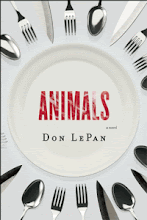
I’ll end with a piece of anecdotal evidence that the old are never too old to change. Among the very first people to be persuaded by reading Animals to change their eating habits was someone who had recently turned 90—the poet P.K. Page. It’s hard to imagine that many of us will be sufficiently open-minded at that age to make truly significant changes—but P.K. was surely extraordinary. With how many people in their nineties does it seem as natural to talk about sexual love, or politics, or religion as it does to talk about the health of relatives, or the weather, or the distant past? And how many people in their nineties talk not only with wisdom but with spark and sharp insight? In 2009 P.K. published four books—and they were good books too. When she died this past January 14 she was 93. I had come to know her only in her late 80s, my early 50s; I so wish I could have known her longer.
*No one seems to be sure where the saying originated; in slightly different versions it has been attributed to Churchill, Bismark, Clemenceau, and others.
Showing posts with label aging and changing. Show all posts
Showing posts with label aging and changing. Show all posts
Saturday, March 6, 2010
Subscribe to:
Posts (Atom)