In Danzy Senna’s recent novel
Colored Television there’s a passage about the advice that the protagonist (a fiction writer, and also a creative writing instructor) gives to her students:
There was a lecture she gave her students every term on how to transform reality into fiction…. She told them you shouldn’t know too much reality if you were to invent something fully on the page. She always used the example of Henry James—how he came up with the concept of his masterpiece, What Maisie Knew. He had been sitting next to a gossipy old woman at a dinner party one night and she told him she had an idea for a novel he should write. She began to tell him a story about a family she knew—two awful, greedy parents who were divorcing and the child caught in the middle, their pawn—when James interrupted her and said he didn’t want to know any more. He only wanted the briefest of details; then he was off and running.
That advice strikes me as being very good indeed. Certainly it rings true in relation to what I’ve found works for me in writing fiction—and not just in connection with story material. It can be better to have just the wisp of a story from the real world rather than the whole thing; in similar fashion, it can be better to set stories in real-world places that you have only wisps of familiarity with, rather than in places you know intimately. With place as with story material, it can help if the imagination is allowed plenty of room to create its own reality.
When I read that passage of Senna’s, I thought of my experience in writing
Leaving Pittsburgh, a book of linked short stories, many of them set—just as the title suggests—in Pittsburgh. (It’s a book I hope will be published some time in 2026). When I embarked on the project, I had spent only a small amount of time in the city—a very memorable period of time, to be sure, but a very short one. When I asked a couple of people who know Pittsburgh intimately to read parts of the manuscript, the first thing one of them said was, “Well, you obviously know the city very well.”
With Google Maps street view, of course, one has a sort-of access to actual views of almost anywhere in the world, and I certainly made use of Google Maps street view. But I also let my imagination fill in a great many spaces.
There are seven places I have lived for reasonably long periods of my life: Ottawa, Kingston, Toronto, Brighton/Lewes in the UK, Murewa in Zimbabwe, Calgary, and Nanaimo. With the partial exception of some scenes in
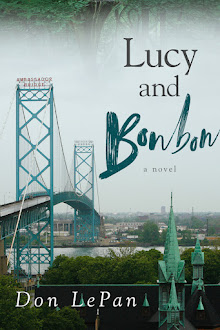
Lucy and Bonbon, I haven’t yet set a piece of fiction in any of them, and perhaps I never will. Places I have merely visited, or lived in for only a few months—places such as Chicago, New York, New Orleans, Pittsburgh—those are somehow far more imaginatively rich for me. And if a place feels imaginatively rich to the writer, chances are that the writer will be able to make it feel real to the reader.
The same is I think largely true of painting, for me at least.
The Skyscraper and the City, a book of my city paintings, will be published later this year. As I look through those images, I find it striking that the cities that have most inspired me have tended to be cities that I have only visited or lived in for brief periods. Chicago, New York, and New Orleans, all repeatedly, but also Phoenix, Sydney, Columbus—and Pittsburgh.