Showing posts with label vegan. Show all posts

Monday, November 11, 2019

Canada's Green Party - Which Way Forward?

In his Nov. 8 Globe and Mail column, Gary Mason puts forward the interesting argument that the Green Party of Canada should either merge with the NDP or “try to build a broader, more serious platform that is palatable to a greater cross-section of Canadians.” By taking this latter path, Mason suggests, “the Greens in Germany reinvented themselves” to become a major player on that country’s political scene.

Let’s look more closely at the German experience. The Greens in that country have indeed been riding high in the polls, and they have indeed put forward a broad, serious platform. But have they done so primarily in the way that Mason suggests—by watering down their environmentalism in order to make themselves “more attractive to centrist voters”? That's highly debatable.

The German Greens recognize—as, in Canada, even the Green Party is sometimes hesitant to do—that fighting climate change and protecting our future isn’t only a matter of reducing the production and consumption of fossil fuels. In particular, they recognize that industrial animal agriculture is damaging to human health in a wide variety of ways, and is responsible for a very significant percentage of global warming. Here are some highlights from the German Green Party’s set of agricultural policies (which together form a central part of their overall program):
We will replace intensive factory farming over the next twenty years by livestock welfare-centred husbandry. We will enforce higher animal welfare standards by law, based on the needs of animals, and on ending agonising breeding techniques and intensive animal farming. … We will restructure Europe’s tax billions to ensure that environmental protection and animal welfare become new income opportunities for farmers, because the new agriculture will depend on these farmers.
A German Green party spokesperson recently confirmed that the party supports increased taxes on meat consumption, with the proceeds being directed to improving animal welfare. In all this, the German Greens are considerably bolder than the Green Party in Canada—which is currently the only major Canadian party to engage at all seriously with the damage done by industrial agriculture. (The NDP echoes the Liberals, the Conservatives, and the Bloc in their enthusiastic defence of the status quo in the Canadian agriculture sector—including massive subsidies to animal agriculture.)

A few years ago things were different for the Greens in Germany; in 2013 their support fell dramatically when they proposed a once-a-week Veggie Day, on which cafeterias would be required to offer only vegetarian choices. The change in the party’s fortunes is partly a result of having pulled back on coercive policies of that sort. But it’s also a result of real changes in public opinion. Germans may still be opposed to any party trying to tell them they can’t eat meat on any given day. But many seem no longer to be opposed to putting a price on the damage done by industrial animal agriculture.

Slowly—ever so slowly—Canadians may be starting to move in the same direction. A 2018 survey by Sylvain Charlebois of Canadians’ eating habits reported that 7.1% of Canadians self-identify as vegetarian, with over 2% of those being vegan. (By comparison, just 3% self-identified as vegetarian in 2003.) A further 10.2% described themselves as “flexitarian” or as having a “primarily vegetarian diet”; that’s over 17% either vegan, vegetarian, or flexitarian. And of those Canadians who do eat meat, fully 51% reported that they were willing to consider reducing their meat intake.

I would argue that the Canadian Greens should be gently encouraging Canadians to move in just those sorts of directions. The Greens should take the lead not only in calling for an end to government subsidies for the fossil fuel industry, but in doing the same when it comes to animal agriculture. And the new Green leader (whoever he or she may be) should speak to us as individuals as well, pointing out that we’re all in this together, that our governments can’t do it all, and that, just as we should all do what we can to reduce our impact when it comes to driving, flying, and heating our homes, so too should we do what we can for our environment, our health, and our children’s future when it comes to choosing what we eat and drink, what we wear, how we live our lives. The German Greens have been doing just that—and public opinion now seems finally to have caught up with them.


Wednesday, November 30, 2016

Cats and Humans, Eating Birds

Margaret Atwood is perhaps the highest profile figure in what has become a widespread North American campaign to restrict cats to the indoors. In "The Case Against Cats" in the December issue of The Atlantic, Britt Peterson reviews Peter Marra and Chris Santella's Cat Wars: The Devastating Consequences of a Cuddly Killer, and asserts that cats are "bad for us, and for our planet." Reviewing the same book in a piece this fall in The New York Review of Books ("The Killer Cats Are Winning," September 29), Natalie Angier insists that it's a no-brainer that all cats should be forced to stay indoors, so that they will not be able to kill birds:
This is a ridiculous point to waffle on: pet cats should no more be allowed to roam around at will than should pet dogs, horses, pythons, or pot bellied pigs.
The reason is that domestic cats are alleged to be responsible for the deaths of "up to 4 billion birds" annually in the US.

That figure comes from a 2013 Smithsonian Biology Institute study, conducted under the direction of Marra. Previous estimates had been in the range of 500 million birds; Marra's study put the range at "between 1.3 billion and 4.0 billion." Marra is clearly not impartial on this issue, and so far as I'm aware, neither the 1.3 billion nor the 4.0 billion figure has subsequently been given credence by other scientific studies. But let's say that his numbers are accurate--and then let's ask where our efforts to save birds and other animals should be concentrated.

On the one hand we have a species--the domestic cat--that is by nature carnivorous. The digestive systems of cats, biologists tell us, are such that these animals cannot choose not to eat the flesh of dead animals. If a domestic cat does not catch and kill its own meat, then it must be fed meat from animals that we humans have caused to have killed. One way or another, it must be a carnivore.

On the other hand we have a species that can choose to abstain from eating other animals (and that will be perfectly healthy if it does so--indeed, much more healthy than if it consumes animal products). Yet most members of this species choose a diet that involves the wholesale killing of members of other species. Moreover, in order to minimize their own expenditure, they confine the animals whose flesh and milk they will consume, keeping them in horrific conditions throughout their lives.

The species that must eat meat is said to be responsible for killing between 1.3 and 4 billion birds in the United States annually.

The species that can choose not to eat meat or other animal products is quite certainly responsible for killing more than 18 billion birds annually in the United States--plus hundreds of millions of cows, and pigs, and other animals. And virtually all of those 20 billion or so animals are subjected to horribly cruel treatment through their lives before the humans have them killed.

Is there a priority here? Of these two species, which should we focus on if we are trying to reduce suffering for other species?

The issue of cats killing and eating birds is not trivial. But it pales beside the much, much larger issue of humans killing and eating birds and other animals. Before we blame humans who choose to keep cats who will sometimes kill and eat birds, let's put the larger share of blame where it belongs--on humans who choose to kill and eat birds themselves, and to kill and eat other animals, all of it cruelly, and all of it utterly, utterly unnecessary.

Tuesday, March 4, 2014

A Fourth Reason to Treat Non-human Animals Well–Human Happiness

There have long been three sets of good reasons for people to refrain from eating factory-farmed animal products (and, ideally, from eating meat or dairy altogether). Now there is a fourth.

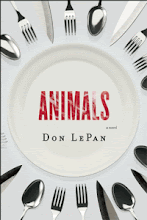
The set of reasons that Animals emphasizes is the one with the longest pedigree; from Pythagoras to Percy Shelley to Peter Singer, Paul McCartney and k.d. lang, there have been well-known figures putting forward the case for treating our fellow creatures with kindness rather than cruelty.

For decades now there have also been two other arguments. The environmental arguments are overwhelmingly strong. When humans eat animals rather than plants we consume far more of the earth’s resources (the land devoted to growing feed for the animals, the water required to irrigate the land, the energy required at every stage of the process); when “intensive” rather than organic methods are used, the damage becomes far worse.

The third set of reasons concerns human health. In the early nineteenth century Lewis Gompertz called on humanity to give up eating animal products–even though he was convinced this would not be good for our health, he felt the moral imperative of refraining from cruelty to other animals trumped whatever concerns we might have over the loss of nutrients in our own diets. Today we may admire Gompertz’s ethical courage, but we know that he was wrong about human health. Study after study after study has shown the health benefits to humans of adopting a diet without animal products. All else being equal, the less you eat animal products the less likely you are to get cancer, stroke, diabetes, heart disease—that’s just the beginning of a long list. (According to some studies, certain sorts of vegan diet can even reverse the effects of some heart disease.) Yes, there are still many in denial about those studies—and many interested parties in the meat and dairy industries would prefer you didn’t know about them, and try to discredit them. But that’s becoming harder and harder to do; the simple fact seems to be that you’ll be healthier if you eat other animals less often, and in smaller portions—and healthier still if you stop eating other animals entirely. (If you'd like more information on this side of things, www.nutritionfacts.org is a good place to start.)

The fourth reason? Human happiness. A substantial and growing body of research over the past ten years or so has found an inverse correlation between the degree to which humans consume other animals and the degree to which they are happy. To some extent, of course, one would expect that to be the case, since healthy people tend to be happy people. But much more than that seems to be involved; it’s also a matter of the chemical activity in the brain. In a series of studies in recent years, scientists have concluded that the consumption of various animal products promotes inflammation of the brain; that, in the other direction, a healthy* vegan diet helps to release chemicals that improve the human mood; and that, in general, those who do not consume animal products tend to report being in a better mood than those who do (to an extent that other variables are insufficient to explain). If you’d like to check out some of the research, I’d recommend starting with this article: “Restriction of meat, fish, and poultry in omnivores improves mood: A pilot randomized controlled trial” by Bonnie L. Beezhold (Benedictine University) and Carol S. Johnston (Arizona State University), Nutrition Journal, 2012 11:9. In their references Beezhold and Johnston point the way to much of the other relevant research.

It may not speak particularly well of our species if humans who consume other animals are deaf to the arguments regarding cruelty to those animals but responsive to appeals to self-interest—whether based on human health or human happiness. Nonetheless, it if the suffering of pigs and cows and birds and the others is reduced through the operation of human self-interest, that will be no bad thing.

*One should emphasize the qualifier “healthy”; all bets are off for those subsisting on French fries and vegan chocolate chip cookies.