Showing posts with label Zimbabwe. Show all posts

Saturday, October 21, 2023

Excerpts from an Animals Interview

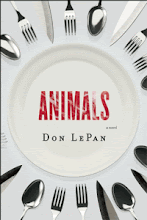
Snigdha Sunith, a doctoral student at India’s Bharathiar University, was recently in touch to ask me a number of questions about Animals, which will apparently be the focus of a good part of Sunith’s dissertation on “Vegetarianism in the Anthropocene.” I’ll share some of what I wrote in my written response.

On the background to my writing the novel:
Around 1991 a friend lent me her copy of Animal Liberation. To that point I had never given much thought to what I ate, or, indeed, to eating generally—to farm animals, to factory farming, to fertilizers and herbicides and pesticides, any of it. I was rivetted and appalled by Singer’s descriptions of the horrific realities of factory farming. I write in the “Afterword” to Animals that I was “persuaded … largely through reading Singer’s book” to start to change my eating habits. What I don’t say is that there was a long lag between the reading and the start of the change. For several years after reading Animal Liberation, I don’t think I made any change whatsoever in my diet. I guess I found ways of pushing to the back of my consciousness what I had read about (and seen—the photos in Singer’s book were very powerful too). Eventually I did start to allow my new knowledge of “farming” to start to shape my eating habits, and then incremental change just kept coming (as I touch on the “Afterword”).

But I did not think of trying to do anything to try to influence others to change their dietary habits until one Sunday morning in 2004 or 2005. As I was doing my exercises that morning, I listened to a CBC radio feature on how horrific things had become in Zimbabwe under Robert Mugabe. I had spent three years in the early 1980s doing volunteer work as a teacher in a rural school in Zimbabwe, and at that time the country’s future had seemed bright. I guess I thought of those volunteer years as a time in my life when (much more than at other points in my life) I really had done something, however modest, to try to help make the world a better place. And now all the work that all of us—dedicated Zimbabweans far more so than we expatriates—had done to try to build something good and lasting in that country was being destroyed by the Mugabe regime, a group of once-proud freedom fighters who had become oppressors and plunderers.

“What might I do today that might do some good?” was the question I found myself asking. Spending another few years volunteering at that point in my life was out of the question—I had started a book publishing company that I couldn’t abandon, and I had two young children. “But I could write,” was my next thought. The only novel I had at that point written was an embarrassingly bad political adventure tale that had never been published (and that I hope never will be—it really was terrible!). But I had done a good deal of other writing, and I had learned a good deal about people—as most of us do by the time we’re fifty. It stuck me that there are many ways of influencing people through the written word; a powerful recitation of facts and marshalling of arguments in a work of non-fiction such as Singer’s Animal Liberation is one, but perhaps some sort of imaginative presentation might be another effective way. And then, in something like 30 seconds, the basic story of Animals came to me—none of the details in that length of time, of course, but the outline of all three parts of the story.

On Naomi’s questioning her parents about the ethics of eating meat:

I don’t know what to say about Naomi. I gave her the name of my daughter, although at the time I wrote the book I didn’t think my daughter was very similar to the character of Naomi in the book. Quite a few people who know both, though, have told me I’m wrong about that, and that real-life Naomi is in fact quite a lot like the character.

I do think many children are wiser than their parents on these issues; parents tend much too easily to laugh off as childish naivete children’s frequently expressed reservations about (or outright opposition to) the killing and eating of other creatures.

Adults tend to dismiss the arguments of children on the grounds that children have a less developed capacity for reasoning than do adults. And too many humans, of course, feel that we're justified in killing and eating other creatures who have a less developed capacity for reasoning than we do. But there isn't any good reason to treat other creatures cruelly on the grounds that they have less reasoning capacity than we do. Humans would see this point more clearly if a civilization of alien invaders a lot brighter than we are decided to treat us cruelly on the grounds that they were justified in doing so because our reasoning capacities were less developed than theirs.

On the impact I hoped at the time Animals would have on readers, and the impact it has had on readers:
As I say in the “Afterword,” I was at the time conscious mainly of aiming to help to shift attitudes regarding factory farming in particular. But as a number of readers pointed out to me soon after publication, the novel can easily be read as an argument against eating animal food of any sort (meat, but also eggs, cow’s or goat’s milk, cheese, and so on*)—an argument for adopting an entirely plant-based diet. Looking back on it, I think the experience of writing the novel did a lot to lead me in that direction (my partner and I have been vegan since 2011). The moral here is perhaps that I should have left it up to readers to decide for themselves how the novel should be read!

There have been many people over the years who have said or written that the experience of reading Animals had a real effect on them—and, in particular, had a real effect on their eating habits. No one has said that they suddenly went vegan after reading the book—nothing so dramatic. But lots by way of small changes. I gave a presentation last week in San Diego to a large group of first-year students, and spoke afterwards with the professor who teaches the course; he has been assigning Animals now for many years, and he told me that roughly 20% of his students have reported to him that reading (and discussing) the novel has led to at least some change in their attitudes and behavior. In 2016 my partner (Maureen Okun) and I did a small study of the effect of the novel; the results can be found here: https://papers.ssrn.com/sol3/papers.cfm?abstract_id=3758567


On my other works of fiction:

My third novel, Lucy and Bonbon, which was published last year, deals with some of the same themes as Animals. My next book of fiction (tentatively titled Leaving Pittsburgh), will be a collection of linked short stories about various sorts of human interaction, with nothing in it about human and non-human animals.

I seem to be alternating between works of fiction focused on human/non-human animal themes, and works of fiction in which those themes are entirely absent. My second novel, Rising Stories, was a book about childhood and the imagination and Chicago, and was in no way concerned with human and non-human animal themes. My fifth work of fiction will I think turn largely on an investigation of a factory farm near Columbus, Ohio.

*In terms of cruelty, the dairy industry may well be the worst of all. One has to start with the fundamental fact at the heart of it—we take the babies from their mothers so that we can steal the milk meant for the babies. And then we kill the babies (or at least the male ones) while they are still very young, and call it veal. Nowadays, the cruelty goes far beyond that, of course; whereas dairy cows once really did graze in fields and eat grass, now they almost always live their lives on concrete floors, chained in place.


Wednesday, March 11, 2020

Cross-Cultural Scholarship: A Cautionary Tale

My original intention was to call my first book The Birth of Expectation: A Cognitive Revolution in Western Culture. But when I told the publishers, Macmillan, of my tentative plans for a follow-up volume they decided they wanted a grander title; when it came out in 1989 the book had acquired a definite rather than an indefinite article at the start, and bore the title The Cognitive Revolution in Western Culture, volume 1: The Birth of Expectation. In a quiet way it’s received a good deal of attention over the years—though, in recent years, not of a sort that makes me at all happy.

The monograph originated in the Masters thesis I had completed at Sussex more than a decade earlier (working under the brilliantly wide-ranging scholar, and wonderfully warm-hearted human being A.D. Nuttall), the central insight of which had been that there was a yawning divide between the plotting techniques employed by Shakespeare and Marlowe and the plotting techniques employed by their medieval (and even their immediate Tudor) predecessors. Shakespeare and Marlowe crafted plots that facilitate the formation of expectations in the minds of the audience members; typically, characters’ intentions are revealed before they act on those intentions. That became the most common template for plots through to our own day; audiences (or readers, or viewers) are provided with raw material that encourages them to form expectations of what is likely to happen as the action moves forward. But almost all plots from the medieval period operate on a very different basis; one thing happens, and then another thing happens, and then another thing happens after that, without our being given information that would allow us to form expectations as to what is likely to happen.

The question I was left with when I had completed the short Master’s thesis was why. Why would such a drastic change in dramatic plots have occurred? And the conclusion I eventually came to was that most people in pre-Shakespearian England had not developed the sorts of temporal and causal thought processes that, for educated individuals in technological societies, have become sufficiently ingrained to make the formation of expectations as to what is likely to happen a deep-rooted habit.

It was a conclusion reached largely through a comparison of the evidence from medieval English (and medieval European) culture with evidence from a wide range of other pre-literate societies. But it was a conclusion carefully qualified in a number of ways. First, I made clear that the generalizations I was making concerned the great majority but not every individual; I was not suggesting that highly educated individuals such as Thomas Aquinas or Geoffrey Chaucer had not developed the ability to form expectations of this sort. Second, I made clear that the differences I was postulating were the result of environmental factors and subject to change; they were not innate. “Indeed,” I suggested, “it seems self-evident that a baby born into [San society on the Kalahari] but brought up from infancy and educated in Toronto will grow up with modern Western habits of thought, and that the reverse is also true.”

Though my focus in looking at developed societies was on those of the Shakespearian and post- Shakespearian Western cultures, I in no way suggested that non-Western literate cultures had not developed causal and temporal cognitive habits of very much the same sort as those developed in the literate West. I said very little about non-Western literate cultures, either in earlier eras or today. Then as now, it seemed obvious to me that even a glance in the direction of the history of China should be enough to make clear that, over much of the past 2,000 years and more, Chinese culture evidenced causal and temporal thought processes at least as sophisticated as those found anywhere in the West at the same time.

It seemed clear to me too that many “developing” countries were indeed developing not just economically, but also in terms of people developing more complex patterns of temporal and causal thought. Of Zimbabwe, for example—a country where I lived for three years in the early 1980s, teaching at a rural high school—I observed that generalizations about causal and temporal thought processes which “still hold for the bulk of the rural population, most of whom are untravelled and (despite the massive developments in the years since Independence) only semi-educated, are manifestly untrue of the growing number of Zimbabweans who are possessed not only of a high level of formal education but also what one can only refer to as urban sophistication.”

Most important of all, I repeatedly made clear that my argument should not be taken to suggest an over-arching superiority of any sophisticated culture over any less sophisticated one. Indeed, my contention was that even where most people in pre-literate cultures may tend to think in quite different –and even less logical ways—than most people in more highly educated and sophisticated cultures, they may still be equal or superior to more “developed” peoples in spheres such as the moral and the aesthetic. I also suggested that pre-literate cultures often possess a poetic vitality that has been largely lost in the developed West, and argued strenuously that a highly educated society in which the majority of people possess highly complex temporal or causal thought processes is no more likely to be a wise or a morally good society than is the most undeveloped of pre-literate societies.

The one thing I regret about the way I expressed the argument of The Birth of Expectation: A Cognitive Revolution in Western Culture (as I much prefer to call the book) is that, instead of referring to “pre-literate societies” or “elemental ways of thought” I used a term that, although controversial, was in the 1980s still fairly common in reputable scholarly discourse; I referred to “primitive societies” and “primitive ways of thought.” I soon realized that I had made a mistake. The 1995 paperback edition of the book includes the following note, which bears repeating:
I have become convinced that the frequent use in the text of the word “primitive” was ill-advised. In the book’s first long note and at many other points I am at pains to point out that I see the proper use of the term as being purely descriptive (to mean “original; primary”) rather than pejorative. But as others have now persuaded me, … one doesn’t get to make the language; once a word such as “primitive” has been corrupted by prolonged pejorative use, it may not be enough to argue that it should not carry negative connotations.
The text [of the paperback edition] has not been reset, and troublesome word thus remains. (Nor am I sure of the best substitute; I suspect “elemental” might serve better than any other.) But at least the paperback may carry a prominently placed apologia for my having used a word that I should have recognized carried with it the risk of tainting for many people the thesis of the entire book, and of allowing it to be suspected of perpetrating the very sorts of preconceptions that it was written largely to challenge.
As it happened, the book was not attacked for its use of the word "primitive," or for its thesis; the scholarly reviews were not numerous but they were on the whole very favorable.

I nevertheless am deeply saddened by its reception. It has had virtually no impact in the field of serious literary studies, and I make no complaint about that; it’s the fate of most scholarly monographs, particularly when they put forward arguments that go nowhere near the currents of a discipline’s main stream. What saddens me is where the book has made an impact. Despite all the disclaimers, despite all the careful qualifiers, the book has been cited again and again by those whose goal is to paint the West as superior to the rest.

Typical is an article by Ricardo Duchesne, posted on the “Counter-Currents” website and entitled “Jean Piaget and the Superior Psychogenetic Cognition of Europeans.” Counter-Currents Publishing—a self declared voice of “the North American New Right” –dedicates itself to principles such as this: “We live in a Dark Age, in which decadence reigns and all natural and healthy values are inverted.” It declares that it “aims to promote the survival of essential ideas and texts into Golden Age to come.” Those “essential” ideas, it is made very clear, are European ideas—evidently code for “white people’s ideas,” given that white North Americans are surely included in the "North American New Right."

Ricardo tries to use my work to support what to me are entirely misguided claims for the supposed “superior intellectual powers and superior creative impulses” of Western culture. He refers to the “he uniqueness of the West,” “the higher fluidity of the Western mind, the multiple intelligences of Europeans”—repeatedly suggesting that “Europeans” are innately superior to other peoples.

Duchesne does acknowledge at one point in his discussion that “LePan carefully distances himself from any claim that Europeans were genetically wired for higher levels of cognition.” But he suggests that the sorts of evidence I present can and should be taken to draw such a conclusion. More, he ascribes to writers of my ilk a fear of confronting the truths my work supposedly points to:
The uniqueness of the West frightens academics. They have concocted every imaginable explanation to avoid coming to terms with the fact that Europeans could not have produced so many transformations, innovations, renaissances, original thinkers, and the entire modern world, without having superior intellectual powers and superior creative impulses. To draw any such conclusions about the world’s various groups of humans is to my mind not only wrong in point of fact; it is also morally repugnant.
It is telling that Duchesne dismisses the final chapter of The Birth of Expectation (“Postscript: Zimbabwe, 1995”—to my mind perhaps the best-written part of the book) as simply “strange.” He observes archly that “LePan praises the cultural ‘vitality’ of this African country,” as if that were all I praised about Zimbabwean culture—and as if any praise at all for an “African country” were to be wondered at.

Anyone who knows anything of the culture of Zimbabwe—the engaging and intelligent fiction of such writers as Charles Mungoshi, Tsitsi Dangaremba, and NoViolet Bulawayo, for example, or the unforgettable music of such songwriters and musicians as Thomas Mapfumo, Oliver Mtukudzi, and Leonard Zhakata—will be aware of its rich complexity and its wide-ranging intelligence as well as its vitality. But writers such as Duchesne evidently have no interest in non-European cultures in and of themselves; such cultures seem to be of interest only insofar as information about them can be twisted so as to suggest that they are inferior to “European” cultures.

It is in the Postscript that I argue most powerfully that “the Shakespearean moment” in our own culture occurred when new cognitive processes were emerging among the majority of the population, but the poetic vitality of pre-literate culture was also still very much alive in the mainstream of society. Given the degree to which such vitality has now been blunted by the post-renaissance emphasis on rationalism, I argue that another such moment has become impossible in our own society—and that “if a new Shakespeare is to emerge,” it is far more likely to be “from the valleys of the Niger or the Zambezi than the skyscrapers of New York or London.” I believed that then; I still do.