Tuesday, June 10, 2014

Cruelty to Animals: Should the Media Tell Us What We'd Prefer Not to Know?

The feature “Behind the Barn Door,” which aired on CTV’s W5 October 18, 2013, might seem a good example of investigative journalism at its best. The program revealed how the animals were treated at two massive Alberta egg facilities, Kuku Farms and Creekside Farms:
Perhaps most disturbingly, sick or injured chicks, are seen being killed by a practice called "thumping"—where a bird is smashed against a hard surface to kill it. On several occasions the video shows birds that survived but are left in a garbage bag along with a pile of already dead chicks.
The video did not merely expose the flouting of regulations at these two farms. Much more significantly, it gave viewers an understanding of how and why such abuse has become commonplace:
Industries such as the egg business have a Code of Practice that defines the care and handling of [birds], but the code is completely voluntary. Any oversight is conducted by the industry themselves. It is up to the Egg Farmers of Canada to perform the inspections, but as W5 learned, their primary focus appears to be the food safety of the eggs, or [issues of quota allocation], not whether the animals themselves are receiving adequate care.
Most significantly of all, the program gave viewers a vivid sense of the levels of animal cruelty that, far from representing “abuses” of the system, are entirely approved practice under current Canadian law and current Canadian industry codes of practice. Packing hens together in battery cages where the birds are so cramped they can barely move became “conventional” industry practice around the world in the second half of the twentieth century. In many jurisdictions there has been a strong push-back against industry; in California a referendum has forced industry to give birds more room, and in Europe battery cages are being phased out entirely. Sadly, nothing of the sort is happening in Canada: the failure in this country to limit the spread of cruelty towards animals in “conventional” farming operations represents a massive (and massively under-reported) failure of democracy.

Now Mercy for Animals has done it again; as reported on CTV News June 9 2014 and on the national CBC News this morning, workers at the Chilliwack Cattle Company (milk from which is packaged under the popular “Dairyland” label) have been shown by a Mercy for Animals investigator to have been engaging on an ongoing basis in abusive behavior of the most sickening sort towards dairy cattle. And, as with the egg industry, there is good reason to believe that cruelty to farm animals is systemic.

Much of the problem is with the law; meaningful reform of Canada’s animal cruelty legislation (the essence of which dates from the 1890s) has been stalled again and again—perhaps most shamefully in 2003, when a bill that would have brought real improvement was passed by the House of Commons but allowed to die in the Senate. In 2008 the government passed very modest amendments to animal cruelty legislation, but these offered so little protection for non-human animals that they were vigorously opposed by the Canadian Federation of Humane Societies. Provincial governments (Conservative, Liberal, and New Democrat alike) have given the issue just as low a priority—and with both federal and provincial law so toothless, the judiciary has been powerless to make any meaningful contribution towards reducing cruelty towards animals in our agricultural industries.

What, then, of democracy’s fifth estate? Are the media making some efforts to raise awareness and bring about reform? And should they bear some responsibility to do so?

The broadcasting of the W5 feature and of the news features on CTV and CBC news might seem to suggest that the media is indeed trying to bring this issue to the attention of Canadians. But dig a little deeper, and the reporting of these investigations—in other media outlets as well as these—starts to reveal a different story.

To begin with, these investigations were not carried out by CTV or CBC, at the instigation of CTV or CBC, or under the auspices of CTV or CBC. They were entirely the initiative of the animal welfare organization Mercy for Animals. That W5 chose to air a feature on the work a Mercy for Animals investigator had done is to its credit (as is the follow-up work W5 did, such as uncovering a directive sent by the Egg Farmers of Canada association to its members: “do not allow [the media] access to your farms or barns”). And it is to the credit of CTV and CBC News to air reports on the most recently uncovered abuses in the dairy industry. But neither W5 nor the networks can in any way be credited for having done the investigative work themselves.

Such has long been the pattern with other exposés of cruelty to animals in Canadian agricultural practice. The 2010 Global television documentary No Country for Animals, for example, relied on investigative work carried out by Twyla Francois (then with Canadians for the Ethical Treatment of Food Animals) and others; Global’s own reporters had not conducted any undercover investigations.

What is most remarkable about the media coverage of these horrors, however, is not the failure to include investigative reporting as part of that coverage; it’s that there has been so little coverage of any sort. To put things in perspective, it may be helpful to look at total numbers. One result of the everyday practices of Canada’s egg and poultry industry is that each year more than 700,000,000 birds in Canada are subjected to horrific treatment throughout their short lives. Set beside that number the estimated annual total of 2,000 birds that suffer horribly after landing in oil sands tailings ponds in Alberta. Or set it beside the “culling” of 56 sled dogs in Whistler in 2010. These were high-profile media stories that received ongoing coverage for weeks, even months. By contrast, W5’s feature on the mistreatment of a far larger number of birds received coverage only for a couple of days. A good deal of that coverage, moreover, focused largely on the side-story of whether or not McDonalds Canada had any connection to the farms that had been investigated. (The headline “No McDonalds Eggs come from Alberta” in the Nanaimo Daily News was not untypical. Nor was the choice by that newspaper of what to highlight in bold: “’We care about the humane treatment of animals and believe they should be free from cruelty, abuse, and neglect’—Karin Campbell, McDonalds spokeswoman.” The actual facts of how the animals are treated at the farms visited are nowhere mentioned in the paper’s report.)

Famed philosopher Richard Dawkins suggested recently that the systematic cruelties of today’s factory farming are so extreme that a century or two from now we may well look back on them in “something like the way we today look back on the way our forefathers treated slaves." Why might it be that the Canadian media have been so quiet about such an important and acutely troubling issue?

One obvious answer might be advertising; the food industry spends many millions annually in Canada on advertising, and most of that industry is in one way or another heavily invested in the cruelties of the intensive farming of non-human animals—if not directly, then in the low prices that these practices bring to the supermarket. As soon as one puts it in those terms, though, it becomes clear that one cannot blame the food industry—or the media that rely to a significant extent on advertising revenue from those industries—without also blaming the consumer.

Let’s put it a little more bluntly—without blaming ourselves.

Food prices in recent decades are a bit like murder rates in North America; they keep going down, even as most people think they are going up. In inflation-adjusted terms the average prices of meat, eggs, and dairy products have been declining steadily since the 1950s; the cruelties of mass production “conventional farming” have lowered the real price by considerably more than half over that time, even as most of us have become far better off. You wouldn’t know it to read reports of food prices in the media—or the reported reactions to the prices of organic and free-range produce. An Iowa State Veterinary Medicine professor (salary range—well over $100,000) who was deputy undersecretary for food safety under George W. Bush recently pronounced that he could not “afford organic, free-range, or food raised with methods from the 1950s.” He neglected to mention that those 1950s methods involved only minimal cruelty to non-human animals. The inference, in effect, is that we should let the pigs and the cows and the birds suffer so that we may have more disposable income for our cars, our gadgets—and the $4 lattes and $6 drinks that even those of us who “can’t afford” an extra $2 for free range eggs seem to be able to find room for in our budgets.

Most of us do a dance around these issues in our minds; in a 2006 column Margaret Wente faced them with appalling honesty:
Most of what we do to animals before we eat them isn't nice. If we knew exactly how they lived and died, we'd be horrified. Fortunately for us, we're so removed from where our food comes that we can choose not to know. Ignorance is bliss, and I, for one, am a devoted carnivore. I have studiously tried to avoid learning about the revolting details of factory farming, because if I knew, then I would have to stop eating meat … or at the very least search out meat that had an okay life. That would be hard. It's easier to be a hypocrite.
How much responsibility should the media in a democratic society shoulder for reporting what most of us don’t want to hear? It’s widely accepted that the media bear a good deal of responsibility to report on what is likely to harm our health and/or harm the environment. As it happens, the factory farming of non-human animals is increasingly acknowledged to cause both those sorts of harm. And, to be fair, the health and the environmental realities are beginning to be more widely acknowledged in the media—though, tellingly, such coverage is usually to be found in the lifestyle sections. To judge from the news and the business sections of our major dailies, one would think that low prices for meat and milk and eggs are nothing but a good news story; when outrage is heard, it is usually over the fact that Canada’s marketing boards prevent prices here from being quite so low as those in the States.

Even if damage to human health and to the environment were not among the byproducts of factory farming, it’s arguable that the media in a democracy would have a responsibility to report on the cruelties of factory farming. As part of the role the media play in our democracy, we expect that from time to time they will stand up for the rights of oppressed minorities, even when the majority is not disposed to respect those rights. Indeed, it is especially when the majority is not disposed to respect those rights that we expect the media to play a crucially important role. We also look to the media to stand up for those who quite literally do not have a voice; if sled dogs are being abused by their owners, if animals are being mistreated in zoos, or if animals in the wild are being harmed, we expect the media to speak out. We should expect no less when it comes to the animals humans intend to consume as food.


Tuesday, April 15, 2014

Petting Zoos: A Test Case of Zoo Psychology

Robert Everett-Green argued persuasively recently in The Globe and Mail that, on balance, zoos do not serve a useful role either in conserving endangered species or in educating human animals to become more knowledgeable and more caring about non-human ones (“Why I’m Never Going to the Zoo Again”). There was a lively reaction to his article, with many writing in support, but also many (including several zoo executives) waxing indignant. A key pillar of the pro-zoo argument is of course that zoos help children learn about animals, and learn to care about animals—not just the individual animals in front of them but also members of the same species who they will never see, who may be thousands and thousands of miles away. Conor Wyche of Mississauga, Ontario, expressed this idea concisely and well in his letter to the editor: “It is difficult to connect to, or care about, things you never see” (Globe, April 5). Massimo Bergamini expressed a similar view in his own op-ed piece, ridiculing Everett-Green’s suggestion that these days we can learn more about the natural lives of animals from films than from viewing them in person in captivity. “As if digital interactions can ever replace being able to see, smell, hear and touch an animal,” he sniffed. “What a frightening, alienating and dangerous vision of the natural world.”

Bergamini’s and Wyche’s views sound like simple common sense. But are they right? One conclusive test comes to my mind: petting zoos. These have become extremely common throughout North America and much of Europe as well. There are eleven in the Seattle area, ten in and around Amsterdam. Most are stand-alone operations, but it has also become very common to find a petting zoo (or “Children’s Zoo”) as a special section within a traditional zoo; from Omaha to Edmonton and from Boston to San Diego, mainstream zoos have developed areas where very young children may see farm animals up close.

The cuteness of the animals in petting zoos (lambs and goats and ponies, but also calves and pigs and chickens and turkeys—many petting zoos include most varieties of “food animal”) tugs on the heartstrings in much the same way as does the cuteness of the baby gorilla or the baby giraffe. Allison Holm’s gush on the Seattle Parent Map site puts it very plainly indeed: “It’s not spring without baby animals, so grab your kiddos (and camera) and get ready to oohh and ahhh over furry and feathered new additions [to the zoos and petting zoos in the Seattle area].”

But do all the fuzzy feelings engendered by these” furry and feathered” friends carry over into the wider world? One would like to think they do, but the evidence points in the other direction; it’s hard not to conclude that, however unintentionally, petting zoos and children’s zoos where farm animals are on display end up doing more to foster cruelty than to prevent it. Children’s zoos and petting zoos began to become popular in the 1950s and 1960s. The first children’s zoos seem to have come into existence around 1950; according to the OED, the first recorded use of the term “petting zoo” in print is in a 1965 article in the Fond du Lac (Wisconsin) Commonwealth Reporter. In Canada, the Experimental Farm in Ottawa seems to have been something of a pioneer in trying to build awareness of farm animals among city children. The British magazine Country Life ran a feature on the farm in 1965, saying that although the primary purpose of the farm was agricultural research, the general public was “welcome to come and see what [was] being done.” I remember myself as a very small child growing up in Ottawa in the 1950s, visiting the animals at the Experimental Farm, and loving the experience—just as children throughout the Western world have come to enjoy the experience of visiting children’s zoos and petting zoos over the past half century. And I would love to think that such experiences help children to develop a humane attitude towards their fellow creatures—not just the cute baby ones that they are allowed to pet but also the ones far away.

But is that the case? Why should we expect that oohing and aahing over little calves or little chicks in front of us should have any real effect on our attitudes towards the calves and chicks we can’t see? How much effect does oohng and aahing over the human babies we see here on Canada have on our attitudes towards the babies in South Sudan or the Central African Republic who may need our help, but usually don’t find help forthcoming?

It is striking that the era of the petting zoo has coincided almost precisely with era of tremendous growth in intensive animal production; the factory farming of “food animals” really took off in North America in the 1950s and 1960s. Even as our society has encouraged its children to express affection for the small number of farm animals who are displayed in petting zoos, it has been complicit in the growth of a system that treats with horrific cruelty the billions and billions of farm animals which the children don’t see. A cynic might suggest that at some level the two go together—that foregrounding small scale but highly visible settings in which kindness towards farm animals is encouraged acts as a useful distraction from the high volume cruelty that has for the most part been hidden away.

I would not go so far as to suggest an intentional link between the two. But whatever the motive, whatever the rationale, the spread of children’s zoos and petting zoos has done little or nothing to deter people from eating the products of cruelty. For all the publicity about free range alternatives to what is now described as “conventional” farming, the products of these more humane alternatives represent well under 5% of the market in North America; almost everyone decides to save money and buy animal products that could never claim to be “cruelty-free.” Families ooh and aah at the cute animals at the petting zoo or the children’s zoo, and then go off to eat the same animals at a nearby McDonalds, where the drive to keep prices low for those families has meant that the levels of cruelty the non-human animals experience (not just at the slaughterhouse but throughout their short lives on the “farm”) has steadily been ratcheted up.

One cannot expect the four-year old petting the little calves and piglets to make the connection—and one would not want to tell a four-year old the facts as to how the calves and piglets who aren’t lucky enough to spend their lives in petting zoos are treated. But what about once children do become old enough to learn something of the truth (the gestation crates for pigs that restrict mothers so fully they cannot turn around; the laying hens crammed five or six to a tiny cage for their entire lives; and on, and on). Do they connect the bond they have felt with the animals they can touch in a petting zoo with the animals far away? Sad to say, there appears to be no connection made.

And what of the adults? If anything, having the opportunity to perform expressions of affection towards calves and turkeys and piglets—and giving their children the same opportunity—may act as a salve to adult consciences. Almost every adult who eats factory-farmed animal products in North America is at some level aware that the animals from which those products come are often treated cruelly; almost every adult wants the prices of these products kept low; but almost every adult also likes to think of him- or herself as someone who loves animals. How can those attitudes be reconciled? At some level, of course, they can’t. But if adults are able to take their children to petting zoos and children’s zoos—and if they themselves smile at the resulting happy interactions between human and non-human animals—it can only help to demonstrate that they are indeed animal lovers. If there’s cruelty happening in the production of what they eat, they surely can’t be in any way held responsible. Can they?

Petting zoos and children’s zoos, to put it bluntly, facilitate a denial of complicity in cruelty.

What, then, of the argument that “it is difficult to connect to, or care about, things you never see,” that ”digital interactions” could never “replace being able to see, smell, hear, and touch an animal”? Much as that argument may seem plain common sense, the fact is, of course, that industry won’t allow us to see in person how the overwhelming majority of farm animals are treated. It has often been suggested that if the barn walls behind which the cruelty happens were made of glass, factory farming would quickly become more humane. No doubt—but the reality is that such transparency will never happen. The only way in which we can see how those animals live their lives is by paying attention to photos and films that brave undercover workers have taken inside those facilities—in short, through “digital interactions.” The sad fact is that going to a petting zoo is unlikely to lead anyone to become more humane in their food choices. Watching a Mercy for Animals video showing what actually happens behind the closed doors of a factory farm, on the other hand, can inspire true compassion, and real change.

Tuesday, March 4, 2014

A Fourth Reason to Treat Non-human Animals Well–Human Happiness

There have long been three sets of good reasons for people to refrain from eating factory-farmed animal products (and, ideally, from eating meat or dairy altogether). Now there is a fourth.

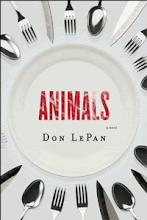
The set of reasons that Animals emphasizes is the one with the longest pedigree; from Pythagoras to Percy Shelley to Peter Singer, Paul McCartney and k.d. lang, there have been well-known figures putting forward the case for treating our fellow creatures with kindness rather than cruelty.

For decades now there have also been two other arguments. The environmental arguments are overwhelmingly strong. When humans eat animals rather than plants we consume far more of the earth’s resources (the land devoted to growing feed for the animals, the water required to irrigate the land, the energy required at every stage of the process); when “intensive” rather than organic methods are used, the damage becomes far worse.

The third set of reasons concerns human health. In the early nineteenth century Lewis Gompertz called on humanity to give up eating animal products–even though he was convinced this would not be good for our health, he felt the moral imperative of refraining from cruelty to other animals trumped whatever concerns we might have over the loss of nutrients in our own diets. Today we may admire Gompertz’s ethical courage, but we know that he was wrong about human health. Study after study after study has shown the health benefits to humans of adopting a diet without animal products. All else being equal, the less you eat animal products the less likely you are to get cancer, stroke, diabetes, heart disease—that’s just the beginning of a long list. (According to some studies, certain sorts of vegan diet can even reverse the effects of some heart disease.) Yes, there are still many in denial about those studies—and many interested parties in the meat and dairy industries would prefer you didn’t know about them, and try to discredit them. But that’s becoming harder and harder to do; the simple fact seems to be that you’ll be healthier if you eat other animals less often, and in smaller portions—and healthier still if you stop eating other animals entirely. (If you'd like more information on this side of things, www.nutritionfacts.org is a good place to start.)

The fourth reason? Human happiness. A substantial and growing body of research over the past ten years or so has found an inverse correlation between the degree to which humans consume other animals and the degree to which they are happy. To some extent, of course, one would expect that to be the case, since healthy people tend to be happy people. But much more than that seems to be involved; it’s also a matter of the chemical activity in the brain. In a series of studies in recent years, scientists have concluded that the consumption of various animal products promotes inflammation of the brain; that, in the other direction, a healthy* vegan diet helps to release chemicals that improve the human mood; and that, in general, those who do not consume animal products tend to report being in a better mood than those who do (to an extent that other variables are insufficient to explain). If you’d like to check out some of the research, I’d recommend starting with this article: “Restriction of meat, fish, and poultry in omnivores improves mood: A pilot randomized controlled trial” by Bonnie L. Beezhold (Benedictine University) and Carol S. Johnston (Arizona State University), Nutrition Journal, 2012 11:9. In their references Beezhold and Johnston point the way to much of the other relevant research.

It may not speak particularly well of our species if humans who consume other animals are deaf to the arguments regarding cruelty to those animals but responsive to appeals to self-interest—whether based on human health or human happiness. Nonetheless, it if the suffering of pigs and cows and birds and the others is reduced through the operation of human self-interest, that will be no bad thing.

*One should emphasize the qualifier “healthy”; all bets are off for those subsisting on French fries and vegan chocolate chip cookies.

Monday, December 16, 2013

Bacon Nation

Most of us are familiar with the phenomenon of privileged, empowered folk who fancy themselves under siege. Who rail against the unreasonable demands of welfare recipients and the unemployed, even as those at the bottom of the economic heap receive an ever-smaller slice of government revenue. Who claim that unreasonable environmental regulations are being rammed down their throats even during prolonged periods during which environmental standards are being eroded. Who stand shoulder to shoulder in their determination to resist the forces of what they inevitably term “political correctness”—and just as inevitably, who suggest that they are a beleaguered minority bravely resisting a juggernaut. It might seem that conservative, well-to-do whites hold most of the cards in places such as Texas or Alberta, but that’s only a matter of appearance, it seems; that if you look a little closer you can find community organizers, and feminists, and environmentalists, and gay rights activists—all of them with nefarious agendas. Alberta’s Ted Byfield was speaking for millions when he said “our distaste for political correctness comes from resisting arbitrary efforts to control what people think.”

In no area is this feeling of being besieged stronger or stranger than the world of meat and vegetables. In most restaurants in North America there are no choices available on the menu for vegans. None. In most supermarkets in North America it is impossible to buy free-range meat or eggs. Not difficult—impossible. Where North American restaurants do offer vegan options or North American supermarkets do offer free-range options, there are almost always far, far fewer of such options available than there are the choices of cruelty: factory farmed meat, eggs, and dairy products. Surely in such circumstances meat eaters could not imagine themselves a beleaguered minority. But that is in fact exactly how many meat eaters do see themselves. When Peter Kaminsky and Marie Rama, in their popular recent book Bacon Nation: 125 Irresistible Recipes express their resistance to the “the food police who would have us eat a diet mostly made with boiled lentils and mashed yeast,” they are not two alone. It is a brave band fighting against the oppressors, and it is a brave fight. I can speak from the inside on this one; I’ve seen them in training, the food police, with their billy clubs and their bullet proof vests and their handcuffs at the ready, readying themselves to go house to house with the nutritional yeast, readying themselves for the force feedings, readying themselves to harden their brutal hearts still further in the face of the anguished cries they will hear as they confiscate the cheese and the bacon. It’s not pretty when they go into action, I can tell you.

The real fear, of course, is not that any police force will force meat=eaters to eat lentils and yeast, but that if lentils and yeast are given equal treatment—if people are given all the information about how good such things are for human health (and how unhealthy bacon and chicken and cheese are), if there is true freedom of information about what goes on in the factory farms and the slaughterhouses, eating factory-farmed meat and eggs and dairy products will become less and less popular, will even become socially unacceptable. Perhaps it could even happen with meat and eggs and dairy products of any sort. Today that seems like a ludicrous fear. But it may well be more far-sighted than it seems. An Ottawa professor who teaches undergraduates about the literatures and cultures of the past—and often hears those undergraduates adopt an attitude of moral superiority towards their ancestors—reported to me not long ago that he makes a practice of inviting those students “to speculate about what, in 100 or 200 years, will be worthy of the condescension to our present that they … routinely send in the direction of, say, an 18th-century culture that would hang someone for sheep-stealing, or a 19th-century culture that would fight a civil war in substantial part about the desirability of retaining slavery.” His answer? “Our contentment with killing and eating animals.”

Those in bacon nation are not content or complacent, of course; they are staunchly resisting the oppressor. The food police are in league with the community organizers, and the feminists, and the environmentalists, and the gay rights activists; where will it all end? Have faith, vegans; our time will quietly, peacefully come. But for the sake of the animals, may it be soon.

Saturday, March 2, 2013

Free Range Meat

Let me put forward a comparison in the abstract.

On the one hand: being complicit in treating an animal with horrendous cruelty throughout his or her existence, having him or her killed long before he or she has had a chance to live a full life, and then eating his or her dead flesh.

On the other hand: allowing an animal to live a happy and cruelty-free existence; having him or her killed only when he or she has grown old and weak, and then eating his or her dead flesh.

The vast majority of the meat from cows, pigs, chickens and other birds that humans eat nowadays falls into the first category; it is the product of the cruelties of "intensive farming."

The vast majority of the horse meat that humans eat nowadays (in Europe and in many other parts of the world) falls into the second category; the horses are killed for meat only at the end of more-or-less happy lives. Yet it is the thought that humans might be eating their dead flesh that brings widespread outrage.

This comparison is not meant as a defense of the practice of eating horse meat. Quite the opposite.

Tuesday, February 12, 2013

“Build Me the Tallest”

One person who didn’t die on September 11, 2001 was Guy Tozzoli, then the head of the World Trade Centers Association and decades earlier a leading force behind the building of the twin towers of the World Trade Center. Tozzoli had an office on the 77th floor of the North Tower, but on September 11 2001 he hadn’t yet arrived at work when the first plane struck. He did not die until this month Saturday, aged 90; his obituary appears in the February 7 New York Times.

It’s often assumed that an urge to build the biggest or the tallest is a form of ambition likely to be found only among capitalist tycoons (or perhaps among architects)—that it’s not something you’d find in a bureaucrat. Tozzoli was evidence to the contrary. As Director of the World Trade Department for the Port Authority of New York (the government body under the auspices of which the World Trade Center was constructed), he played a key part in making the twin towers the world’s tallest buildings. According to the Times, it was Tozzoli who pushed Minoru Yamasaki, the architect, to make the towers 110 stories tall, when Yamasaki’s preference had been for 80-storey towers. “President Kennedy is going to put a man on the moon,” Tozzoli is quoted as saying to Yamasaki; “you’re going to build me the tallest buildings in the world.” And so they were, albeit only from 1971 to 1973. From then until 1998 the title of world’s tallest building was held by the Sears Tower in Chicago; then the title was taken by the Petronas Towers in Kuala Lumpur—like the World Trade Center, the brainchild not of tycoons in private business but of a government body (the state-owned oil company Petronas). More proof, if any be needed, that the ambition to be the tallest is not the preserve of private enterprise.

* * *

I started posting on this site this month for the first time since June of 2011; during the past couple of years my spare time has been taken up largely with writing a new novel. It's called Rising Stories, and it's now under consideration by publishers in both the US and Canada. If you'd like to have a look at the new novel in draft form, please email me (don.lepan@broadviewpress.com) and I'll be happy to send along an electronic copy.

Monday, February 4, 2013

Electronic Monitoring for Non-Human Animals

There's an extraordinary example in today's New York Times of the disconnect between the way wild animals and farm animals register in many human minds and hearts. Emily Anthes writes approvingly in "Tracking the Pack" of how the "expensive GPS tracking collar" worn by some wolves can allow scientists to "gain crucial insight into the lives of gray wolves." Advances such as these in modern communications technologies are, as Anthes points out, beneficial in all sorts of ways. "Bird lovers can follow the migrations of bald eagles," and followers of fish can do the same with some marine species. That sort of learning, she reasonably suggests, "can prompt affection for these creatures, even if we never meet them."

The disconnect occurs when she brings in cows:
The technology is still evolving, and we've only just scratched the surface of what's possible. In the years to come, perhaps wildlife biologists will take a take a page from the creators of Teat Tweet, a yearlong project featuring twelve tagged dairy cows and an automatic milking machine. Each cow was given her very own Twitter account, and a program broadcast her milking stats to all her followers. On July 14, 2011, for instance, a cow named Goldwyn Windy tweeted "I just squirted 18.9 kgs of milk out of my teats in 7.10 minutes. What did you do today?"
It would be hard to find a more pernicious example of how effective the propaganda of the shills of factory farming can be. First, we breed cows to make endlessly cheap milk and dairy products, killing their male children with quick brutality, growing the cows' udders until they are massively uncomfortable for the cow, and keeping the animals indoors all their lives--again, so they can produce more, more cheaply, of what we want to consume. But now the final touch; let's pretend the cow can speak. And wouldn't it be cute if, instead of objecting to all the pain we cause her, she were to say how proud she is of doing just what we want her to do. Wouldn't it? Wouldn't it? Well, let's pretend.

When Anthes moves from cows back to the non-human animals that truly interest her--wolves--she provides an interesting segue: "Of course, tweeting cows are pretty silly, and we don't need technology to get to know an animal." "Silly." That's a word worth thinking about.

So too is this sentence from the Teat Tweet website: the reality of modern farming is that "the cows are now able to literally milk themselves at all times, day and night." How lovely. How upbeat. All something they they have managed themselves, of course, not something that humans have done to them, and that makes their lives painful and unpleasant. Of course not. Silly.

* * *

Postscript: I have just checked out Anthes's own blog. She enjoins us to enjoy turkey at Thanksgiving dinner, and, when we think of the bird, to "marvel at its remarkable genome." In fairness, it is possible that, in focusing on wild animals, Anthes has managed not to know of the horrendous cruelty that humans inflict on factory farmed animals--turkeys surely included. How do we stop the not-knowing? How do we stop the cruelty?

Sunday, February 3, 2013

Cruelty Comes Cheap

In today's New York Times: the average American family spent 40% of its income on food in 1920. The figure today? 10%.

That should surely be food for thought for all those today in the middle class or richer who put it forward as an argument against changing to free-range meat or eggs, "They're so expensive."

For the cost conscious, of course (as well as those conscious of all issues relating to the killing of other conscious creatures), vegan remains the best option.

Saturday, February 2, 2013

Bird Killers

There's been a good deal in the news this past week about the claim that “US cats kill up to 3.7 billion birds a year.” In fact it appears the true number is nothing close to that, but certainly there is a good deal to be said for trying to reduce the number of birds killed by cats. Requiring cats to be on a leash would be extreme, but the Humane Society is surely right to call for licensing of cats. (It may well be that feral cats are responsible for more songbirds than are domestic cats.)

Before we condemn any sort of cat too loudly, though, we would do well to remember that human beings in the US and Canada cause about 9 billion birds to be killed every year—more than 25 per person. And, whereas cats may occasionally treat birds cruelly before killing them, we humans cause almost every bird we kill to be cruelly treated throughout every day of his or her life. That is the reality of factory farming as it’s practiced in North America. It doesn’t have to be this way; in much of Europe there is far, far less cruelty. When will we put a stop to this horror here in North America?

* * *

This is my first post since June of 2011; during the past couple of years my spare time has been taken up largely with writing a new novel. It's called Rising Stories, and it's now under consideration by publishers in both the US and Canada. If you'd like to have a look at the new novel in draft form, please email me (don.lepan@broadviewpress.com) and I'll be happy to send along an electronic copy. I will post occasionally on topics related to that book, but I'll keep posting on matters relating to animals too--I hope with a little less time between posts than there has been!

Monday, June 27, 2011

It Leaves a Bad Taste in Your Mouth

If the human animal were a purely rational animal, there would be no need to draw attention to the ways in which meat production and meat eating are disgusting. The facts about the harm done to the environment, the harm done to human health, and the terrible harm inflicted on the non-human animals that humans kill and eat would be enough to persuade every meat eater to change his or her behavior. But the human animal is often impervious to argument of that sort; what else can be tried?

For one thing, vegetarians and vegans can start to make clear that we find the sight of meat—and, even more so, the smell of meat—disgusting. That’s not the sort of thing that can or should be done in all circumstances, or on all occasions. But if, for example, the person beside you on a long flight starts to eat a greasy Big Mac, or dig into a large plastic bag filled with very smelly chicken parts, I don’t think it’s amiss to ask them to keep it as far away from you as they can. And if they ask why, we shouldn't hesitate to say politely, "I’m sorry, the smell of meat really makes me nauseous.” If I remember rightly, it was in part through that sort of small request that the movement against smoking started to make progress in the 1970s; at the same time as informational campaigns were starting to get across the message that smoking was bad for our health, individuals started to say openly that they found the smell of tobacco smoke bothersome.* Disgusting, in fact. I don’t think we should shy away from doing the same now over the sight and smell of meat.

Nor do I think we should hesitate to use language that is calculated to make people think of what is really happening when seals or whales or tuna or salmon are “harvested,” when “pork” or “beef” or other “meat” and milk and cheese and eggs are “produced,” when all these are “consumed.” None of those words speaks to the reality of what occurs. We give a better picture of the truth if we talk of tuna being slowly frozen to death or beaten into unconsciousness before they are cut up for human animals to eat; of the sows that give birth to “bacon” being immobilized for their entire lives; of egg laying hens living in a few square inches of space in a dark sheds filled with the smell of ammonia, of chicken excrement, and of dead birds; of fresh excrement inevitably being mixed in with the dead flesh of the cows and the pigs and the chickens that humans put into their mouths.

Nor, finally, should we shrink in certain circumstances from gently making clear that the human habit of eating the dead flesh of other animals tends to make for more smelly and disgusting humans; the gases emitted from the anus of a human who has consumed a lot of meat are far more noxious than those produced by those who live on a vegetable diet.

Disgust is a reaction to certain things we see and taste and smell; it is also, as George Orwell, William Ian Miller, and various others have pointed out, “a moral and social sentiment.” For all of us engaged in the struggle against cruelty to animals, it should be a natural ally in the cause.

*I was a moderately heavy smoker in those days, and I remember feeling mildly irked when on the receiving end of such comments. But the message sank in; like the rest of the smoking world, I did slowly change my ways—and then was very happy to have been pushed to change.

Friday, May 20, 2011

Helping One Bird at a Time

The week’s most heartwarming story is surely that of the rescue carried out at an eagles' nest near Sidney, British Columbia. The nest, which since 2007 has been viewable through a webcam set up by David Hancock and the Hancock Wildlife Foundation, is home to two parents and three baby eagles (all born last month). As millions around the world are now aware, one of the eaglets—named “Donald” by Hancock, for his Trump-like bullying of his siblings (and “Flyer” by a group of local schoolchildren, though he is still too young to fly)—became tangled in some fishing line that had been in the material of the nest. Yesterday rescuers on a great crane managed to reach the nest and free Donald’s leg from the line; the 7½ pound bird, who almost certainly would not otherwise have survived, will now be free to lead a normal eagle’s life.

That the story captured the imagination and the sympathy of millions must in large part be attributed to the fact that it was visible. If a distressed bird suffers out of our sight (and our hearing), our sympathies will inevitably be less fully engaged. At the other extreme, of course, is the plight of the billions of birds that humans condemn to entire lives of suffering far worse than that endured for a few weeks by Donald the eaglet. The industry makes sure that those lives and deaths happen out of the sight of humans, confident that out-of-sight (and out-of-hearing) will also be out-of-mind. Our senses are dulled too by numbers: Donald the Eaglet is recognized as an individual, whereas we are conscious of the birds that we allow to be treated with endless cruelty only as part of an endless mass.

That's how our minds are in the habit of working, and how industry wants them to work. Psychologically it's quite understandable—but we can hardly pretend that mental habits of this sort have any ethical justification. For a moment, then, let's try think of the billions and billions as we think of Donald—and think too of what just one individual human is responsible for. Just one person. If you are an average American you consume about 30 birds per year. That means you, personally, bear real responsibility for the cruelty with which those birds (with very few exceptions) are treated throughout their lives, and real responsibility for having them killed. More than two birds every month. Canadians and Europeans eat somewhat fewer birds; if you are an average Canadian or European you’re likely responsible for only about half as much cruelty to birds, only about half as many killings. But responsible you are. And it’s up to you to decide what to do in the future—whether you just don’t care how much cruelty is inflicted on how many birds so long as the result is cheap meat and eggs for you; whether you’d like to try to reduce the cruelty a bit by paying a little more and buying free-range chicken and eggs; or whether you’ll just say no to cruelty by eating other things instead. Donald the eaglet was saved through a lot of effort (and many thousands of dollars) from a life of suffering and an early death. With almost no effort (and certainly through no additional expenditure) the average North American or European could save one bird from the same fate every month, even every two weeks. Starting now.

Sunday, April 10, 2011

Moral Psychology (2)

In a recent posting I discussed one of the ways in which issues relating to the treatment of non-human animals may connect with matters of moral psychology. Do people who might otherwise be persuaded by the horrors of factory farming to give up the consumption of meat and dairy products tend to refrain from making that choice if an ethical “half-way house" is available in the form of “happy” meat and dairy products? Or are there likely to be more people who will decide, once they have reached the halfway house, that they should keep on going?

Those are arguments to do with strategy, carried on by people who are in broad agreement on certain ethical fundamentals; they agree that veganism is a better choice than free range—and they agree as to the desirability of changing human behavior. The point at issue is how best to do that.

Another sort of argument that turns on moral psychology may seem similar in some respects, but is in all its fundamentals utterly different; it’s the sort of argument put forward in Hal Herzog’s Some We Love, Some We Hate, Some We Eat. Herzog’s stated intention is to explain the many inconsistencies and outright contradictions in human attitudes toward non-human animals—such as those that relate to consuming those animals as food. But what he ends up providing is more a catalogue of those inconsistencies than an explanation—and again and again he ends up throwing up his hands at the complexity of it all; everything is “more complicated than we thought,” he concludes:
Moral consistency is elusive, if not impossible, in the real world, and both head and heart can lead us astray in how we think about the treatment of animals. … I have—mostly—come to accept my own hypocrisies. … The yahoo [within me] tells me that the exquisite taste of slow-cooked pit barbeque somehow justifies the death of the hog whose loin I am going to slather [with sauce]. … When I first started studying human-animal interactions I was troubled by the flagrant moral incoherence I have described in these pages—vegetarians who sheepishly admitted to me that they ate meat; cockfighters who proclaimed their love for their roosters; purebred dog enthusiasts whose desire to improve their breed has created generations of genetically defective animals; hoarders who caused untold suffering to the creatures living in filth they claim to have rescued. I have come to believe that these sorts of contradictions are not anomalies or hypocrisies. Rather they are inevitable. And they show we are human.

Thus we are assured that whatever is the case now is somehow “inevitable.” And, as Herzog implies through rhetorical sleight of hand, is also right. The extraordinary implication of his ringing conclusion is that we would lose our humanity if we behaved in less contradictory—and ethically better—ways toward non-human animals. Others might call the cruelty of our treatment of the animals we raise in order to eat them "inhuman." Herzog turns that on its head and suggests that it would be “inhuman” to try to eradicate such cruelty; he implies that to do so would go against the grain of our extraordinarily complicated natures.

But he only implies this; it is noteworthy that the list of contradictions he ends with steers the discussion away from the most vexing of the sets of contradictory attitudes that he set out to explore: the contradictory and hypocritical attitudes of humans who, in a system of great cruelty, raise non-human animals in order to kill them and consume their dead flesh. That would be a distasteful contradiction with which to conclude; let's look instead at the morally less heinous hypocrisies and contradictions of other sorts of behavior. According to the number of lapsed vegetarians that can be found, carnivores may feel secure in concluding that they’re doing something ethically acceptable after all.

It’s not hard to point out the logical absurdity of the sorts of connections Herzog is trying to make here. Just try applying them in a different context, substituting “slaves”, or “gays and lesbians”, or “women” for “non-human animals”:
Moral consistency is elusive, if not impossible, in the real world, and both head and heart can lead us astray in how we think about the treatment of women. … When I first started studying man-woman interactions I was troubled by the flagrant moral incoherence I have described in these pages—suffragettes who sheepishly admitted to me that they were attracted to men who stand firmly opposed to the women’s movement; men who publicly proclaim their desire to give women the vote but confess privately to their worries as to what may result if such a change ever occurs; campaigners for the supposed betterment of women’s lot who have ended by making things worse for those they aim to help. … I have come to believe that these sorts of contradictions are not anomalies or hypocrisies. Rather they are inevitable. And they show we are human.

If we’re going to be grown-ups we have to live in the real world. Yes, there are sometimes going to be contradictions and hypocrisies, Professor Herzog suggests. But that’s no argument for change.

Like Herzog, Melanie Joy teaches psychology. And her Why We Love Dogs, Eat Pigs, and Wear Cows has a similar starting point to that of Herzog’s similarly-titled Some We Love, Some We Hate, Some We Eat. But Joy’s purpose in trying to understand the mechanism through which humans hide from themselves the true nature of what they are doing is not to provide us with a rationale for avoiding change; it is to help bring about change. She sees clearly the parallels between the ways in which humans today think about other animals and the arguments that “enabled widespread discrimination and hatred towards homosexuals, the deeply entrenched system of apartheid, and the genocide in Darfur.” The lesson she draws is a fundamentally different one from that of Herzog. She acknowledges our human tendencies towards “apathy, complacency, self-interest, and blissful ignorance”—as well as towards hypocrisy. But she also believes that “as humans, we have a fundamental desire to strive to become our best selves.” Surely she is right as to the existence of that one vitally important human desire. And if behaving ethically is a concept that has any meaning at all, it surely means that we are obliged to strive for what is right—not to complacently accept the worst aspects of our natures.

________________________________________________

As I re-read this I wonder if the posting is too harsh on Professor Herzog--a person who seems genuinely interested in broadening our understanding, and genuinely in favor of lowering rather than increasing the level of suffering for non-human animals.* It's just very sad that, by spending so much effort on rationalizing and so little on taking a strong stand against cruelty, he is surely helping to support an utterly horrific status quo.

*Interestingly, Herzog reports that, in recognition of such cruelties, he and his wife now eat free-range eggs and chicken and beef. Yet he appears uninterested in forcefully speaking out against the mass-scale cruelty of factory farming; indeed, he downplays any suggestion that there might be a significant ethical difference between his eating behavior and that of humans who choose to consume the products of factory farming; "I ... make what are probably symbolic gestures to reduce the cruelty of the fork ... I know ... that according to Consumer Reports terms like natural and cruelty-free ... are usually marketing ploys that mean little."

Saturday, April 2, 2011

"Animal Justice"--A New Umbrella Term?

At one session at the just-concluded “Thinking About Animals” conference at Brock University, Katie Sykes of the Law faculty at Dalhousie University gave a good paper about the concept of animal rights and the medieval trials of non-human animals (in which pigs, for example, were tried for causing damage to human property or physical harm to humans). The non-human animals in such circumstances were, notionally at least, granted rights; they had a counsel for the defence, and so on. But in practice, of course, the fix was in. Sykes's point was that in practice things such as rights can have only a limited force without underlying changes in attitudes.

I was prompted by the paper to reflect on the degree to which “animal rights” has become a loaded term; the sad truth is that phrases such as “animal rights activists” and “animal rights movement” alienate many people before they even begin to think about the issues. However fraught it may be, “animal rights” surely remains a useful term—indeed, a necessary one in many contexts. But there are also certain contexts in which it would be good to be able to use a different term: circumstances where rights vs. interests is not the primary concern, and circumstances where it is important to bring together animal rights advocates, animal welfare activists, animal liberationists—the full spectrum—so as to maximize our chances of bringing about positive change on a particular issue.

I asked at the conclusion of the session in which Sykes had given her paper if anyone had specific suggestions as to what we could use as an umbrella term in such circumstances. I suggested simply “animal advocates,” and someone else suggested “animal protection” advocates, but neither of those seems entirely satisfactory. Towards the end of the following day, however, another academic who had given a paper in the same session—Andrew Weiss of Ryerson University—came up to me and said he had been reflecting on the question and thought “Animal Justice” might make a good umbrella term. He also said he had been trying the idea out with others at the conference through the day and that they had all had a positive reaction. I’ve since tried it out on a handful of others, and everyone I’ve talked to so far has reacted very positively. I really like Andrew Weiss’s suggestion – and the more I imagine it being used the better I like it:

“Animal Justice advocates responded with a strong statement concerning ...”
“The Animal Justice movement was out in force today to protest the …”

What do you think?

Moral Psychology

At the very interesting and lively “Thinking About Animals” conference this past week held at Brock University there was an ongoing current of tension regarding the animal welfare approach to improving the lives of non-human animals. There were in fact few if any pure “animal welfarists” at the conference; almost everyone there believed (as I certainly do) that the best solution to the horrors of factory farming is simply for all of us to adopt a vegan diet. Halfway measures (“freedom food,” “happy meat”) that try to improve the welfare of non-human animals while leaving in place the underlying paradigm of human animals raising other animals purely in order to kill them and eat them can at best be classed as constituting merely a lesser evil than that of factory meat production.

But is it possible that "halfway measures" are actually counterproductive? Many abolitionist vegans argue that by presenting humans with a seemingly more ethically acceptable alternative means of consuming meat and dairy products, advocates of animal welfare approaches are helping to perpetuate the underlying paradigm. If, on the other hand, the choice remains an utterly stark one in which humans must choose between veganism as one alternative and eating dead flesh (or eggs, or dairy products) from animals that have suffered conditions tantamount to torture throughout their lives, that stark binary may make it more likely that people will make an ethical choice, and that real change will happen.

I would like to think that the hearts and minds of most human animals operate like that. But certainly my own case argues otherwise. As I discuss in the Afterword to Animals, the move towards veganism has been for me a long and slow process. Looking back now, I very much doubt I would have started on that road had there not been way-stations available. For a number of years I ate free range beef and chicken and so on; if you had told me that I could give up meat and milk entirely and not miss them at all (as is now the case), I’m sure I would have been entirely disbelieving.

The reactions I’ve received to Animals from people who say the novel has led them to change are an absurdly small sample to go on, but it's a sample that goes to support the view that not all human psyches are alike in this way. (Interestingly, few people reference the Afterword when they say how the experience of reading the book has led them to change; they tend always to speak of the novel itself.) I have had some people tell me that they stopped eating meat entirely the day after reading the last page of the story; I have others (a larger number) tell me that reading the novel led them to significantly reduce the amount of meat and dairy products they consume, or to switch to eating free range meat and to start thinking seriously about the issues while they considered if they could go further than that. Like me, they found it impossible to contemplate an immediate, 100% change.

In many ways Animals itself provides a strong sense of the tension between abolitionist veganism and welfarism.* When I began writing the book my aim was simply to combat the evils of factory farming, not to present in imaginative form a more broad-ranging argument against humans eating other animals. But as I was writing the book I was changing, and by the time I had finished there was a great deal in it that undercuts the animal welfare position; Broderick’s arguments in defence of “free range yurn” as an option are hideously blinkered, and I think those who have argued that the novel reads much more coherently if it is taken not as an argument against factory farming, but as an argument against consuming other animals have a very good point. Of course the Afterword that appears following the novel itself takes a different tack; it emphasizes that the book's declared intent is to help turn people against factory farming, and it very much downplays any suggestion that the book might have a broader message. To undermine factory farming was indeed my main intent—but if the book does in fact convey a broader message I now feel very happy about that. And I would be overjoyed if, fifty or a hundred years from now, the Afterword is read (if it is read at all) as a historical curiosity in a world in which human animals have given up eating other animals.

Is it in fact the case that on average human animals are more likely to give up eating other animals if the choice is an entirely stark one—or is it the case that they are more likely to approach that destination in the way that I have, in slow steps? My guess is the latter; that’s not something that makes me happy, either about my own nature or about human nature generally. In terms of what I would like to see happen, I've become a fellow traveller in the abolitionist vegan camp. But my guess is that along the way we will stand a better chance of achieving wholesale change if we don’t try to insist that people must immediately choose veganism or the status quo, with nothing in between.

I want to emphasise that this is a guess; I don't think any one of us can really know what will work best on average with the human psyche. But one thing we we do know is that the forces defending the status quo when it comes to factory farming are very, very powerful, and that attitudes supporting it are deeply entrenched. If you put all the vegans and all the vegetarians and all the animal welfarists together, we are still badly outnumbered. That doesn’t mean that it’s impossible to bring about change; those pushing for justice for women and for an end to slavery were also badly outnumbered at first. And in those cases too there were a wide range of approaches, with gradualists often at odds with absolutists on many points. But they managed at key moments to bridge those differences and to work together for positive change. In the same way, if we are to bring positive change for non-human animals, surely our best chance of doing so is to work together as much as possible. That doesn’t mean that we should ignore the very real differences (of which abolitionism versus welfarism is only one; the debate over whether we are defending the rights of non-human animals or their interests is another broad issue, and there are many other smaller ones). But it does mean that we may be well advised to try to find common ground as much as possible. We may strongly disagree, for example, as to whether “free range” is an adequate response to the cages in which battery hens are now confined, or to the cruelties of gestation cages for sows. But surely we can come together in common cause over the fact of these things being wrong; we can keep trying to publicize those wrongs, and we can keep protesting together.

*One interesting paper at the conference ("The Critique of New Welfarism in LePan's Animals and Ishiguro's Never Let Me Go" by Dru Jeffries and Emily Fraser-Jeffries) looked at precisely this point. Jeffries and Fraser-Jeffries suggest that the novel Animals makes an effective case against “a welfarist approach to animal agriculture reform”; they also argue, however, that the Afterword severely undermines this message, with the result that the book as a whole “embodies the moral schizophrenia underlying new welfarism as an approach towards advancing animal rights.”

I think they are right--on this as well as on many other points they make (both about my novel and about Ishiguro's) in their very intelligent paper.

In my January 4, 2010 blog posting “Words After an Afterword” I discuss the text of the Afterword as it was originally published (in the 2009 Canadian edition), and how—as I had just then been made to realize—the alternative ending in the Afterword to that edition does not connect coherently with the novel itself. At that point I also posted on my website a revised text of the Afterword, which became the basis for the text of the Afterword in the American edition. (It will also replace the original afterword in the Canadian edition on the first reprint of that edition.) I still find it an extraordinary instance of a moral/psychological disconnect on my part that I was able to write the original version of the “alternative ending” in the Afterword without getting that the alternative ending was advocating eating free-range human meat. Perhaps just as striking is that as many as fifteen others read the book in advance of publication of the Canadian first edition; none of them raised this as a problem either.

When the Afterword and the novel itself are treated as a whole, the brief alternative ending in the Afterword as originally published is the most striking pointer towards “moral schizophrenia.” But–as suggested above—I think it is arguable that something of the sort operates even with the revised Afterword. Certainly I've come to think that there is tremendous tension between the explicit message of the Afterword (even in its revised form) and the implicit message of the novel itself—and I thought Jeffries and Fraser-Jeffries explored that tension very perceptively in their conference paper.

Quite a few people in advance of publication advised against including an afterword—the novel should stand on its own, they suggested. I think that in fact the novel has stood on its own and that it will continue to do so. But I don’t apologize for having included an afterword between the same two covers. I’ve written in my blog about my reasons for doing so initially. I now have another reason; an afterword written at the time a novel is published can demonstrate wonderfully well just how wrong an author can be about what the underlying message of his or her own work really is!

Monday, January 31, 2011

Disgust

It came to me today that, when it comes to eating dead animals, everything I eat these days would be classed by many people as disgusting. Clams. Oysters. A lot of people find clams and oysters disgusting; slimy is a word that’s often used.

What’s so bad about slimy? Why are some people who love sex disgusted by oysters? Maybe oysters and sex are both gross, but sex is delightful, and--to me at least--an oyster tastes wonderfully good. And (much much more importantly) eating an oyster isn't unethical--at least, so far as I know.

Leave aside cows and dogs and wolves and cats and pigs and parrots and eagles and chickens—and what they think and feel when we are killing them so we can eat their dead flesh (it isn’t always a quick process, the killing). Think only of what they may think and feel when they are being bred for slaughter—tortured, essentially, according to the principles of modern intensive farming. Those non-human animals are, as most of us do know, fully conscious beings, capable of both thought and feeling—capable in many cases of something very like our own thoughts and feelings.

(The surprise for me has been that shrimp are sentient too. That’s why I no longer eat them.)

The fact is that disgust doesn’t connect with ethics as it should. No matter how horrifically a pig or a calf or a chicken has been mistreated in confinement awaiting slaughter, no matter now horrendously it has been slaughtered, most of us have made ourselves immune to disgust. To my unending shame, I did this myself for more than half of a life.

In a very good book that I’ve recently discovered,* Melanie Joy points to something very interesting: “what is most striking about our selection of edible and inedible animals is not the presence of disgust, but the absence of it. Why are we not averse to eating the very small selection of animals we have deemed edible?” This goes to the heart of the matter. As children we react with the same level of repulsion to the mistreatment and eating of a pig or a chicken as we do to that of a cat, or a dog, or a robin. But as a society we have trained ourselves to lose our disgust. Along with that, as Joy points out, we have trained ourselves to lose our empathy. And, it seems fair to add, our moral compass.

* * *

Animals events next week: I'll be joining classes for discussion on Monday at the University of Toronto, and on Tuesday at York University. On Thursday I'll be at the Happy Endings bar in Manhattan as part of the Animal Farm Reading Series--"dedicated to promoting the best writing, in any genre, that has a satirical and/or critical point of view on the world." If you are reading this and will be in New York next Thursday, please come.

* Why We Love Dogs, Eat Pigs, and Wear Cows: An Introduction to Carnism

Sunday, November 21, 2010

Angry and Self-Righteous?

Try googling “self-righteous” or “angry” in combination with “meat eaters” or “carnivores.” Then try the same thing with “vegetarians” or “vegans,” and compare. The numbers I just got totaled 2,912 on the meat eaters/carnivores side of the ledger, 40,280 on the vegetarian/vegan side. What is happening here?

One can surely find angry or self-righteous people of all sorts. Yet the vegetarians and vegans I’ve met tend to be, if anything, more gentle and unassuming than most.* That’s particularly striking, I think, given how much there is for them to be angry about—and, to be sure, you can find many vegans who express anger and frustration over the system of institutionalized cruelty that is at the heart of today’s factory farming. What you hardly ever find are vegans or vegetarians making angry attacks on the people who eat factory farmed meat and dairy products.

The vast majority of meat eaters are just as reasonable in the other direction. But a surprisingly large minority get very angry and self-righteous accusing vegans and vegetarians of being angry and self-righteous. If you haven’t run into this sort of thing, you can get a good sense of what I’m referring to by checking out www.vegetariansareevil.com or People for the Eating of Tasty Animals. One gentle vegan was brave enough on the latter forum recently to put forward a long and carefully considered argument as to the environmental damage done by the system through which North Americans obtain meat and dairy products. The contributor was anything but angry or self-righteous, ending with the thought that “we ought to be respectful of each other. Everyone's views are important.” The responses he received? Here is one of the more polite: “I've heard these arguments ad nauseam from self-righteous vegans such as yourself. While it may be true that it takes more energy and resources to raise the livestock that you so detest, it will continue to be done because the human race is omnivorous.”

This sort of approach to argument is nothing new, of course. Angry and self-righteous defenders of male privilege fought for two hundred years in this way against equality for women—angrily, unreasonably, and self-righteously accusing bluestockings and feminists of being angry, unreasonable, and self-righteous, while putting forward little by way of actual argument (other than the claim that male superiority came naturally to them, and thus would continue). Defenders of slavery angrily accused anti-slavery campaigners of being angry and self-righteous do-gooders, and insisted that the system would never change, since it was in accord with the natural order.

The habit of accusing others of the unpleasant emotions one exhibits oneself is of course an enormously widespread psychological phenomenon—and it’s particularly common with hot button issues where change is perceived as a threat. Interestingly, though, angry bloggers are not the only ones who sometimes substitute ad hominem attacks for reasoned argument when it comes to attacking vegans and vegetarians. Even Michael Pollan, who many would regard as a fellow traveler of the veggie crowd, ends his discussion in The Omnivore's Dilemma of the pros and cons of vegetarianism by resorting to unsupported assertion as to the psychological makeup of those who have decided not to eat meat:
I have to say there is a part of me that envies the moral clarity of the vegetarian, the blamelessness of the tofu eater. Yet part of me pities him, too. Dreams of innocence are just that; they usually depend on a denial of reality that can be its own form of hubris.

The diction and syntax here is far more sophisticated than is that of the angry meat eater on the Tasty Animals forum (and condescension rather than anger seems here to be the dominant feeling), but Pollan’s “argument” is in essence identical. The way it has always been in the past is “reality,” and we shouldn’t mess with that; indeed, it would be presumptuous of us to do so, hubristic. Here again is the same old “argument” that was used in the rear guard struggles against slavery, against equal rights for women, against giving the vote to the poor—the list goes on a long way. Happily, Pollan does in fact want to change the reality of today’s factory farming, and to change the reality of the unhealthy levels at which North Americans consume meat and dairy products. He chooses to eat very little meat himself, and advises others to do the same. Why would he have felt the need along the way to suggest that hubris is inherent in the approach of those who choose to eat no meat at all? I'm sure I don't know--and no doubt it is best not to speculate on that score. But it's good to see that Pollan has recently adopted a less condescending attitude: in one 2010 interview he went so far as to say that he now has "enormous respect for vegetarians." Perhaps it will take a little longer for the "Vegetarians Are Evil" group to reach the same point.

*I will note one recent case in point. This past week I joined Prof. Janelle Schwartz’s very interesting “Literature and the Environment” class at Loyola University in New Orleans, where Animals has been one of the assigned texts this term. One of the students identified himself as vegan; in doing so, though, he emphasized that he regarded this as a matter of personal choice. He felt going vegan was an appropriate response to today’s factory farming and, more generally, to the current state of the world’s environment, and he was happy to make a case for going vegan—but to do so gently and respectfully. He never suggested that the road he had taken was the only appropriate response to the current set of environmental conditions—indeed, he suggested that at other moments in world history he might not advocate or adopt veganism himself. In my experience the vast majority of vegans are just as thoughtful and as respectful of others as was this student.

Sunday, October 3, 2010

New York, Peterborough, happy endings

The two Animals events this past week could hardly have been more different. The first, a reading in the KGB Bar’s Sunday Evening Fiction series (with Matthew Pitt, whose fine collection Attention Please Now is new this year) was entirely conventional in its format: two or three dozen people listening to authors read, and then drinking and chatting. The venue was delightful, as was the dark Russian beer—and so was the evening generally. (There's a write-up at NBC New York Online: http://www.nbcnewyork.com/blogs/niteside/NTSD-Author-Don-LePan-103835859.html)

The second, at the Only Café in Peterborough, Ontario on Thursday, attracted only seven people, almost all of them old friends of mine from the years in the late eighties and early nineties when I was starting Broadview Press. Sean Kane, whose own books include the extraordinary Wisdom of the Mythtellers, wisely suggested we just pull a couple of tables together and forget about having a formal event. That turned out to be a lot more fun, not least of all in hearing of other literary events with small turnouts—Sean recounted one story of poet Dennis Lee flying from Toronto to Vancouver for an “event” to which one person showed up.

The low turnout in Peterborough fits in with the larger picture for Animals in Canada: despite some fine reviews, a year after publication the Canadian edition has sold fewer than a thousand copies. Some of this, I'm sure, is simply a reflection of the fact that Canadians remain resistant to expressions of concern over how farm animals are treated. (Driving into Peterborough I noticed the huge Sealtest Dairy sign: “where good things never change.” No doubt people want to believe that their milk and cheese have not changed in Sealtest's 60 years; most would prefer not to know that lower prices and higher outputs have been achieved by adopting methods that greatly increase the suffering of animals.)

But I’m sure there is also a good deal about the book itself that has contributed to the Canadian edition being—so far, at least—a commercial failure. For one thing, it’s not a book that lends itself to sale through word of mouth. Many people who have read it have clearly found it deeply moving—“devastating,” even—but how many of us are likely to say to our friends, “hey, I read this great book recently; you should give it a try. It’s really disturbing, and maybe not in a way that you can easily leave behind when you stop reading. Oh, and don’t count on a happy ending to the book. … But you’ll love it!” As I mentioned to the group on Thursday night, I have thought of proposing to UK publishers a version of Animals that would give the book a less bleak ending (as well as cutting back on the footnotes that several reviewers have complained about).

Like most people who have read the book and been moved by it, my companions at the Only Café weren’t keen on the idea of giving the book a happier ending. And from any aesthetic angle, nor am I; I have no reason to think it would be a better work in any literary sense if the story ended differently. But it might be more effective in encouraging positive change. Certainly it is the case that most of the novels that are known for having helped to inspire significant social change recount tragic events but do not end on a note of devastation or despair. Mary Barton, Oliver Twist, Uncle Tom’s Cabin, Black Beauty, The Jungle—in all of them the story takes a hopeful turn at the end.

A couple of years ago one of the pre-publication readers of Animals (a former editor at a major publishing house) suggested to me that I should change the ending—that readers “deserve” a happier ending than they are given in Animals. Jonathan Franzen has recently spoken in a similar vein about his own writing:
There’s so much to be upset about in the world, I feel an obligation from time to time to have the final note in a book not be a despairing one. Or an ironic one. To actually maintain the possibility of some kind of hope. (The Globe and Mail, August 27, 2010)

The ideas that readers deserve a happy ending or that writers have an obligation not to strike a despairing final chord seems ludicrous on the face of it; would anyone seriously suggest that readers of Madame Bovary, or Jude the Obscure, or The House of Mirth (or, for that matter, Romeo and Juliet and King Lear) deserve a happy ending? Surely we should never try to make tragedy a no-go zone for literature.

But Franzen’s reference point in suggesting that readers may deserve hopeful endings is clearly not literature but life—life at a specific point in human history. The obligation to provide happy, hopeful endings exists because “there’s so much to be upset about in the world.” With all around us so grim, in other words, we must be given hope. It’s an idea that might ring true if we were talking of readers facing extraordinary privation; if the Black Death is all around or you have just lost everything in the Haitian earthquake you might fairly be thought to “deserve” a little light reading. But surely such an idea isn’t applicable to the majority of readers in North America today. Indeed, it seems almost self indulgent to suggest that most of us in North America have too many upsetting things to deal with. Even as we come out of a deep recession, most of us in North America are extraordinarily pampered by comparison with most people, here or elsewhere, at any other time in history. And we are, if anything, shielded too often from the true horror and tragedy that is the reality for humans in much of the rest of the world. Most people hear about such horror only very briefly in the context of an extraordinary disaster such as an earthquake, and then the upsetting truth is tucked away again out of view.

Such is surely the case for the horrors endured by non-human animals—horrors rarely reported by the media, horrors hidden from view behind the walls of North America’s factory farms. Animals, of course, is a work that aims quite deliberately to look behind those walls and to upset the reader. And I don’t think as a matter of aesthetics that it goes too far. But it may well be that it does go too far as a matter of practical reality—that it would have a better chance of influencing more people in the direction of positive change if it ended more happily. And that would be no negligible thing; I think I’ll write that letter to a UK editor tomorrow!

* * *

A question prompted by the above: is there some correlation between the flourishing of tragic literature and a relative absence of tragedy in society at large? The age of the Black Death was also the age of the Decameron and The Canterbury Tales. Compared to the horrors of that era Shakespeare’s England was a place of ease and contentment—and on the stage tragedy flourished. A few generations later a land exhausted by the horrors of the English Civil War had no wish to face Shakespeare’s King Lear—except in Nahum Tate’s new “happy ending” version. The great tragedies of the nineteenth and very early twentieth centuries—by Flaubert, Hardy, Wharton, and others—come from times that for all their troubles were tranquil and prosperous relative to, say, the time of the French revolution and the Napoleonic Wars, or that of WWI. Perhaps it is not by coincidence that the literature of Europe or North America has not tended successfully towards tragedy since WWII and the Holocaust. But we are now almost as far distant from 1945 as Hardy was from Waterloo when he began to write his great tragedies. Perhaps we are almost ready again ourselves for tragic literary forms; perhaps the reception that The Road has received is one sign that we might be.

Wednesday, August 25, 2010

Labelling

There has been an interesting little discussion recently on the Page 247 blog about Animals—about the questions regarding non-human animals that are at the heart of the novel, but also about the question of what is appropriate or inappropriate in dealing with sensitive issues.

The blogger began the discussion with a posting likening Animals to Brave New World and calling it “a difficult and challenging read” that prompted some contradictory thoughts; “LePan claims his main argument is against factory farming and for the humane treatment of our food animals, but I was left with a much broader sense of ‘let’s stop eating meat and fish, period.’”

The most interesting comment posted thus far has been from “El Fay,” who takes the discussion in quite a different direction. El Fay also finds the premise of the book “disturbing—but for all the wrong reasons.” He or she argues that comparing marginalized peoples to [non-human] animals is “highly problematic due to the history of labeling many of these groups as sub-human,” and points to a recent PETA blog posting as an example of why this sort of comparison is “so troubling.”

The PETA ad is indeed deeply troubling. It shows a photo of Tiger Woods with the following words superimposed:
TOO MUCH SEX CAN BE A BAD THING
… for little tigers too.
Help keep your cats (and dogs) out of trouble; always spay and neuter.

The advertisement seems to me to be offensive in several ways. To start with, the “bad thing” in this case wasn’t the amount of sex—it was infidelity. But the more serious issue is the way the advertisement engages with the long-standing myth propagated by racists that black sexuality is inherently dangerous—and the accompanying view that it needs to be controlled, forcibly if necessary. As another blogger (Renee of Womanist Musings) has pointed out, the ad displays no sensitivity whatsoever “to the ways in which black bodies have been stereotyped” or to the “history of black men being castrated for having relations with white women.” The advertisement doesn’t engage with what is sometimes referred to as 'the myth of the big black buck' by questioning that pernicious myth in any way. Quite the opposite; it feeds off it in pursuit of a cheap laugh.

Is Animals insensitive—or downright offensive—in parallel ways? There is no question that it also deals with material that is highly sensitive; the list of categories under which humans have labeled other humans as subhuman is appallingly long (Jews, women, blacks, native North Americans, Chinese, Armenians, Roma, Tutsi, those suffering from disabilities, gays and lesbians, Protestants, Catholics, Ndebele—it goes on and on and on), and what humans have done to other humans, using these labels as justification, is endlessly horrific.

Far from joining in (or feeding off) that sort of labeling, Animals is deeply critical of it. But is the very fact of its using story material of this sort inappropriate? Why use story material of this sort in the first place?

For one thing, to point out what I think are entirely legitimate (albeit provocative) parallels. For it is not just other humans that we humans have had a habit of separating into categories that result in horrific cruelty. We have developed habits of classifying dogs and elephants, for example, as beings to be treated with kindness and respect, and pigs as beings who we can in good conscience subject to lives of endless suffering before we kill them. To draw parallels between that sort of labeling and the labeling of other humans as sub-human is not to make a claim as to degrees of wrong; I have no wish to defend the view that our treatment of non-human animals is as bad as the ways in which various human groups have been treated. That simply does not to me seem a fruitful discussion; the point is rather that the process is similar—the process of labeling in such a way as to justify horrific cruelty.

There is another reason too for using this sort of story material in Animals. The reality is that most of us tend to be more readily capable of imaginative sympathy with other humans than we are with non-human creatures. The closer a protagonist “standing in” for a non-human animal is to a human being, the more easy it is likely to be to bring home to readers the horrific realities of factory farming in a way that may engage their imaginative sympathy—and lead to real change. And clearly the book has led to at least some such change; a significant number of readers have been in touch to say that they have changed their eating habits as a result of the book, either reducing or eliminating from their diets foods that are the product of the cruelties of factory farming.

The strategy, then, has at least to some extent been effective. But from fairly early on I recognized that it was indeed a highly problematic approach. There is a thin line in dealing with sensitive subjects that it is important not to cross; it would be essential in this case not to inadvertently create the impression that the book was in any way disrespectful towards people with disabilities—that it could be read as in any way questioning the legitimacy of their rights, or the importance of their ongoing struggles.

I won’t go into detail here as to the book’s narrative strategies (the ways, for example, in which Broderick is shown to be an unreliable narrator). But I will say that I am confident that the book cannot be fairly read as in any way supportive of discrimination against people with disabilities. It’s not a solitary confidence, I may add. I don’t have unbounded faith in my own knowledge or my own judgment in such matters, and I thus thought it appropriate to consult a number of people who are far better versed than I am in issues relating to human disability. I am particularly indebted to one academic, who is also a parent of a child with Down Syndrome, for reading the unpublished manuscript and making a considerable number of helpful suggestions—as a result of which I made numerous revisions, some of them quite significant.

As to the Page 247 blogger’s lingering suspicion that Animals doesn’t just criticize factory farming but also leaves “a much broader sense of ‘let’s stop eating meat and fish, period’”—that’s a question I’d like to leave for the moment—and let others weigh in on.

Monday, August 2, 2010

No Country for Animals

I caught up last night with Kevin Newman's No Country for Animals, which aired last Wednesday on the Global television network. I found it an absolutely first-rate documentary--the first program I've seen to give a good overview of how non-human animals are treated in Canada, and of how little legal recourse there is to stop the horror. Twyla Francois of Canadians for the Ethical Treatment of Farm Animals is interviewed extensively for the show; her commentary is excellent--as is the footage she provides showing what goes on behind the walls of Canadian factory farms. And there is very good (and extensive) coverage of how far behind many European countries Canada is in its approach.

Google "No Country for Animals" and you'll be able to download and watch the show--I can't recommend it too highly.

* * *

No new reviews of Animals since the Publishers' Weekly and Boston Globe ones of several weeks ago, but two very positive reviews were posted on amazon.com recently--both from distinguished readers:
“If you read any novel, read this! Animals is one of the most important Canadian novels to have emerged in many years. ... What can get lost in the brilliance of the satire is just how beautiful the writing is—always at its most poetic at all the most awful moments. ... The final sections were about the saddest thing that I have read, but never in a way that seemed needless or opportunistic or excessive....”
-Paul Keen, Professor and Chair, English Department, Carleton University

“As gripping as it is important, LePan's brilliant first novel tackles the largest moral issue of our time...”
-Jonathan Balcombe, author of Second Nature: The Inner Lives of Animals

It now looks as if there will be a San Francisco Animals event November 23. More soon.

Afterwords and Prefaces

Why should an afterword appear with a work such as Animals—indeed, with any work of fiction? (Or, for that matter, a preface by the author?) Surely a literary work should “speak for itself” without the author endeavoring to “control” the reader’s response.

Such has been the conventional wisdom for generations now—interestingly, the conventional wisdom as much of deconstructionist or post-modern critics of the 1990s or 2000s as of the leading critics of the 1950s and 1960s. Like the view that didactic or polemical literature cannot be good literature, it has for the most part been assumed or asserted rather than argued. And, like that view, it has flimsy foundations.

Of course no author should be allowed to “control” the response of the reader—and no author could do so. Inevitably (and appropriately), the author’s voice will be only one voice among many. But on what grounds should it be seen as inappropriate for authors to comment on their work? I can see the argument against doing so directly during the course of a novel. Aesthetically, it is certainly arguable that an author is well advised not to step outside the movement of the fictional world of the novel to comment on its progress. (There are plausible arguments in the other direction too, as any reader familiar with Henry Fielding’s novels must be aware.) But words such as “Preface” and “Afterword” signal clearly text that is outside the novel—text that shares the same covers but is no more part of the novel itself than are the blurbs often found on the opening page or the author interviews and other “reading club” material that is often found at the back. These things may all be part of the book, but they are not part of the novel.

Why would novelists want to comment directly on their work through a preface or afterword? One obvious point is that by including something of that sort adjacent to the novel one ensures that all readers will notice it and will have the opportunity to read it—as one is unable to do by commenting on one’s own work through a newspaper interview or a website or a blog. And there are surely many matters on which it is not unnatural for authors to wish to communicate to all readers. First and foremost, perhaps, is the question of how authors may see the imaginary worlds they have created as connecting to the real world. “How close to reality is all this?” may well be the first question of many readers. It was in response to such questions that Elizabeth Gaskell wrote her preface to Mary Barton: she laments that “the woes, which come with ever-returning tide-like flood to overwhelm the workmen in our manufacturing towns, pass unregarded by all but the sufferers” and speaks of how the more she discovered of this suffering, the “more anxious I became to give some utterance to the agony.” Harriet Beecher Stowe wrote both a preface and a final chapter—she did not call it an afterword, but it was clearly outside the novel itself—to Uncle Tom’s Cabin, in order to answer “whether this narrative is a true one”—whether the narrative truthfully portrayed the actual horrors of slavery. Animals is written to address a very different issue from that of slavery, but like that work it runs along parallel lines to various works of non-fiction and of argument that have tried to present the facts and to present a variety of reasoned arguments. The parallel role of the novel in such cases is to enlist imagination alongside reason and emotion in the cause of pointing the way towards positive change. Even for those that have had access to the facts and the arguments, such a work can provoke a different and sometimes more powerful response. But there will always also be those who come to the relevant issues as presented through the imagination without prior knowledge of the facts and arguments. “What’s written here about factory farming in the late twentieth and early twenty-first centuries—is it true?” they may well wonder. An afterword can provide only the briefest of responses to this sort of question—but it can, after such a novel ends, provide a useful beginning.

That said, I think that making clear the author’s moral intent or trying to clarify the connections between the facts of a novel and the facts of the real world are only two of an almost unlimited range of appropriate purposes to which an author’s afterword may appropriately be turned. Ursula LeGuin uses the afterword to Lavinia to speak to the aesthetic choices she made in re-fashioning classical material. Henry James in his famous prefaces also focuses largely on the aesthetic choices he has made—and no more than LeGuin or Gaskell or Stowe should he be accused of trying to “control” the responses of his readers, or of refusing to allow his novels to “speak for themselves.” He is simply exercising his right to put his own voice forward about his own work. In the visual arts nowadays it is entirely accepted—indeed, it is expected—that artists will foreground something of their interpretation of their own work when it is presented to the public. There is no good reason to feel it inappropriate for authors to be granted parallel opportunities.

[Most of the material in this posting originally appeared in advance of the publication of the Canadian edition of Animals in 2009.]