Sunday, April 28, 2019

Ethical Clothing and the Need for a Fashion Revolution

Over the last few years I’ve started (finally) to pay attention to the ethics of what I wear. If something’s been made by a company that treats its workers horribly, I don’t want to wear it. (The same goes for the fabric that goes into what I wear.) I’m sure many feel the same—but as anyone who has tried will know, it can be extremely difficult to obtain reliable information on such matters. When I have asked in shops, the answers I’ve received have ranged from “They don’t tell us that” to “People don’t usually ask us that sort of question” to “That’s a pretty reputable brand; I don’t think they would allow unethical practices.”

But the fact is that the vast majority even of “reputable brands” aren’t transparent about their practices. And, interestingly, there seems to be little or no correlation between the list of companies that have cultivated reputations as ethical enterprises and the list of companies that actually behave in a responsible, transparent, ethical way. I came across one instance of this recently when my partner was ordering some of my favorite L.L. Bean shirts for me. I thought I had some sense of L.L. Bean being an ethical brand, but after Maureen had put in the order I thought “maybe I’ll just check their website and see what it says.” Sure enough, the reassurance was all there in black and white—and in large print too: “You can be assured that [an L.L. Bean product] was manufactured under legal, safe and fair working conditions. Because we believe every worker—and every person—deserves respect.”

Those visiting the site can also click on the L.L. Bean Official Manufacturer’s Code of Conduct. That’s in much smaller print. Here is some of what it says:
As a base, employers will pay employees the prevailing industry wage or at least the minimum wage required by local law, whichever is higher….
Except in extraordinary business circumstances, employees …will not be required to work more than … 66 hours per week.
My favorite L.L. Bean shirts are made in Malaysia, so I looked up the minimum wage in Malaysia—it’s equivalent to roughly $1.25 in American currency. Was the “prevailing industry wage” any higher? I couldn’t find anything suggesting that it was; “prevailing industry wage” is of course a notoriously slippery term. So too is “extraordinary business circumstances.” I sent the folks at L.L. Bean an email:
Dear LL Bean

… I’d always assumed LL Bean would have high standards; what a rude shock it was to discover that what you describe as “strict standards” are in fact so lax. You allow people to work 66 hours per week in your factories—that’s 10 ½ hours a day, 6 days a week! But in fact they may have to work even more than that if their employer declares that “extraordinary business circumstances” apply. That’s a loophole wide enough to drive a Mack Truck through.

And how much are employees paid? In Malaysia, where these shirts are made, I see the local minimum wage is 5.05 local currency an hour—equivalent to roughly US $1.25. In other words, when one checks out the fine print in your “Official Manufacturer’s Code of Conduct,” it’s clear that the workers in your factories can work incredibly long hours at incredibly low wages. Yet in the large print you make this boast: “you can be assured that it was manufactured under legal, safe and fair working conditions. Because we believe every worker – and every person – deserves respect.”

How do you square the two? And when will you be raising your standards?

That was over a month ago; I’ve received no reply.

But I did discover late last week that L.L. Bean is far from unusual. The CBC had an excellent feature last Friday on The Current—a David Common interview with Carry Somers, the founder and head of Fashion Revolution, “an advocacy group that demands transparency and improved business practices in the fashion industry.” They publish a Fashion Transparency Index that lists 200 leading suppliers of clothing—and ranks them. I urge you to check it out. You’ll find, among other things, that no brand achieved a score of over 70%, and that only five brands achieved a score of between 61 and 70%. Of the 200, 92 scored in the 0-10% range. And in between? Let me pass along a very partial list of the various categories:
61-70%: 5 brands— Adidas, Reebok, Patagonia, Esprit, H&M

51-60%: 15 brands, including The North Face, Wrangler, Nike, Converse, Banana Republic, The Gap, Old Navy, and Levi Strauss

41-50%: 17 brands, including Hugo Boss, Calvin Klein, United Colors of Benetton, Tommy Hilfiger, and Lululemon

31-40%: 15 brands, including Gucci, St Laurent, Bonprix, Burberry, and Target

21-30%: 30 brands, including Walmart, Hudson’s Bay, Saks Fifth Avenue, Ralph Lauren, Prada

11-20%: 47 brands, including Land’s End, Abercrombie & Fitch, American Eagle, Hanes, Macy’s Bloomingdales, Joe Fresh, J.C. Penney, J. Crew

0-10%: 92, including Brooks Brothers, Footlocker, Urban Outfitters, Versace, Eddie Bauer—and L.L. Bean
Again, there seems to be little or no correlation between the list of companies that have cultivated reputations as ethical enterprises and companies that actually behave in a responsible, transparent, ethical way. Nor is there much correlation between higher priced, luxury brands and brands that behave more ethically. Prada and Ralph Lauren and Saks Fifth Avenue are in the same low group as Walmart—while Old Navy and Converse are in the second-highest group. Not surprisingly, I suppose, the companies that could most easily afford to treat their workers better are not always most likely to do so.

I know one thing: next time I buy shirts, I’m going to be looking at what Patagonia has to offer before I consider buying my old favorites at L.L. Bean!

Deforestation

I sent the letter below to The Globe and Mail this past week after reading an excellent column by Paul Shapiro. The letter was published in yesterday's paper (along with a very good letter by Anna Pippus, calling for governments to play a much more active role on these issues).
Re If You Don’t Want to Ditch Meat For your own Health, Do It To Avoid Pandemics (April 24): Paul Shapiro’s piece on the many good reasons we should transition away from eating animals mentions the UN’s conclusion that 15% of greenhouse gas emissions can be attributed to animal agriculture. But the relevant UN Food and Agriculture Organization study looked only at the agricultural operations themselves. An additional 10-15% is attributable to deforestation, which is primarily also related to animal agriculture; we cut down “carbon sink” forests primarily in order to grow crops that are to be fed not to us, but to animals we will then eat.

When we obtain our nourishment directly from plant sources, far, far fewer forests are destroyed; if we transition away from eating animal products, the net positive effect on climate change will be closer to 30% than 15%.

Monday, April 22, 2019

Voting Green

I've just posted the message below on the Facebook page of Vegans of Nanaimo. (That's a group that had a little over 400 members a year or so ago; now it's well over 1,000--in a city of fewer than 100,000.)
For the past several months I’ve been doing everything I can to lobby two Canadian political parties—the Green Party and the New Democratic Party—on issues relating to the harms caused by animal agriculture to the environment, to human health, and of course to non-human animals.

A couple of weeks ago I urged members of this group to come out to a town-hall style NDP meeting at which federal leader Jagmeet Singh would be speaking. As those of you who were there will know, both he and local candidate Bob Chamberlin spoke at some length about the environment. As is usual for New Democrats, however, they said nothing in that context about animal agriculture. The flyers I started to distribute on this issue were collected by an NDP staffer almost as fast as I could hand them out. When I spoke with Singh one-on-one following the meeting—the second time I had spoken to him on this issue—he said he was thinking about it; he gave no indication that his thoughts might translate into policy recommendations for the party anytime soon. Over the phone, a staffer said local candidate Bob Chamberlin would phone me about this issue; he never has. I had also written Singh (and two other NDP MPs who I thought might have an interest in this area) over 6 months ago; there has been no response whatsoever from any of them.

Over the same period I’ve been in touch with Green Party people; what a contrast! When I wrote Green Party shadow cabinet members last fall on these issues, several responded thoughtfully and at length. Elizabeth May herself eventually wrote to say that she agreed that “we must transition to a more plant-based diet as part of the fight to combat climate change.” And this week local candidate Paul Manly wrote, saying that he “definitely would support policies to encourage Canadians to eat a plant based diet.”

The Green Party as a whole is still very far from fully recognizing the importance of these issues. As my email correspondence with Green shadow cabinet members made clear, there are many in the party who regard it as much more important to support organic meat and dairy operations than it is to encourage Canadians to move away from animal products, period. And there are many Greens too who are reluctant to acknowledge the importance of animal agriculture (and associated deforestation) as a key driver of climate change; under the heading “Solving the Climate Crisis,” the Green Party’s website still says absolutely nothing about animal agriculture and the degree to which it contributes to climate change. At the moment there is nothing on the party’s website supporting policies to encourage Canadians to eat fewer animal products, and more plants and vegetables. But however slowly, the Green Party does seem to be moving in the right direction on these issues—and certainly that seems to be the case for Party leader Elizabeth May and local candidate Paul Manly. Moreover, the Greens are clearly open to hearing us—and to welcoming us into the Green Party and encouraging us to try to influence the shaping of future policies. The NDP, on the other hand, does not seem to be moving at all on these issues—and they don’t even seem willing to listen.

I first joined the NDP in 1978, and I’ve volunteered for the party in dozens of elections since then. I ran as a federal candidate for the New Democrats in 2000. But gradually over the past couple of decades (I started changing my meat-eating habits in the late 1990s, and went vegan in 2011) I’ve come more and more to appreciate just how important and just how interconnected these issues are. On this network of issues—arguably the most important we face today—the NDP has failed completely. I’ll be voting for Paul Manly and the Greens in the May 6 by-election; I urge you to do the same.

Sunday, February 10, 2019

A Plant-based, Whole-foods Diet – Is It Elitist and Expensive, or Cheap and Cheerful?

Just about everyone knows that, as formerly-poor countries such as China and India have become richer, many people in those countries have developed a taste for foods that were previously beyond their budget—most notably, animal products.

And just about everyone in North America also knows that, in this part of the world, “the high costs [of vegetarian and vegan options] make them inaccessible to many” (Sylvain Charlebois in The Globe and Mail, 22 January, 2019).

Can both these ‘knowings’ be right? Can it really be the case that animal products are far more expensive than vegetable ones in India or China, but far less expensive in North America?

No, is the short answer.

Let’s compare. Say you’re planning to make a simple spaghetti and tomato sauce meal tonight. For protein you can throw in 454 gram package of extra firm tofu, cubed. That will set you back $2.89 at the local grocery story here in Nanaimo—or, if you want to go organic, $3.79 for the same size package. What if you choose ground beef for your protein instead? If you buy the “family size” lean ground beef, it will cost you $4.99 for 454 grams ($1.10 per 100 grams). If you want to go upscale, 454 grams of organic lean ground beef will cost you $7.99 (1.76 per 100 grams); 454 grams of non-organic but extra lean will cost you $6.99 ($1.54 per 100 grams). So here’s the chart:

Extra firm tofu (regular) $2.89

Extra firm tofu (organic) $3.79

Lean ground beef (regular) $4.99

Lean ground beef (organic) $7.99

Extra lean ground beef $6.99
Partisan carnivores might reasonably quibble here that there’s more protein in 454 grams of lean ground beef than there is in 454 grams of extra firm tofu—and partisans of another stripe might reasonably respond that it’s now been conclusively demonstrated that humans require far less protein than the food guides of the past (and the meat and dairy industries) long tried to make us all believe. Either way, it would be hard to argue on the basis of these prices that the vegan option is the more expensive one.

The above is in fact an example stacked in favor of making meat options seem cheaper; let’s look as well at a chili dish as a point of comparison. Our recipe for “Great and Fast Vegan Chili” of course calls for no meat—and it needs no tofu either, since there’s lots of protein in the kidney beans. (The full list of ingredients includes an onion, several cloves of garlic, a large tin of diced tomatoes, 1 large tin of kidney beans, and spices). That’s pretty much the basis for most chilis with meat in them too—except for the meat, which of course is a lot more expensive than kidney beans are. If you want your chili to be served con carne, the meat costs extra—and it's a cost you simply don't need to incur if you choose the vegan alternative.

But what if you really want a “meat and two veg” sort of meal? Maureen and I often still want exactly that; our go-to option for the “meat” part of it tends to be Tofurky brand tofu-based meatless Italian Sausage. That is definitely something of a premium product; a pack of four large sausages costs $7.99 for 397 grams. By comparison, 397 grams of the in-store mild Italian sausage or the in-store Bratwurst in our neighborhood would set you back only $5.24 ($1.32 per 100 grams); 397 grams of the somewhat fancier Grimm’s garlic sausage would set you back $6.98 ($1.76 per 100 grams)—still a dollar less than the premium Tofurky product. You could I think argue that much of the difference disappears in the weight lost in fat when you cook sausages made from meat. But that would be to quibble. Let’s grant that this vegan “’meat’ and two veg” meal costs a dollar or two more than the animal-product equivalent. That’s still more than balanced by the lower expense of the spaghetti meal (vegan version significantly less costly) and the chili meal (vegan version much less costly).

In fairness, it should be conceded that certain forms of processed vegan food (such as vegan cheese) are often more expensive than the closest animal-product equivalents. But there’s no question that the fundamentals are such that, for any animal-product based meal, there are less expensive vegan alternatives that are nutritionally comparable.

The above examples are of standard North American-style meals. We haven’t even begun to consider the many delicious meals you can make with little more than lentils and rice and few spices (if you don’t believe me, again I will volunteer to give you one or two of Maureen’s recipes!). It’s these sorts of dishes, or course, that poor people all over the world who can afford neither chorizo nor Tofurky sausages eat on a regular basis.

The simple fact, then, is that it’s not inherently more expensive to adopt a plant-based, whole-foods diet; if anything, quite the reverse.

How has the misconception that vegan = expensive taken root? In part it’s no doubt because, until quite recently, the sort of person in North America who would consider going vegan tended also to be the sort of person who would consider buying everything organic if they could. Organic products (whether for vegans or carnivores) are typically more expensive; whether they’re worth it or not is an interesting argument, but one I won’t get into here. (Sometimes yes, sometimes no, is I suspect the answer.) For the present purpose, the point is twofold.
One: these days there are many, many different sorts of vegans, including many who rarely if ever buy organic.

Two (and more importantly): The simple fact is that organic and vegan are entirely different categories, and not to be conflated. As it happens, organic alternatives tend to cost more than non-organic ones—but vegan food more often than not costs less than food made from the flesh or milk or eggs of animals.
The other reason why people often wrongly imagine vegan options to be more expensive than animal product ones is much sadder. It has to do with fast food. McDonald’s and KFC and the others are cruel and ruthless machines, creating vast externalities—costs that others in society will eventually pick up, whether it be the costs of the health care and other benefits these companies don’t provide for their workers, or the costs of the pollution inflicted on the environment by animal agriculture. As a result, these companies are able to provide meals at extraordinarily low prices. They are meals that are bad for our health, bad for the environment, and bad for the animals who have been bred and killed in order to manufacture them, and in the end they carry high costs for our society. But in the short term they are low cost to the individual who buys a burger and fries at McDonalds—that much, sadly, is undeniable.

Vegan fast food is still in its infancy; given that no cruelty to animals is involved, it is impossible that vegan fast food will ever rival the ruthless cruelties of animal-product fast food. But perhaps vegan fast food will one day rival McDonald’s prices. If—and we should all fervently hope this occurs—governments everywhere start to see the error of their ways and reduce the subsidies they currently provide to animal agriculture, and start to charge fast food companies appropriately for the external costs they are imposing on society at large, it will then be a level playing field—and we can expect the Beyond Burger at the local fast food joint to cost no more than the comparable-size beef burger.

Gaps in the Story: Kathy Page's Dear Evelyn and The Concept of Chronochasmus in Literary Plotting

Modern-day literary critics sometimes pay lip service to Aristotle’s argument that plot is the most important element in a literary work, but they rarely do more than that. When it comes to prose fiction, the shaping of character, or the imagery, or the diction, are far more often the focus of critical attention than is the plot. When reviewers and literary critics turn to the qualities that make a literary work worthy of praise, again and again they fall back on phrases such as “the sheer beauty of the prose” and quote a particularly striking image or a particularly memorable phrase. With rare exceptions, though, images of startling originality or phrases that bring the reader up short with their surprising insights do little to contribute to the overall effect of a work of fiction; indeed, to the extent that they may take us out of the story as we admire their brilliance, they may even detract from the overall effect. (“Murder your darlings”* is advice that most of us should heed more often than we do when writing fiction.)

The whole, then, is more important than the parts, however much the parts may sparkle. And plot is all about the shaping of the whole—the organization. The story is the raw material, but story material can be shaped in an almost infinite number of ways; the plot of a novel is the shape a writer gives to the material.

Aristotle’s definition of muthos (plot) (Poetics, 1450, 5-15) has been translated into English in several ways, among them “the ordering of the incidents” (T.S. Dorsch—Penguin) and “the structure of the incidents” (S.H. Butcher) . George Whalley’s edition of Poetics should perhaps be regarded as the most authoritative; he gives us “the putting together of events” as his translation, with “structuring” offered as a possible alternative to “putting together.” (See pages 70-73 of Whalley’s Aristotle’s Poetics for his translation and commentary.)

Having no Greek, I cannot vouch for the accuracy of any translation myself, but I can and will argue that to regard plotting as simply “the ordering of the incidents” is to misrepresent what is involved.

To be sure, it is on the ordering of the incidents that most attention has tended to be placed, both by literary scholars and in Creative Writing programs—flashbacks and flashforwards, beginning a narrative in medias res, enclosing a narrative in a frame from a later period—all these aspects of the ways in which incidents can be ordered have been fodder for a great deal of discussion.

Much less frequently noticed have been aspects of structure that have nothing to do with the order in which things are told. Here's one very important such aspect: the choice as to whether or not to leave gaps in time in the telling of a story—and, if one does leave gaps, how to space those gaps, and how long to make them extend. If one is telling the story that unfolds over many years, one can include significant pieces of story material from every stage of the story. But one can also choose to simply leave out large chunks of material—years and years of it—along the way. That’s the approach Kathy Page takes in her interesting and evocative novel Dear Evelyn (which won the Writer’s Trust of Canada award for best work of fiction last year); almost everything is recounted in chronological order, but a very great deal is skipped over.

The novel begins with Mavis giving birth to the child she and her husband Albert call Harry—and the book proceeds to give us the story of Harry’s life. That story is given shape largely in the recounting of Harry’s relationship with Evelyn, who first makes an appearance in the third of the book’s twenty chapters and who remains a secondary focus the rest of the way through. (For much of the time Evelyn is an unattractive character—self-centered to the point of cruelty; Dear Evelyn is fascinating not least of all for its convincing portrayal of how powerfully human love can persist even when its object becomes anything but endearing.)

Through the central decades of the lives of Harry and Evelyn, the gaps between the segments of their lives that are part of the novel each seem to be three or four years in length; in all there are ten of these more-or-less regularly-spaced segments. At the beginning and the end of the novel there is much less regularity to the temporal structure. The first part of the novel includes just two brief clips of Harry’s early life, followed by three segments recounting events occurring in little more than a year—principally, the development of a relationship between Harry and Evelyn and the ways in which the coming of World War II disrupts the nascent relationship.

At the other end of the book, there is a gap of perhaps sixteen or seventeen years between the series of regularly-spaced segments that make up the book’s second part (“Blue”) and the five segments that comprise the final section (“Hotel Paris”); the spacing of these final five segments is quite irregular.

What to say about this structure? First, perhaps, how fitting it seems in a book largely about the relationship between Harry and Evelyn to place the greatest emphasis on the years that are at the centers of their lives. But it also strikes me that this structure is gently suggestive of the ways in which we sense time to pass in our own lives—at a more regular pace through the middle years, and at more variable speeds in childhood and old age.

Page’s Dear Evelyn is of course not the first work of fiction to be structured in segments with long gaps between them. Another notable example (pointed out to me recently by Jamie Dopp of the University of Victoria) is Carol Shields’ Pulitzer Prize-winning 1993 novel The Stone Diaries. But whereas Shields places each segment precisely in measured time (giving the parts titles such as “Marriage, 1927,” “Love, 1936,” and “Motherhood, 1947”), Page’s technique is more fluid. For one thing,** the segments in Dear Evelyn are undated; the sort of estimates I have provided above of time elapsed between segments are the product of analysis after the fact and are of necessity imprecise; there is nothing in the novel itself to draw attention to the exact number of years that has passed between each segment. Again, that seems to me to be a structure suggestive of the ways in which we sense time to pass in our own lives. Our active sense of how much time elapsed between events is usually dormant, and often imprecise; if we do reflect on such matters, we ask ourselves questions that it may take us some time to figure out the answers to (“When was it exactly that they moved to the island? Fifteen years ago? Perhaps it was more like twenty.” “How many years did Sheila spend trying to play the trombone? Three? Four? There were moments when it seemed like forever.”)

The inclusion of gaps of time in the presentation of fictional lives—and the spacing of those gaps—is an aspect of plotting that, so far as I’m aware, has never been given a name. In the highly-categoried world we inhabit, things should always have names—and, if they are to be taken seriously, it’s preferable that they be given foreign names. People are far more likely to take literary effects seriously if they have names like onomatopoeia than if they have names like flashforward (which sounds like something from a cheap adventure novel). I am thus giving up on the term time-jumpage, my working word for this aspect of plotting. Someone has kindly suggested to me Zeitspringen or Zeithuepfen (trans.: time jumping), from the German; another possibility would be chronochasmus (trans.: time gaps) from the Greek. I leave you to choose between these two enticing terms—but I urge you to read Page’s highly accomplished novel.

*Like so many famous quotations, this one has a tangled history. The source is apparently not William Faulkner but rather Sir Arthur Quiller-Couch, who offered this advice (under the heading “Extraneous Ornament” in a 1914 lecture entitled “On Style”:
If you here require a practical rule of me, I will present you with this: “Whenever you feel an impulse to perpetrate a piece of exceptionally fine writing, obey it—whole-heartedly—and delete it before sending your manuscript to press. Murder your darlings.” (See Forrest Wickman, “Who Really Said You Should ‘Kill Your Darlings’?” Slate, 18 October 2013.)

**Page’s segments are fluid in other respects as well. They are named, but in ways that suggest their themes more elliptically than the titles of Shields' segments. “Chatterley,” for example, recounts Evelyn’s experience of trying that book by D.H. Lawrence everyone had been reading (“Was the whole rest of it going to be them either fucking, as they insisted on calling it, or talking about it?”) and then recalling a wartime near-romantic experience she had had with another man while Harry had been overseas.

Saturday, January 12, 2019

The Case for Individual Reparations

Until I read Ta Nahesi Coates’ now-classic article “The Case for Reparations” (published in the June 2014 issue of The Atlantic), I hadn’t given much thought to the idea that the beneficiaries of slavery—and of the decades of Jim Crow exploitation as well—should pay reparations to the victims and their descendants. It was tucked it away on that top shelf of the mental closet we reserve for ideas we class as unrealistic, impractical. We acknowledge they might have something to be said for them as a matter of moral principle, but we feel instinctively that, realistically, practically, nothing could possibly be done for the foreseeable future.

Ending slavery was once an idea like that. So was giving women the vote.

When I read Coates’ article I was immediately persuaded that reparations were justified. But as I discovered, raising the topic of government-sponsored reparations tends to be a conversation-stopper. Many prefer to discuss not whether or not reparations are justified, but whether or not people should be forced to pay reparations; that second question is one they feel confident answering no to. And there the matter rests.

Plainly, government-funded reparations will not be politically possible for the foreseeable future. One might as well imagine the American government ending all its subsidies to the factory-farming of animals and encouraging us all to go vegan. Perhaps it should happen, but we all know it’s not going to happen any time soon.

Does that mean that, as individuals, we’re helpless? Far from it. Why wait for governmental action when we can act now, as individuals, to make reparations?

I’m not the only one to have had this idea. Michael Eric Dyson, for one, in Tears We Cannot Stop, suggests that individual white Americans keep their own “individual reparations” accounts by making appropriate donations.

This past year I put the idea into practice. In the spring of 2008 I had bought a small house in the Bywater area of New Orleans, with the thought of one day being able to live in the little back unit, at least for part of the year. I rented both units out, and the years went by. By 2017 it was clear my idea of living there for much of the year would never happen. My partner and I were quite happy in a different little house—on Vancouver Island, a very long way from New Orleans. I sold the property last December. I’d owned it for nearly ten years, and the house had of course appreciated. On reflection it seemed to me that about one quarter of the capital gain was an amount I felt comfortable in paying in reparations, and I sent a check for $7,500 to a worthy non-profit dedicated to increasing opportunities for African Americans. Is a quarter of the capital gain in fact the most appropriate amount? Probably a higher percentage would be more appropriate. But at least it’s a start—and I’m absolutely persuaded that this sort of contribution is the right thing to do.

It’s the right sort of thing to do in terms of my own past history. I’m Canadian, but my great grandfather lived in New Orleans from 1838-1849; it’s impossible to imagine that, as a white person living in New Orleans at that time, he did not benefit significantly from slavery.

It’s also the right thing to do in the context of a large transaction involving a transfer of assets. Even more striking than how disadvantaged African Americans have been in terms of wage levels are the disparities in wealth. Whereas white North Americans have typically been able to pass on wealth generation after generation, and thereby start small businesses and buy houses, African Americans have been heavily and consistently disadvantaged in terms of wealth. For that reason I think it’s particularly appropriate to think of reparations at times when those of us who have been privileged are receiving the proceeds of a capital gain. (I should emphasize here that, much as whites as a whole have been advantaged in North America, there are of course some whites who have never been and will never be privileged recipients of a capital gain, from a real estate transaction or from any other source; the argument I am making here about making voluntary reparations should apply only to those with the means to consider that course of action.)

Again, individual reparations shouldn't preclude a more general plan of reparations through government action--far from it. But unless and until governments can be persuaded to act, individual reparations (and reparations payments made voluntarily by companies and other organizations) are a lot better than nothing--and white folks like me who have the means to take such action shouldn't hesitate. If you're in any doubt as to why, I urge you to read Coates’ extraordinary article.

Saturday, November 17, 2018

Why Eggs and Ham Are Not Green--and Why a Plant-Based Diet is the Best Thing We Can Do fior the Planet

What does it mean to be green? At it simplest, being green surely means to support policies—and, at a personal level, to adopt habits of behavior—that are good for the planet.

Increasingly, researchers are concluding that the biggest single thing human animals can do for the planet is, at a personal level, to stop eating other animals—and, at a government level, to stop providing billions in subsidies to those sectors of the food industry that turn non-human animals (and their milk and eggs) into human food. Results of the most broadly-based study to date were published earlier this year in Science; the study, led by Joseph Poore of the Department of Zoology at Oxford University, has the unappetizing title of “Reducing food’s environmental impacts through producers and consumers.” Its conclusion? “Moving from current diets to a diet that excludes animal products has transformative potential, reducing food’s GHG emissions by 49%....” For a developed nation, “dietary change has the potential for a far greater effect on food’s different emissions,” reducing them by as much as 73%. Poore used more direct language when interviewed by The Guardian: “A vegan diet is probably the single biggest way to reduce your impact on planet Earth—not just greenhouse gases, but global acidification, eutrophication, land use, and water use. It is far bigger than cutting down on your flights or buying an electric car.”

It’s no secret that the byproducts of large-scale agribusiness include large-scale pollution of the traditional sort. In recent years researchers have begun to appreciate as well the extent to which large-scale agriculture contributes to climate change. That’s not only—or even mainly—the result of methane emissions from the obvious sources (emissions from the rear ends of cows and pigs, emissions from slaughterhouse effluent, etc.). It’s also the result of deforestation; to the extent that we choose to eat animal products, far more forest needs to be turned into farmland than would be the case if we adopted a whole-foods, plant-based diet. Animal agriculture is fundamentally inefficient: rather than grow crops to feed humans directly, we devote massive amounts of land and of energy to growing crops to feed animals that will later be killed and fed to humans. “Meat, aquaculture, eggs, and dairy use 83% of the world’s farmland and contribute 56-58% of food’s different emissions, despite providing only 37% of our protein and 18% of our calories,” the Oxford study reports.

But aren’t eating local, and eating meat or cheese from organically certified farms just as good for the environment as going vegan? No, is the short answer. To be sure, obtaining our nourishment from organic meat or dairy is better than obtaining it from factory-farmed meat or dairy—but the Oxford study confirms that it’s far worse than obtaining our nourishment from beans, greens, nuts, and fruit; in the long run, even organic animal agriculture is simply not sustainable. Poore provided a personal perspective in his interview with The Guardian: “The reason I started this project was to understand if there were sustainable animal producers out there. But I have stopped consuming animal products over the last four years of this project.” Given all the evidence, you’d think that every Green Party would have made eliminating subsidies to animal agriculture a central plank of its platform. You’d expect too a suite of measures designed to encourage us all to adopt a whole foods, plant-based diet—or, at the very least, to greatly reduce our consumption of non-human animals.

If you thought that, you’d be dead wrong. Again and again when it comes to agriculture and food policies, Green Party platforms such as those of Green Party US, the Green Party of Canada (and Green Parties in Canadian provinces), and the UK Green Party tout their support of organic farming and of eating local—and say nothing about discouraging the consumption by humans of animal products. Even Germany’s powerful Green Party—which calls for an end to the “industrial livestock farming within the next 20 years”—does not put forward any set of policies designed to reduce the consumption by humans of non-humans.

Greens, in other words, are not truly green—and conventional mainstream parties that claim to be “green” are no better. Arguably, the only parties with platforms that qualify as truly green are parties such as the tiny Animal Protection Party in Canada, and the Party for the Animals in the Netherlands. That name may sound laughable to some, but the Party for the Animals has several seats in the Dutch Parliament, and it’s largely as a result of their pressure that the Dutch government has become one of the few in the world to make the reduction of meat consumption a goal.

None of this should be taken to suggest that it’s wrong to tax carbon emissions and encourage renewable sources of power generation. But for parties to say they are green and not propose any measures to reduce the human consumption of non-human animals is to ignore—excuse the metaphor—the elephant in the room.

This is one area in which the media are largely ahead of the politicians. Even The Economist—which has had a long track record of either ignoring or ridiculing veganism—recently ran a three-page piece with this heading: “People in rich countries are eating more vegan food. The further they go, the better.” If all the politicians who call themselves “green” could pay a little attention, it might be just in time to save the planet.

Copyright and the 50-Year Rule

Following is the text of a brief I submitted to the parliamentary committee studying copyright. Sadly, in the USMCA negotiations, the Canadian government caved on the 50-year rule; though it will not be enforced retroactively, a 70-years-after-the death rule will go into effect in Canada if that trade deal is approved by all parties. The arguments against, though, seem to me to be still strong; those of us who feel even 50-years-afyter-the-death is too long should keep making them--and perhaps we may yet find legal means to undermine the sway of the large corporations on this issue.
A Brief Submitted to the Standing Committee on Industry, Science and Technology, August 23, 2018

RE: 2018 Statutory Review of the Copyright Act

Don LePan (CEO and Company Founder, Broadview Press Inc.; Literary Executor, the Estate of D.V. LePan; novelist)

Interest groups continue to pressure the Canadian government to increase the period during which copyright restrictions on written material apply from 50 years after the death of the author to 70 years after the death of the author. It’s pressure that Canada should continue to resist. Let’s think for a moment of how very, very long copyright restrictions already apply in Canada: Leonard Cohen died in 2016; his The Spice-Box of Earth, published in 1961, will not enter the public domain until January 1, 2067—106 years after it was published. Cohen’s now-classic 1966 novel Beautiful Losers will enter the public domain the same year—101 years after it was first published. P.K. Page died in 2010. Her breakthrough book of poetry, The Metal and the Flower, published in 1954, will not enter the public domain until 2060—106 years after it was published.

Mavis Gallant died in 2014. Her breakthrough short story “The Other Paris,” first published in The New Yorker in 1953, will not enter the public domain until 2064—111 years after it was published.

What about the works of authors who are still young or middle-aged today?

Yann Martel was born in 1963, Miriam Toews in 1964; Life of Pi was published in 2001, A Complicated Kindness in 2004. If each lives to at least 85—these days, an average lifespan—those already-classic Canadian novels will not enter the public domain before 2099 (in the case of Martel’s) and 2100 (in the case of Toews).

Terese Marie Mailhot was born in 1983; her memoir Heart Berries was published in 2018. Assuming she lives to at least 85, that acclaimed work will not enter the public domain until 2118—100 years after it was published.

Look at examples such as these, and it’s hard to imagine that the large publishers would like copyright to be extended even further into the future, but such is the case. They’d like to keep “The Other Paris” out of the public domain until 2084—131 years after it was published, and The Spice-Box of Earth out of the public domain until 2087—136 years after it was published.

What practical difference does any of this make? Quite a bit, actually. Copyright protection gives publishers a monopoly for as long as it extends—and with it, monopoly pricing power. As I write this the only in-print edition of Robertson Davies’ famous 1970 novel Fifth Business is a deluxe paperback retailing for $22.00.

By definition, a monopoly also prevents competition. Where classic novels are in the public domain, editions tend to proliferate; readers can choose a deluxe edition or a cheap edition; professors can choose for their students an edition that offers just the text itself or an edition that offers the text together with a range of critical essays (as with the Norton’s Critical Editions series), or an edition that offers the text together with a range of contextualizing historical material (as with the Broadview Editions series).

Because copyright restrictions extend so long, that range of options is simply not available for classics of late twentieth century literature—or even for the literature of mid century. Even with copyright law as it is now, a publisher such as Broadview will not be able to publish “value-added” editions of classics such as Gabrielle Roy’s The Tin Flute (Bonheur D’Occasion) or Margaret Laurence’s The Stone Angel until 2034 and 2038 respectively. If copyright were extended by another 20 years, we’d be prevented from offering those sorts of editions to readers until 2054 and 2058 respectively.

It’s not just works by Canadian authors that are affected by Canadian copyright law, of course. Currently we at Broadview publish a superb edition of T.S. Eliot’s The Waste Land and Other Poems. A few years ago the only edition of The Waste Land that was available in Canada was that issued by Faber & Faber, which included no explanatory notes (other than Eliot’s own), no introduction, and no supplementary materials. That edition remains available for those who prefer a bare-bones edition, but now that Eliot’s works have entered the public domain in Canada readers can also choose the Broadview edition, with its wealth of explanatory notes and background materials on modernism—or the excellent Norton Critical edition, with a different set of background materials, or a fine edition from Penguin.

T.S. Eliot died in 1965; if Canadian law mandated 70-years after the death on copyright, Eliot’s 1922 poem would not enter the public domain until 2036—114 years after it was first published!

Dorothy Richardson’s Pointed Roofs is another telling example. This 1915 novel was the first to use what came to be known as “stream of consciousness” technique. We at Broadview have published an edition (edited by Canadian scholars Stephen Ross and Tara Thomson) that does a wonderful job of setting this modernist classic in context by including a wide range of background materials alongside the novel itself.

Dorothy Richardson died in 1957; if Canadian law mandated 70-years after the death on copyright, her 1915 novel would not enter the public domain until 2028—113 years after it was first published.

Currently, we at Broadview are looking at publishing “value added” editions of works by a number of authors who have been dead for more than 50 but fewer than 70 years—works such as Ian Fleming’s 1953 novel Casino Royale—the book with which the James Bond series began—and E.M. Forster’s classic 1908 novel A Room with a View; we plan to publish in 2021 editions of both those titles that will include a wealth of background contextual material in addition to the text itself. If Canadian copyright restrictions were extended 20 years beyond their current level, we would be prevented from publishing those editions in Canada until 2035 (in the case of Casino Royale—Fleming died in 1964) and 2041 (in the case of A Room with a View—Forster died in 1970). That last is worth repeating. If copyright restrictions in Canada were extended for a further 20 years beyond their current level, competing editions of Forster’s 1908 novel could not be made available to Canadian readers until 2041—an astonishing 133 years after the book was first published.

It’s often imagined that extending copyright to 70 years beyond an author’s death benefits that author and his or her descendants. More often than not it works in the other direction. To be sure, the grandchildren and great-grandchildren of the few authors that remain highly popular 50 years or more after their death may receive an undeserved windfall. But the vast majority of works do not remain popular 50 years after the author’s death; they do not even remain in print. Should a publisher wish to try to bring those works back into print, it’s not always easy to do; with decades having elapsed, copyright holders are often very difficult to locate. Neglected authors stand a far better chance of being recovered if their work has entered the public domain.

In saying all this I should make clear that I am not writing simply from the perspective of a publisher of a large series of literary editions. I’m also speaking as the literary executor for my father, Douglas LePan, who won two Governor General’s awards in the 1950s and 1960s, but whose work was receiving little attention by the time he died in 1998. Next year a new selection of his poems will appear from Porcupine’s Quill, and his novel The Deserter will be re-issued by Dundurn Press; neither publication would be possible were it not for my (a) having made information as to the whereabouts of the copyright holder for my father’s Estate readily available, and (b) being willing to ask for virtually nothing by way of royalties, and no advance. It is absolutely in the interests of the author in a case such as this for the author’s heirs to make the work readily available, and virtually free for prospective publishers (who will of course still need to make the usual investments in editing, typesetting, printing, and so on, as well as paying for a new introduction for the re-issue.) To ensure that my father’s literary works remain accessible a generation from now, my preference would be to have those works enter the public domain even before 50 years have elapsed beyond his death. Since Canada is a signatory to the Berne convention I’m sure that’s not likely to happen, but I would hate to see 50 years extended to 70 years.

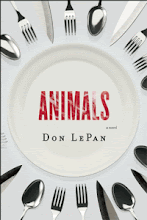
I’m also writing from the perspective of an author myself. My third novel is projected for 2019; my first, Animals: A Novel, was published in 2009 by Véhicule in Canada and in 2010 Soft Skull/Counterpoint in the US. It was widely acclaimed—Nobel Prize winner J.M. Coetzee called it “a powerful piece of writing and a disturbing call to conscience”—and it received many positive reviews. But already annual sales have slipped significantly. Would I want that book to still be under copyright protection (and thus more difficult for prospective publishers to rediscover and re-issue) more than 50 years after my death? Absolutely not. Even in the highly unlikely event that the existing edition were selling well at that point, I don’t see any reason why the book should decades from now carry a higher price than it would otherwise, merely so that royalties can be paid to my grandchildren.

The interest groups that push for extending copyright even further (and the high-powered media corporations and media lawyers who support them) like to suggest that those who oppose any extension of the 50-year rule in Canada are in a dwindling minority—that inevitably nations such as Canada will have to step into line with the United States and the EU. In fact Canada is far from alone in having resisted the push by the large corporations to extend copyright restrictions further and further. There are approximately 100 nations who have some form of the 50-year rule in their copyright laws—and that list includes some very significant players (among them China, Japan, South Africa, the Philippines, and New Zealand). In Australia a 2017 Commission recommended reducing that country’s length of copyright protection from 70 years to 25 years after the death of the author. At the moment that seems unlikely to happen—but the very fact that it’s been recommended by a reputable group is an indication of the degree to which the tide is starting to turn.

Canada has shown real courage thus far in standing firm on this issue in the face of pressure from the United States and from large media conglomerates. Let’s not give in

Saturday, August 18, 2018

Reflexive anti-Americanism

Near the end of a recent column on Sir John A. Macdonald that calls on Canadians to put things in context and see things from more than one side (“If Sir John Must Stay,” August 10), Toronto Star columnist Heather Mallick offers us this: “Americans don’t do context, they just bomb. They think all of their pointless wars of recent history stand alone, not realizing they’re just Vietnam over and over again.” She writes as if “Americans” were one amorphous mass. Editors would surely have cut any such crude generalization about “Russians” or “Chinese”; why is crude anti-Americanism given a free pass?

Sloppy thinking, is the short answer. So much attention is paid to Donald Trump and the Trump administration that many Canadians--like so many others around the world who are rightly horrified by the opinions and actions of the current occupant of the White House--allow themselves to start responding in a reflexively negative way to everything American and to the very idea of America. At some level people know that Trump is not America--that 3 million more Americans voted for Clinton than for Trump in 2016, and that since then polls have consistently shown majority opposition to Trump among Americans (in contrast, a significant majority of the Russian population is believed to support Vladimir Putin.) Yet many allow themselves to forget those facts, and to fall into sloppy generalizations.

If it happens with respected journalists such as Mallick and the Toronto Star editorial staff, how much more frequently does it happen with ordinary citizens who do not make their living by following public affairs? Very, very frequently, it would seem; a few months ago the Environics Institute found that Canadians viewed the United States more negatively than any other country in the world--including even North Korea (Canada's World Survey 2018-- https://www.environicsinstitute.org/projects/project-details/canada's-world-2017-survey; for an interesting commentary see Doug Saunders' April 14, 2018 Globe and Mail column, "Canadians are seeing the whole world through an anti-American lens").

Those of us who live outside America and who oppose Trump and all he stands for should stand firm in our opposition. But we should stop conflating the worst of America with all of America.

Saturday, March 31, 2018

A Prize of Prizes in the Book World?

The Guardian has an interesting piece on how there has been a significant backlash against the Man Booker Prize having been opened up to Americans: https://www.theguardian.com/commentisfree/2018/mar/30/the-guardian-view-on-the-man-booker-prize-time-for-a-turnaround

The piece makes the case well. But if the Booker does revert to being a "Britain and the Commonwealth" prize, let me suggest that a new prize be organized: a prize winner's prize. (Indeed, even if the Booker remains open to Americans there might be good reason to start a prize of this sort.) Such a prize would work in much the same way as does the Champion's League in soccer: the winners of the world's top prizes for a work of fiction in English would each be eligible, and a separate jury would judge which novel they thought to be the best of the best. Or, eligibility could be expanded to allow all the books shortlisted for any of the prizes to be eligible; that would spark some heated debate if a novel that had only been shortlisted for an award won the prize of prizes. (In much the same way, the Champions League also admits some runners-up.)

Which prizes would be included? The Booker, obviously. The Pulitzer and/or the National Book Award from the US. The Dublin International Book Award. The Giller Prize and/or the Governor General's Award from Canada. The Miles Franklin Literary Award from Australia. The Costa (formerly the Whitbread) Best Novel in Britain and Ireland. The Irish Book Award for Novel of the Year. The Acorn Foundation Prize for Fiction (New Zealand). It would be important too not to leave out the annual awards from Asia and Africa--awards such as the UJ Prize for South African Writing in English, the Nigeria Prize for Literature (Fiction), the DSC Prize for South Asian Literature, and (from India) the Crossword Book Award (Fiction).

Even if the Booker stays as it is, a Prize of Prizes would be a good way of drawing more attention to books of interest from around the world.

Monday, March 26, 2018

Commas for Clarity

Would these sentences be improved by the addition of a comma?
In the days after the disaster the family had little to eat other than bread and little to do other than dwell on their hunger.

Though the image appears quite inoffensive at a distance, the artist has affixed to the painting cutouts of body parts from magazines and has incorporated clumps of elephant dung into the piece.
If you are like me, when you see a word combination such as “bread and…” in the first sentence, a part of your mind may be already thinking of possible combinations—bread and butter, bread and jam, and so on. The word and starts to attach itself in your mind to the word bread, and then you have to perform something of a double take when your reading brain finally realizes that the word and should properly be attached in this context not to bread but to the verb had. For the sake of clarity, then, wouldn’t it make sense to add a comma after bread, as a signal to the reader not to attach and to bread, even for a split second?

Similarly, in the second sentence, when you see the word combination “magazines and…” a part of your mind may already be thinking of a phrase such as magazines and newspapers. For the sake of clarity, wouldn’t it make sense to add a comma? A comma between the word magazines and the word and would help the reader understand more quickly that the word and should not be attached to the word magazines—that the sentence has a compound predicate, with and has incorporated structurally echoing the earlier has affixed.

Adding a comma for clarity in cases such as these seems to me like simple good sense, and a few authorities (particularly in Britain) are of like mind.

Not so in North America, where just about every language authority asserts that such sentences should never, ever be broken up by a comma in this way. We are told that, whereas a comma may be used—indeed, must be used—before a coordinating conjunction such as and when the coordinating conjunction is used to join two independent clauses, in other circumstances a comma should not normally appear before a coordinating conjunction (whether and or any of the six others*). Further, in the case of compound predicates, various authorities put forward the principle that a subject should not be separated from its predicate by a comma. To do so in a sentence with a compound predicate is termed by one authority “the worst punctuation mistake” of all.

Obviously one wouldn’t want to separate subject and predicate with a comma in a short sentence, but every authority in fact accepts commas between subject and predicate in at least one circumstance—the sentence with three or more predicates. Such sentences are treated as lists—which are also regarded as an exception to the rule that a comma should not appear before a coordinating conjunction unless the conjunction joins two independent clauses. Where lists are concerned, preferences vary as to whether the last item in the series should be preceded by a comma (this is the issue of the serial comma, or "Oxford comma."). But in a sentence such as the following, all authorities would agree that a comma should appear after the word bread—and most authorities would also endorse the use of a comma between the word warm and the word and:
In the days after the disaster the family possessed little to eat other than bread, could find little to keep them warm and had little to do except dwell on their discomfort. [no serial comma included]

In the days after the disaster the family possessed little to eat other than bread, could find little to keep them warm, and had little to do except dwell on their discomfort. [serial comma included]
An exception, then, is made in the case of lists—for clarity, in order to enable the reader to better understand the structure of the sentence. For precisely the same reasons, why not allow a comma to be used in the two examples cited in the first paragraph above? Why indeed? At the very least, I would argue, the inclusion of a comma in such circumstances should be considered an acceptable option.

I realize, of course, that I live in North America, where the trend has long been to use fewer commas than in Britain or some other parts of the English-speaking world. But that’s a matter of style rather than of correctness. If North American authorities want to recommend against the use of these sorts of commas, let them do so on the grounds of style—not by suggesting that to add a comma before the word and in sentences such as the one above is to contravene any logical set of grammatical rules.

*This issue arises with far greater frequency with and than it does with any of the other six coordinating conjunctions (but, for, nor, or, so, yet).

Saturday, February 17, 2018

Nation Rising

I heard today through a post on Vegans of Nanaimo about the "Nation Rising" demonstration planned for Parliament Hill July 14. It has the support of a number of excellent groups (including Animal Justice), and sounds like a great idea. The aims of Nation Rising are as follows:
1. Stop subsidies to animal agriculture: Stop the multi-billion dollar subsidies that go to animal agriculture. It is wrong that our tax dollars are used to fund food that makes us sick, destroys our planet, and hurts animals.

2. Make healthy food affordable: Create new subsidies to ensure healthy, organic, plant-based food is affordable for everyone, in particular Indigenous and low-income communities.

3. Help farmers transition to plant-based farming: Provide financial assistance to farmers wishing to make the transition to plant-based farming, and set up the necessary committees to provide guidance during that transition.
If you can go to Ottawa mid July and join in, that would be wonderful. I doubt if I can--but I'm thinking that maybe those of us who can't make it to Parliament Hill might organize support demonstrations in other cities across the country.

For more information, here are the "Nation Rising" website and Facebook page locations:

http://nationrising.ca/

https://www.facebook.com/nationrisingcanada/

Saturday, December 9, 2017

Dee Gordon's 68 Steals: Speedsters, Sluggers, and a New Approach to Batting Order

Much as he is often praised for stealing bases (and for many other aspects of his game), Dee Gordon is also often disparaged for failing to steal bases. His 60 steals in 2017 led the major leagues—but so did the sixteen times he was caught stealing. Most baseball authorities in recent years have been of the view that, for base stealing to be worthwhile, a runner must be successful at least 70-75% of the time; by those standards (and I don’t say I agree with them), Dee’s 2017 percentage of 78% rates as good rather than great.

But Dee’s base stealing in 2017 didn’t result in just 60 extra bases; it resulted in 68. Eight times during the season the catcher’s throw to second was sufficiently wild that Dee ended up taking an extra base on the error. Those extra bases, of course, are scored as errors, not credited to the runner. I’m not aware of such errors being recorded anywhere as a statistic in connection with individual runners (though I wish such statistics existed). To get the number in Dee’s case, you have to watch a reel of all 60 of his steals on YouTube, and count the number of times it happens; 13% of the time, Dee gets to third base when he steals second. You can also see how often the catcher fumbles with the ball and never gets off a throw. There are a lot of those too; clearly having Dee on the base paths makes catchers nervous.

What’s particularly interesting about those 8 extra bases is how they compare with Billy Hamilton’s numbers. Hamilton stole 59 bases—but only twice did he reach third on an error after stealing second. Why so many more errors when Dee was running? Might there be slight differences in their styles—feints or distractions that Dee has perfected, which have the effect of making catchers more jittery? Perhaps, but it seems to me that the answer is more likely to be found by looking at who was batting behind Gordon and Hamilton.

In 2017 Hamilton batted ahead of various players, many of them towards the bottom of the batting order; the most imposing hitter to bat behind him with any frequency was Zack Cozart (63 runs batted in, 24 home runs). Solid numbers, but they pale beside Giancarlo Stanton’s 132 RBIs and 59 home runs; in a managing stroke of genius, Don Mattingly moved then-slumping slugger Stanton to second in the batting order June 11, and he batted behind Gordon for most of the season. It’s hard not to think that the combination of tremendous speed at first and tremendous power at the plate made catchers particularly nervous, and hard not to conclude that such nervousness would lead to more errors when the catcher has to make a quick throw to second. Having Stanton bat behind him almost certainly worked to Gordon’s advantage, both when he stole and when he took an extra base on those errors.

But that’s only the half of it. It’s not just the catcher who’s likely to be made nervous by the combination of great speedster on base and great slugger at the plate. Nervous pitchers are more likely to miss the plate, and that means hitters are more likely to get ahead in the count, and then get a fat pitch to hit. Moreover, pitchers are likely to throw more fastballs when a speedster such as Gordon is on base; fastballs give the catcher a better chance than would a curve ball to throw the runner out at second. But a slugger such as Stanton loves to hit fastballs; in this way too, having Gordon on base makes it more likely Stanton will get a pitch he can hit out of the park. (I’m indebted to my son Dominic for these points about pitchers and batters.)

What will happen to Stanton’s numbers next season? Stanton hit a homer every 2.69 games this year; previously that number was one homer every 3.69 games. As Neil Payne has pointed out today in his post on Five Thirty Eight (https://fivethirtyeight.com/features/how-much-should-we-fear-giancarlo-stanton-in-pinstripes/), simply on the basis of the regress-to-the-mean principle one would have to expect a 2018 less spectacular than Stanton’s 2017 season (even given that Yankee Stadium is a more hitter-friendly park than Marlins’ Park). But there are other factors involved too. For a change, Stanton enjoyed an injury-free season in 2017. He also changed his stance. But batting behind speedster Gordon may well have played as big a part as anything. Before the change Stanton was batting .262; he had hit 11 homers in 62 games—an average of one every 5.6 games. After the switch he hit 47 homers—an average of one every 2.1 games. Just as Stanton helped Gordon get further on the base paths, Gordon helped Stanton get more hits, and more homers.

As of now, the Yankees don’t have a speedster in their lineup; there is no one they could slot into their batting order ahead of Stanton who would have anywhere near the same effect as Gordon. Unless they acquire such a player (and there are not many of them out there), it’s hard not to think there’s one more reason a decline in Stanton’s performance in 2018 is likely. The Mariners, on the other hand—alone of all major league clubs—now have two speedsters and two sluggers in their everyday lineup. Jean Segura has averaged 29 stolen bases the past five seasons. And Robinson Cano and Nelson Cruz are of course among the game’s top sluggers. Conventional baseball wisdom would suggest batting Cano and Cruz one behind the other at 3 and 4 in the order (as they were in 2017). The Stanton-Gordon story of 2017, however, suggests that the Mariners might do much better by alternating speedster and slugger: Gordon-Cano-Segura-Cruz (or Segura-Cano-Gordon-Cruz).

One thing is sure: there was just a one-in-29 chance that my favorite baseball player would be traded to the team nearest me geographically, and it happened this week. I’m a happy baseball fan, and I’ll be making a trip or three from Nanaimo to Seattle next season!

Monday, October 2, 2017

Experimenting with Humans: Scientific Research and The Moral Imagination

A great many of the foundational ethical principles that humans have set out for themselves have involved an imaginative component.* Involving the imagination can be of obvious assistance if we are trying to figure out (or to remind ourselves) how we should treat other individuals, or other groups of humans. But what if entire species are involved? It’s a lot less easy to involve the imagination in figuring out how we should treat chimpanzees and bonobos, or rhesus monkeys—let alone cows, pigs, and chickens.

It may help to imagine a species that doesn’t exist—or, at least, that is not known to us. Let’s imagine a species that’s smarter than we are—imagine the smartest person you know, and then imagine a species in which that person is far from the sharpest tack in the drawer. But let’s imagine that the habits of moral reasoning among members of that species aren’t that much different from our own habits of moral reasoning. Let’s imagine that they arrive on earth, and decide to stay. We’re allowed to stay too—they don’t wipe us out—but they’re clearly the more intelligent species, and they’re more powerful too; they’re in charge.

Let's further imagine that that the members of this other species are similar to us physically, and in many genetic respects—including in their propensity to die from various diseases. Understandably, when it comes to trying out prospective new treatments or new drugs, they decide to use us as we have used chimpanzees and rhesus monkeys. They try the drugs on various human populations, with various control groups. Of course, the humans in question have to be given the diseases first—and of course, the norm is for all experimental subjects to be killed at the end of each experiment. That’s unfortunate, but any reasonable person would have to understand that it’s justifiable—necessary, even. Any reasonable person would understand too that, within the scientific community in this species, different groups would compete to see who could develop the best means of infecting human subjects with these diseases or debilitating medical conditions—even of genetically engineering human subjects so that they would be bound to develop those diseases and conditions. We can hardly fail to understand the rationales that would be provided as justification for all this; we use the same justifications ourselves:
Some may find it especially objectionable that the primates are genetically engineered to mimic the symptoms of human brain diseases. That adds a new dimension to the debate, but existing standards ought to be able to deal with any welfare issues.

The bald fact is that Japan and China are going to do this research anyway. It is surely better for it to be part of a global scientific program – accompanied by a welfare debate – so we can all benefit from the research as ethically as possible. (“Monkey experiments are a necessary evil for better medicine,” New Scientist, 15 June, 2016)
“As ethically as possible”—given that the subjects will have to be made to suffer, and then killed.

It’s worth looking closely at the language we use to help us justify these killings. “Culling” is a word that occurs frequently; animals aren’t described as having been killed at the end of the experiments we subject them to; they are described as being “culled” or “euthanized.” “Sacrifice” is another word you run into a lot: the subtitle of the article quoted above runs as follows: “Like it or not, primates are an essential part of biomedical research. But we must ensure the sacrifice is worthwhile…”

But for many scientists, there is not even a show of regret at using innocent beings in this way; the Canadian Broadcasting Corporation’s Sunday Edition radio program, for example, carried an interview yesterday with a neuroscientist who lauded the discovery that “you could mimic a disease” such as Parkinson’s “in an animal model.” Imagine again that other species subjecting us to experiments, and scientists belonging to that species marveling at the wondrous discovery that you could mimic in human subjects the diseases that their species suffered from; what tremendous scientific advances such discoveries make possible!

There are plenty of practical reasons why we shouldn’t be basing human biomedical research on experimenting with other species; it turns out that relatively few important scientific advances have been dependent on research conducted on non-human subjects—and that such research has not infrequently brought with it costs for humans as well as for non-humans. (See, for example, https://www.peta.org/issues/animals-used-for-experimentation/animal-testing-bad-science/). But just as important as the practical arguments are the arguments from first principles—as a little exercise of our moral imagination may help us to see.

*Religions ask us to Imagine how we would feel if another were doing the same thing to you. Immanuel Kant advised that, if we can imagine an action justified as a universal law, then we may be confident it is ethical in particular circumstances. John Rawls asks us to imagine ourselves behind a veil of ignorance, unable to know whether the persons affected by a possible action are rich or poor, black or brown or white, male or female; behind such a veil we can discern whether a given action is right or wrong in itself.

Wednesday, July 19, 2017

What Humans Do To Other Animals Before Eating Them--and What a New Government Can Do to Make Things Better

Maureen and I today sent some variant of the message below to every NDP and Green MLA in British Columbia. In the long term we have both believed for some years now that the best solution to these sorts of issues is for we human animals to give up eating non-human animals. But given that such an outcome will almost certainly not come in our lifetimes, it is surely imperative for vegans to join with concerned omnivores in trying to do everything we can to reduce the cruelty that has grown and grown over the past half century with the spread of "intensive" farming methods. If you agree, please join us in encouraging the new government to take meaningful action to improve the lives of animals, to improve human health, and to improve the environment too.
Dear [MLA]

First of all, congratulations to you; it’s great to see a change of government!

We’re writing you about an issue that involves human health, the health of the environment, and the welfare of animals. When a Mercy for Animals video in 2014 (http://www.cbc.ca/news/canada/british-columbia/3-men-in-chilliwack-cattle-abuse-scandal-get-jail-time-1.4121997) exposed what was really going on behind the doors of BC’s largest dairy farm, the government responded (at the recommendation of the SPCA) by incorporating national guidelines (from the Dairy Code of Canada) as to what constitutes “generally accepted practice” into the BC Prevention of Cruelty to Animals Act.

This spring, a Mercy for Animals video (http://www.cbc.ca/news/canada/british-columbia/fraser-valley-chickens-spca-1.4157891) has exposed what is really going on in an important segment of BC’s broiler chicken industry—and again, it’s been suggested that the SPCA will work with the government towards incorporating national guidelines (this time regarding the treatment of broiler chickens) into the BC Prevention of Cruelty to Animals Act.

That’s not nearly enough.

Such a move might remove any possible doubt that pulling the legs off a live chicken is not generally accepted practice. But it would further entrench into our laws the systemic cruelty that currently is generally accepted practice.

Take the issue of overcrowding on chicken farms. The Code of Practice for the National Farm Animal Care Council has lovely words in it. Here is how the “Stocking Density” section opens: “Birds must have enough space to move freely…” It sounds pretty good. But what does it actually mean? You need to look at the numbers, not the words. The requirements are that “stocking densities for broiler chickens must not normally exceed 31 kg/m2 at any time.” That phrasing (“must not…at any time”) makes it sounds like quite a stiff restriction—until you do the math. The average broiler chicken is slaughtered at 2.4kg. live weight; translate that into inches and you realize that, in the view of the “Care Council,” each bird need have no more “space to move freely” than an 8.5 x 11 inch sheet of paper. Not quite that much actually—you need to shave an inch or so off the side. It works out to almost 17 birds per square metre. Imagine a five-pound bird living in less space than an 8.5x11 sheet of paper for her entire life.

Numbers matter too with the National Farm Animal Care Council. Much as they welcome among their members “any national or provincial association that accepts the use of animals in agriculture (e.g. Canadian Federation of Humane Societies),” a voting majority always rests with the vested interests of industrial farming, as represented by the “National Farmed Animal Associations.” Such a group cannot be expected to strike any sort of humane balance that gives adequate weight to the welfare of non-human animals—or to the importance of environmental concerns, or to the importance of human health.

The “Raising and Handling Broiler Chickens” guidelines of the BCSPCA (on which the BC Liberal government has largely relied for setting standards in such matters) are already virtually identical to those of the National Farm Animal Care Council: the BCSPCA’s recommended maximum density is 30 kg/m2; the BCSPCA also specifies “no more than 17 birds per square metre.” A density level of 30/m2 is not the world’s worst (the unspeakable cruelty allowed by some jurisdictions entails densities of 40 or more kg/m2), but it’s considerably worse than the “Freedom Food” recommendations of the RSPCA in Britain (no more than 12 birds per square metre), and it’s almost unimaginably worse than the sort of environment in which truly happy chickens can be raised; the Happy Chicken Coop website recommends a density of less than one bird per square metre—about 15 square feet (1.4 square metres) for each bird.

With a new government, British Columbia has an opportunity to become a world leader in limiting cruelty in animal farming, in limiting the damage that poorly regulated industrial farming does to the environment—and in limiting the damage that industrial farming does to human health.

More than that, we have an opportunity to provide an unanswerable response to Donald Trump’s demands over agricultural trade. If here in British Columbia we create a renewed agricultural sector based on taking animal welfare seriously and on mandating strict environmental and health standards for all agricultural products, we will prevent a flood of low-cost, low quality animal food products from swamping our markets—at the same time as we are improving our own lives and those of the animals on which we depend. If BC regulations mandate standards that other jurisdictions can’t meet, we will have an unprecedented opportunity to become exporters of products that are high value in every conceivable respect. Much as some businesses are sure to resist such a path, in the end, the long-term profitability of BC’s agricultural sector will be protected just as much as will be our animals, our environment, and our own health.*

We ask the new government to think of the birds in BC, the cows in BC, the other farm animals in British Columbia—but also of our environment, and of our own health. We ask the government to design a new system, from the ground up. British Columbians deserve nothing less.

Don LePan, CEO and Company Founder, Broadview Press Inc.

Prof. Maureen Okun, Chair, Liberal Studies Dept., Vancouver Island University

* There is one negative to seriously addressing animal welfare, human health, and the environment in this way, and it should be faced squarely: such an approach would inevitably mean some increases in the cost of food from animals. Such costs have, in real terms, decreased by more than half over the past half century as industrial farming methods have ratcheted down costs and ratcheted up cruelty; it’s not unreasonable to ask those with good incomes to pay a bit more now for a system that will improve the environment, their own health, and the lives of animals. But in the case of those with low incomes, it would surely be appropriate to provide some financial consideration to compensate for increased prices.

Monday, July 17, 2017

The Strategy Behind Tonight's Walk-Off Win by Dee Gordon and the Marlins

Baseball is a game of strategy, but if you always stick with the same strategy you become predictable—and your team loses. A textbook example of the importance of flexibility in forming strategy occurred today in extra innings in Miami. With the game tied in the bottom of the ninth the Marlins had had the bases loaded, and couldn’t score. In the top of the tenth the Phillies had had the bases loaded, and couldn’t score. Now, in the bottom of the tenth, and with two out, the Marlins again had the bases loaded. My baseball hero, Dee Gordon, was coming to the plate. Dee is a poster boy of small ball; his game is beating out the throw to first, and then stealing a base, and then when the throw from the catcher or the pitcher goes astray, taking another base on the error.* But infield hits are harder to come by when the bases are loaded with two out and the defense is playing five infielders.

That’s where you need strategy—and, if I may be immodest for a moment, that’s where I come into the picture.

For weeks I’ve been fine-tuning strategy with my two Miami Marlins hats; I wore the beige hat with the bright red and yellow and blue logo when I saw the Marlins play two games in Milwaukee a couple of weeks ago; they lost, so for a few days I switched to the dark grey/light grey hat. When that strategy backfired I went back to the beige hat—and the Marlins responded with a string of wins going into the All-Star break. I had to switch again when the Dodgers beat the Marlins last Friday—but the switch proved ineffective. I switched to the beige again on Sunday; that wasn’t working either.

Back to tonight. I had put the grey hat on as the game went to the bottom of the ninth. But that hadn’t done the trick in the ninth; how best to deal with this crucially important opportunity now, in the bottom of the tenth?

Dee was down a strike after the first pitch—and that’s when it came to me. I grabbed the beige Marlins hat and put it on—right on top of my double grey Marlins hat. And presto—on the very next pitch Dee lined a run-scoring single to right. Walk off win for the Fish!

Now I don’t want to take all the credit for this; many events have more than one cause, and I have to believe this was one of them. The quality of the pitch, the placement of the Phillies outfielders, the strategy of Don Mattingly and of the Marlins’ coaching staff—all these probably played a part. Dee’s own skill may have had something to do with it. But it would be absurd to claim that the hat strategy wasn’t also in this case a contributing cause. I’m waiting now for Don and for Dee to be in touch—to say thanks, of course, but also to advise me on how often I should resort to the two-hat strategy in the future. Should it be reserved for these sorts of game-on-the line crisis moments? Or should there be a place for it in everyday strategy?

* * *

The actual two hats used during the 17 July 2017 game at which the dual-hat strategy debuted.

As a nine-year old I’m sure something close to one half of my mind was persuaded that I really could influence the outcome of far-away hockey games by putting on a Montreal Canadiens jersey. The equivalent percentage now is down to—what? Perhaps an eighth or a tenth of my mind? But like so many humans, I’m loath to give up that 1/8th or 1/10th. It would be like letting go completely of the child within. And who wants to do that—even at the ripe old age of 63? Go Fish Go! I’ll do what I can to help.

*Fans love stolen bases (and bunt singles, and going first to third on a another player’s single, and scoring from first on another player’s double, and all the other manifestations of speed on the base-paths), but for many years now baseball’s conventional wisdom has underrated the value of speed—in large part, I would suggest, because it’s difficult for statistics to capture its disruptive impact; when a Dee Gordon or a Billy Hamilton is on base, pitchers are distracted, fielders tense up—and the defense makes mistakes (many of which are not egregious enough to show up in the box score as errors, but can still cost a base or a run).

Sunday, June 11, 2017

Why Plato Was Right: Those at the Top Should Be Paid No More than Three or Four Times What We Pay Those at the Bottom

Through the 1950s and early 1960s—considered by many to be a golden age of corporate well being and of growth for the economy generally—CEOs of large businesses typically made about 20 times what the average worker in those organizations made. But the seeds for the explosion in executive pay that followed had already been sown. As Duff McDonald has detailed in his book The Firm, Arch Patton, an executive at the management consultant firm McKinsey & Company, had in 1951 developed a survey of executive compensation that compared executive pay not with the pay of others lower down in an organization, but with executives at other organizations. Understandably, the survey came to be closely followed by executives, and the results were published annually in The Harvard Business Review. Patton expanded on the ideas underlying the survey in an influential 1961 book, Men, Money and Motivation, arguing that corporations would be well served by knowing how the pay of their top people compared with the pay of other corporations; “when compensation of executives is above the industry average, above-average demands can be made on the executive group.” Boards of Directors listened, and compensation levels for those at the top increased significantly through the 1970s and 1980s. Much of that compensation, though, was opaque; it was difficult to assign a monetary value to deferred payment schemes and complicated stock option plans. The 1992 decision by the US Securities and Exchange Commission to require full and transparent disclosure by corporations of the compensation paid to their top five officers changed all that. Often described as an attempt to “help investors keep compensation in line” (as The Globe and Mail put it in a 5 December 2015 article), the move was in fact designed merely to increase transparency, with no judgement made as to the desirability of reining in executive wages. The previous system of providing information as to what companies were actually paying their top people was described by SEC Chair Richard Breedon described as “impenetrable”; he complained that it “insulated management from accountability to shareholders.”

Whatever its intent, the introduction of the new system became a landmark in the history of inequality. Suddenly boards and shareholders could see clearly the value of total compensation packages, and compare them to the packages other companies were offering. Far from choosing to rein in compensation, boards became ever more determined to ensure that compensation for their organization’s top people was “above the industry average.” With everyone continually striving to be above the average, the result was not hard to foresee. Average executive levels soared ever further beyond those of the average worker, and further still beyond those of workers at the bottom of the wage scale. We are now faced with unprecedented levels of inequality—inequality that is not only unfair in itself, but also undermines the cohesiveness of society, and undermines the economy itself, as more and more capital is devoted to savings socked away by the rich, and less and less to expenditures that drive further economic activity. (That such expenditures have continued at relatively high rates is largely attributable to many people carrying debt loads that are, in the long run, unsustainable.)

In such circumstances it seems obvious that we should return to measuring compensation for people at the top by comparing them to people in the middle or at the bottom of their own organizations—and that we should aim to set maximum multiples. But just where should those maximums be set?

In the fourth century BCE Plato suggested than in human societies governments should “permit a man to acquire double or triple, or as much as four times the amount [that is deemed to be at poverty levels]” (Plato, Laws V, sect 744). In the early twentieth century the financier J.P. Morgan—the epitome of American business establishment values of the day—is said to have recommended that those at the top should be paid no more than twenty times what the average worker made. In 1940 George Orwell called for “limitation of incomes, on a scale that the highest tax-free income in Britain does not exceed the lowest by more than ten to one” (“The Lion and the Unicorn,” Part 3, Section 2). In the 1970s management guru Peter Drucker argued in The Wall Street Journal for “a published corporate policy that fixes the maximum compensation of all corporate executives…as a multiple…of the lowest paid regular full-time employee,” and suggested maximum multiples ranging from 15 to 1 for smaller businesses to 25 to 1 for large multinationals. Also in the 1970s, Manitoba premier Ed Schreyer (later to become Canada’s Governor General) aimed “to bring about greater equality…and reward the dignity of work,” proposing that the ratio of incomes for those at the top of the income scale to the incomes of rank-and-file workers be no more than 2.5 to 1. (Errol Black and Jim Silver, “Manitoba's NDP: time to return to its social democratic roots, Canadian Centre for Policy Alternatives, 15 August 2012).

A proposed multiple of 2.5 between the highest and the average might translate into a multiple of 3.5 or 4 to 1 between the highest and lowest paid—or, after tax, a multiple perhaps closer to 3:1. That range has always felt intuitively appropriate to me, but I’ve never seen any attempt to present an extended argument for the appropriateness of that or of any other multiple. That’s what I want to do here.

I should preface the argument by making clear that such multiples should, to my mind, apply to all organizations—not just to corporations. Given the extraordinary multiples at many large corporations, it’s understandable that they have been the focus of most discussions. University professors or hospital administrators may think of their organizations as being relatively free of inequality. Yet the levels of inequality in those organizations are now typically greater than were corporate levels of inequality in the 1950s and 1960s. A hospital cleaner in America makes $11.19 an hour or $22,380 a year, while an orthopedic surgeon working in the same hospital may make well over $400,000. A cleaner at an American university working 40 hours a week makes, on average, $10.76 an hour or $21,520 a year, and at some universities an adjunct instructor working full time (teaching 8 one-semester courses per year) will make barely more than that—$22,000-$28,000 at institutions where adjunct professors are paid $3,500 or less per course taught. Meanwhile, the average for American university presidents has reached $500,000 a year.

So why a multiple of 3? Why that number specifically?

Let’s start by thinking of a normal work day of 8 hours, and two salaried workers. Perhaps one of the two may worker harder than their colleague—perhaps even twice as hard. So to provide fair compensation, arguably, she should receive an additional eight hours worth of pay. Suppose on top of that she doesn’t just work harder; she also works longer. Let’s say she always works twelve hour days, compared to the eight hour days worked by her colleague. In my experience (now more than 40 years in the workplace), there are in fact very, very few people who actually put in twelve hour days as a regular practice—and most of the ones who actually do so are not working flat-out for the full twelve hours. But for the sake of argument let’s say this person is one of those very, very few; let’s allocate to her on that basis a further 4 hours worth of pay.

We’re now up to 2 ½ times the level of the fellow worker. But perhaps that’s still not enough. Maybe the person in question manages somehow to work more than twice as hard as her colleague, or somehow does manage to put in more than 12 hours of flat-out work per day. As compensation for this extraordinary individual, let’s arbitrarily allocate to her a further amount equivalent to 50% of her fellow worker’s pay, bringing her up to three times what the fellow worker makes.

But surely that’s still not enough, you may say. It’s not just that this person—let’s say she is the CEO or the President of the organization—it’s not just that she works much harder than others and much longer hours; it’s also that she bears much more responsibility. Another argument for paying more to heads of organizations is based on weight of responsibility: the larger the responsibility, according to this argument, the higher the rewards should be. Most of us feel intuitively that there is something to this argument, and to some extent I think so too; if I didn’t think so, I would not have felt it reasonable for the company that I have headed to pay me about 2.5 times as much as our lowest paid employee, when I am sure that I have not worked more than twice as hard, or more than a twelve hour day (an average of something like 9.5 is more like it). But there’s far less to the argument that greater responsibility deserves greater pay than is commonly assumed. The CEO or President of any organization bears substantial responsibility, of course—but that responsibility is arguably less than the responsibility borne by many ordinary workers in everyday occupations. Someone who heads up a company that manufactures Kleenex, or that processes accounting information shoulders important responsibilities—but are they any greater than those shouldered by a day care worker or a camp counsellor—let alone those shouldered by a pediatric nurse? People working in those sorts of capacities constantly shoulder life and death responsibilities involving small children. If weight of responsibility is to be the basis on which pay differentials are determined, surely a pediatric nurse should make far, far more than the CEOs of a great many companies. And let’s not just look to jobs with obviously important responsibilities. Consider for a moment the job of hospital cleaner. If these workers don’t do their jobs very thoroughly and very well, the consequences to human health are almost incalculable; the spread of c difficile and other deadly “superbugs” becomes far, far more likely. Yet these are among our lowest paid workers. (Over the past generation they’ve become even lower paid than they were, as hospitals have outsourced jobs such as cleaner to companies that will pay the workers less than the hospital would be obliged to; instead of being valued members of the hospital team, such workers are now as marginalized as they are poorly compensated.)

What about the unpleasantness of the job, and the stress? I think there’s a lot to be said for the idea of paying more to people whose jobs are very unpleasant to compensate for that. But again, if we truly believed in that principle, the extra rewards would go to those who clean the toilets in airports and hospitals, and who scrounge the garbage dumps of the developing world for a living—not to the CEOs of large corporations. And stress? Yes, it’s stressful to lead an organization—but numerous studies have shown that the sort of stress that damages health and shortens lives is far more common among those who struggle to make ends meet than it is for those who head large organizations.

But wait, many of you may say. Those who are paid large amounts often have far more education than the average worker. Surely they should be paid more in recognition of the level of education they have attained.

But should they? Let’s think the matter through from first principles. Higher levels of education typically enable the beneficiaries to have much more interesting jobs than do those with little education. Should they benefit from their education both by being able to obtain more interesting work and by being paid much more for doing it?

Doctors often argue that they deserve very high levels of pay because they suffered through (and paid for) so many years of school. But by far the greater part of the expense of their education is borne by the taxpayers—most of whom make no more than a fraction of what doctors make for the rest of their lives once they do finish their education. Does a doctor really deserve to make more than three times what the average taxpayer makes?

What, then, of one’s ability to do a job effectively? It’s fair to point out that those who are paid huge amounts often have huge talents—and as a result do indeed work more effectively than many others. But why, precisely, should humans be compensated for ability? No doubt some people are able to achieve considerably more than others, but let’s set to one side that part of their achievements that has resulted from their education and that part of their achievement that has resulted from working harder than others. What we’re left with are the abilities one is born with, and the opportunities one’s family was able to provide during one’s upbringing. To be sure, genetic difference and differences in family background create large differences in the levels of ability of different individuals. But such differences are surely a matter of good or bad luck, not of desert. Does someone who has had the good luck to be born with an extraordinarily high level of intelligence (or with extraordinarily good hand-eye coordination, or with extraordinary talent of any other sort), or someone who has had the good luck to be born into a wealthy family that is able to provide for them a privileged upbringing, deserve to be paid more because of the higher level of ability that is the result of those genes and that upbringing? To pay such people more on those grounds amounts, in essence, to paying them more for having been lucky. What possible justification could there be for building luck money into our system of compensating workers? Arguably, it would be at least as fair in the other direction to compensate people for having been disadvantaged in the talent they were born with, or the upbringing they had—or the opportunities they never had.

What of what some will call the “practical argument”—that, regardless of the rights or wrongs of it, one will not be able to attract and keep top talent unless one pays top dollar?

Those who make this argument overrate three things. They overrate, first of all, the importance of financial incentives to human beings. There will always be many talented individuals willing to try for interesting and demanding jobs, even if they are not paid astronomical sums for doing so; if that were not true, countries would have no one willing to serve in Cabinet positions, or in the senior levels of the bureaucracy (where most people make only a fraction of what they could make with large corporations). For most people—including most talented people—money is not everything. It’s not even the most important thing.

Those who make the so-called “practical argument” overrate too the degree to which talent is scarce; in any large organization there are almost always many individuals capable of filling the top jobs. Finally, they overrate the degree to which organizations owe their success or failure to one individual (or to a handful of individuals) at the top. During the start-up phase, to be sure, many organizations are disproportionately reliant on the abilities and the vision of the founder(s). But the evidence suggests that, in the case of large, established organizations, who the CEO is usually makes relatively little difference to how the organization performs.

Does a company, then, really need to pay its CEO tens of millions of dollars a year? The facts of the matter simply don’t bear that out. Many North American companies have done exceedingly well without ever paying their CEO at anything like the multiples that most large institutions offer their top people. And in the other direction there are many, many companies that have seen their fortunes decline drastically despite paying the CEO tens or even hundreds of millions of dollars. And again, North American corporations thrived in the 1950s and 1960s despite far, far lower multiples of CEO to average worker compensation.

One should also look to outside North America. American corporations may have gotten into the habit of paying their CEO a fortune every year, but that’s been much less the case in other countries. In Japan the head of a large organization can expect to make ten or twenty times more than what those lower down the ladder make—not four hundred times more, as in the United States. But no one I’m aware of has suggested that Honda or Toyota would be far more successful if those organizations paid their top people in the way that American companies pay their CEOs.

* * *
Many of the above numbers are multiples of the average worker—not of the lowest paid. What is the rationale for referencing the lowest paid rather than the average? About that there can be no mystery. Western societies have become far too much in the habit of focusing on the incomes of the middle class—and far too little on the incomes (and the wealth, or lack thereof) of those at the bottom of the ladder. If we focus only on a comparison of the highest paid with those in the middle, it becomes ever easier for society as a whole to keep forgetting about its least fortunate members—and for inequality between the middle and the bottom to keep growing, even as inequality between the middle and the top begins to shrink.

* * *
I have been trying to put forward a case for 3:1 being an appropriate multiple. Is it possible to prove that this is precisely the appropriate number? Of course not. By their very nature these issues will always involve a large subjective element. But I cannot believe that something in the range of two and a half, or three or four is not a more appropriate multiple than J.P. Morgan’s 20—let alone than the 350-400 that has become common among large American corporations.

Apparently I’m not alone in my intuitions. Psychology professor Kevin Payne’s book The Broken Ladder: How Inequality Affects the Way We Think, Live, and Die (the subject of a 4 June 2017 Nicholas Kristof column in The New York Times) reports on surveys as to what members of the general public feel to be appropriate pay multiples. Interestingly, there is no great divide between left and right: “liberals said CEOs should be paid four times as much as the average worker, while conservatives said five times.”

A multiple of three (or four, or five) is still a very long way from Marx’s “from each according to his abilities, to each according to his needs.” A multiple of three or four does not eliminate inequality; it still accepts the value of monetary incentives for people to work hard, to strive to succeed. But a multiple of three or four would mean the end of “luck money” as a guiding principle of compensation. It would be the basis for a far fairer, far more livable society. Let’s go there.

CEO Compensation

(The following is the full version of a letter to The Globe and Mail that was published in slightly edited form on June 1. I have been developing a longer argument on this topic; I will post that shortly.)
I may be unusual among CEOs in entirely agreeing with Mark Roberts (letters, May 30) that CEO compensation should be limited to a certain multiple of the compensation of a corporation’s lowest-paid employee. I remember that many years ago a Manitoba premier suggested this idea—and suggested that three would be an appropriate multiple. That sounds about right to me—and it’s a multiple that I don’t think our corporation has ever exceeded in its 32 years. It’s just about impossible to work more than three times as hard as someone else; there are only 24 hours in a day. Should one be paid more for having more ability or education? Perhaps, but arguably it’s at least as fair in the other direction to compensate someone for having been disadvantaged in the talent they were born with, or the upbringing they had, or the educational opportunities they never had.